
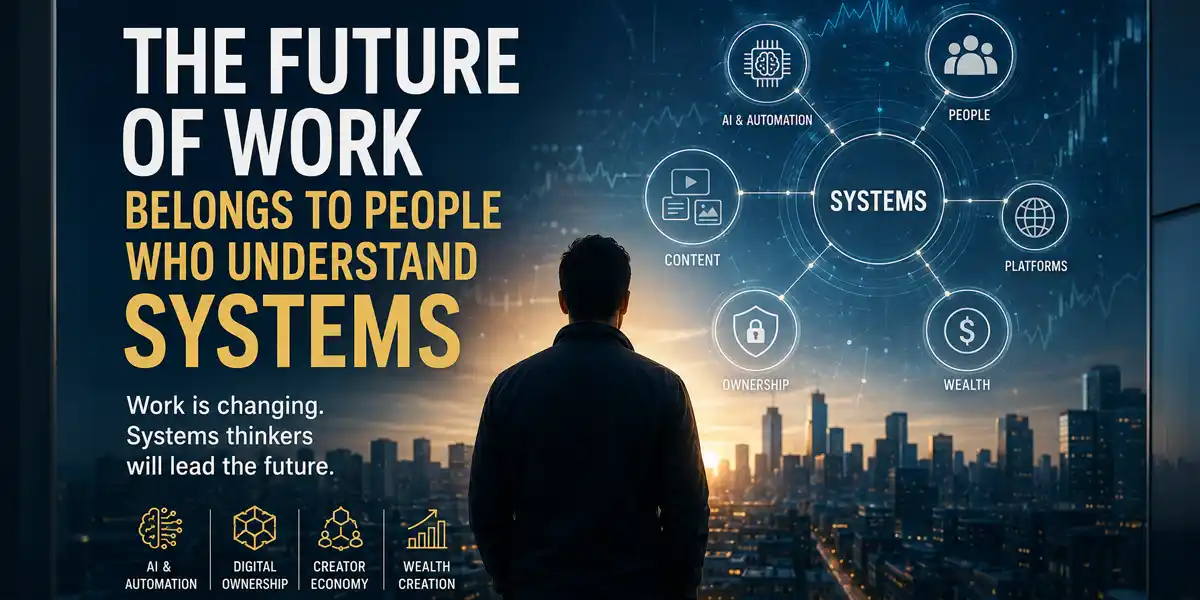
The Future of Work Belongs to People Who Understand Systems
The future of work is no longer just about getting better at a job. It is about understanding the systems that are changing how work gets done, how value is created, how people build ownership, and how opportunities are formed.
For decades, many people built their careers around a simple model: learn a skill, get a job, gain experience, move up, and hopefully build stability over time. That model still exists, but it is being reshaped by artificial intelligence, automation, digital platforms, blockchain, global competition, and new models of wealth creation.
The people who thrive in the next era will not only be the people who know how to use tools. They will be the people who understand systems.
They will understand work systems, AI systems, business systems, ownership systems, media systems, and wealth-building systems. They will understand how those systems connect. Most importantly, they will know how to adapt when those systems change.
That is why I believe the future of work belongs to systems thinkers.
Work Is Becoming More System-Driven
Work used to be defined mostly by roles. A person had a title, a department, a set of tasks, and a clear place inside an organization. Today, that structure is becoming more fluid.
AI can now assist with research, writing, planning, design, coding, analysis, content production, customer support, administration, and strategy development. Digital platforms make it possible for individuals to publish, sell, educate, consult, build audiences, and create income outside traditional employment structures. Automation allows small teams to do work that once required large departments.
This does not mean work disappears. It means the value of work changes.
When tools become more powerful, the advantage shifts from task execution to judgment, direction, strategy, taste, communication, and system design. The question becomes less “Can you complete this task?” and more “Can you understand what should be done, why it matters, how it connects, and how to build a repeatable process around it?”
That is a very different way to think about work.
AI Is Not Just a Tool — It Is a Work System
Many people still talk about AI as if it is simply a tool you use for individual tasks. That is a limited view.
AI is becoming part of the operating system of modern work. It can help people generate ideas, organize information, analyze patterns, summarize research, draft content, test creative directions, improve workflows, and accelerate decision-making.
The World Economic Forum’s Future of Jobs Report 2025 highlights how technology, AI, and changing skills are reshaping the labour market. The OECD has also noted that AI can improve productivity and job quality, while also creating an urgent need for skills development and adaptation through its future of work research.
The important point is not simply that AI exists. The important point is that AI changes the structure of work around it.
People who only learn individual prompts may get short-term benefits. People who understand how to build AI into repeatable systems will have a much stronger advantage.
An AI system might help a person research a topic, generate outlines, create content, repurpose that content into multiple formats, analyze performance, improve future ideas, and connect that work to a larger business objective. That is not just using a tool. That is building leverage.
And leverage is one of the most important ideas in the future of work.
The Future Will Reward People Who Can Connect the Pieces
One of the biggest challenges people face today is fragmentation. There are too many tools, too many platforms, too many trends, and too many opinions. AI. Automation. Blockchain. Crypto. Content. Digital products. Personal brands. Online business. Future finance. Web3. Creator platforms. Remote work. Digital ownership.
Each of these areas matters, but none of them should be understood in isolation.
The real opportunity is in understanding how they connect.
AI changes how work gets done. Content changes how trust is built. Digital products change how knowledge becomes income. Blockchain changes how ownership can be verified and transferred. Personal brands change how individuals create opportunity. Future finance changes how people think about assets, value, risk, and wealth creation.
This is why the future of work is not only a workplace conversation. It is a future digital economy conversation.
On Sights.com, I am building this idea more directly through the lens of the future digital economy. On CurtisRandall.com, I see this same shift through the lens of experience, creative leadership, media, technology, and practical adaptation.
The future belongs to people who can connect the pieces before everyone else sees the pattern.
Skills Still Matter, But Systems Create Leverage
Skills are still important. People need to learn how to write, communicate, lead, sell, analyze, design, build, speak, manage, and think clearly. Those skills do not disappear because new technology arrives.
But skills become more valuable when they are connected to systems.
A person who can write is useful. A person who can build a content system around writing is more valuable. A person who understands video is useful. A person who can build a media workflow that turns ideas into articles, videos, shorts, newsletters, products, and authority is more valuable.
A person who understands AI tools is useful. A person who can design an AI-assisted workflow for research, production, publishing, customer communication, and business development is more valuable.
McKinsey’s research on generative AI and the future of work has pointed to the potential for AI to raise productivity while also accelerating the need for occupational transitions, reskilling, and new ways of working.
This is why simply learning tools is not enough. Tools change. Platforms change. Algorithms change. But the ability to understand systems travels with you.
The New Worker Needs to Think Like a Builder
In the old model, many people thought primarily like employees. They focused on tasks, responsibilities, approval, and advancement inside a fixed structure.
In the new model, more people will need to think like builders.
That does not mean everyone needs to become an entrepreneur. It means everyone needs to understand how value is built.
A builder asks different questions:
- What problem is being solved?
- What system creates the outcome?
- What can be automated?
- What should remain human?
- What asset is being created?
- What can be reused or scaled?
- What creates trust?
- What creates ownership?
- What creates long-term value?
These questions matter because the future of work will not only reward people for effort. It will reward people for useful thinking, clear communication, intelligent systems, and the ability to create value in ways that are difficult to replace.
This is where creativity still matters, but not in the narrow sense of making things look good. Creativity matters because it helps people see possibilities, connect ideas, communicate clearly, and design better ways forward.
Digital Ownership Is Part of the Future of Work
One of the biggest mistakes people can make is separating the future of work from digital ownership.
If work is changing, income is changing. If income is changing, ownership matters. If ownership matters, people need to understand digital assets, intellectual property, websites, email lists, personal brands, content libraries, digital products, blockchain, and future finance.
This is why I believe digital ownership needs to be part of every serious future-of-work conversation.
A person who only trades time for income has limited leverage. A person who builds assets has more options. Those assets might be a business, a product, a media library, a course, an audience, a brand, a community, a software workflow, a newsletter, or a digital ownership position.
That does not mean every asset is valuable. It does not mean every crypto project is trustworthy. It does not mean every digital product will sell. But it does mean the ability to understand ownership is becoming more important.
People who understand work but not ownership may stay dependent on systems they do not control. People who understand both have a better chance of building freedom, resilience, and long-term value.
Wealth Creation Is Becoming a Work Skill
Wealth creation used to be discussed separately from work. Work was something you did to earn income. Wealth was something you built later if you had enough money left over.
That separation is becoming less useful.
In the future digital economy, wealth creation is connected to how people work, what they learn, what they build, what they own, what they publish, what systems they create, and how they use technology.
AI can help people create faster. Digital platforms can help people distribute ideas. Content can help people build trust. Websites and email lists can help people own relationships. Digital products can turn knowledge into income. Blockchain can introduce new models of ownership and verification. Future finance can help people understand assets, risk, and long-term value creation.
None of this replaces discipline, responsibility, or risk management. But it does expand the conversation.
The future of work is not only about employment. It is about capability, adaptability, ownership, and wealth creation.
The Human Advantage Is Direction
As AI becomes more capable, people often ask what humans will still be needed for. I think one of the answers is direction.
AI can generate. Humans must decide what matters.
AI can produce options. Humans must apply judgment.
AI can accelerate execution. Humans must understand context, meaning, trust, values, and consequence.
This is why the future of work is not only technical. It is strategic. People will need to ask better questions, define better outcomes, and build better systems.
That is especially important for leaders, creators, consultants, founders, educators, and anyone trying to build a future beyond simply reacting to change.
Technology will continue to move quickly. The people who do best will be the ones who can slow down enough to understand what is actually changing, then move forward with clarity.
The Future of Work Is Really the Future of Adaptation
The future of work will not arrive as one clean moment. It will keep unfolding through thousands of small changes: new tools, new business models, new expectations, new platforms, new risks, and new opportunities.
That means adaptability is no longer a soft skill. It is a survival skill.
But adaptability does not mean chasing every trend. It means understanding enough to make better decisions. It means knowing what to ignore, what to study, what to test, and what to build.
This is where systems thinking becomes valuable. A systems thinker does not get distracted by every new tool. A systems thinker asks how the tool changes the process, the business model, the value chain, the ownership structure, and the opportunity.
That mindset will become increasingly important.
What People Should Start Building Now
If the future of work belongs to people who understand systems, then the next step is practical. People need to start building system literacy now.
That could mean learning how AI fits into your daily work. It could mean building a personal website instead of relying only on social platforms. It could mean starting an email list, documenting your expertise, creating a digital product, learning about blockchain, understanding investing basics, improving your communication, or building a repeatable workflow around your knowledge.
It does not have to happen all at once. But it does have to begin.
Start with five questions:
- What skills do I have that can become more valuable with AI?
- What knowledge do I have that could become content, a product, or an asset?
- What systems do I currently depend on that I do not control?
- What digital ownership should I begin building?
- What do I need to learn about wealth creation to make better future decisions?
These questions are simple, but they change the direction of thinking. They move a person from reaction to design.
Final Thought
The future of work is not only about jobs. It is about systems.
AI systems will change how work gets done. Business systems will change how value is created. Ownership systems will change how people build assets. Media systems will change how trust is built. Wealth systems will change how people think about freedom, security, and opportunity.
The people who understand these systems will not have all the answers. No one will. But they will be better prepared to ask the right questions, make smarter decisions, and build with more confidence.
That is why I believe the future of work belongs to people who understand systems.
The future belongs to people who understand how work, technology, ownership, and wealth creation connect.
That is the conversation we need to keep having.
Explore More
Read more future-focused articles on the Curtis Randall B-Log, explore the broader future digital economy on Sights.com, or reach out through the Contact page.

About the Author
Curtis Randall is an award-winning creative executive and future systems thinker helping people and businesses understand the future of work, technology, digital ownership, and creativity. Through CurtisRandall.com, and Sights.com, Curtis explores the systems shaping how people work, create, own, and build value in a rapidly changing world.
Connect with Curtis: LinkedIn · YouTube · Instagram · X · TikTok · Facebook · Threads