
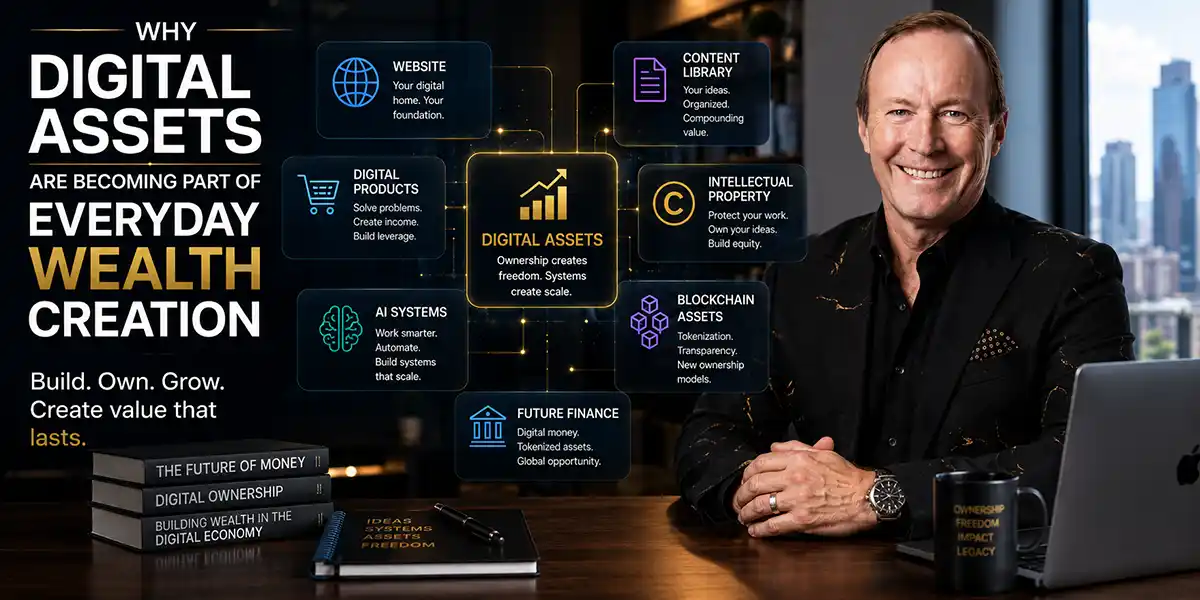
Why Digital Assets Are Becoming Part of Everyday Wealth Creation
Digital assets are becoming part of everyday wealth creation.
For many people, the phrase digital assets immediately brings up thoughts of crypto, NFTs, tokens, or blockchain-based investments. Those are part of the conversation, but they are not the whole story.
The bigger shift is that more value is being created, stored, distributed, and owned through digital systems. Websites, content libraries, email lists, digital products, intellectual property, online courses, AI workflows, personal brands, communities, software tools, and blockchain-based assets can all become part of a modern wealth creation strategy.
That does not mean every digital asset is valuable. It does not mean every online project becomes an asset. It does not mean crypto is automatically a path to wealth. But it does mean people need to understand how digital ownership is changing the way value is built.
In the future digital economy, wealth creation will not only be about what you earn. It will also be about what you build, what you own, what you can reuse, what you can scale, and what continues to create value over time.
That is why digital assets matter.
What Is a Digital Asset?
A digital asset is something that exists in digital form and can create, store, support, or transfer value.
That definition is broader than many people realize.
A digital asset can be a website, domain name, email list, content library, online course, digital product, book, template, framework, membership, newsletter, software tool, data set, brand system, intellectual property, community, or digital identity. It can also include blockchain-based assets such as crypto, tokens, tokenized assets, and smart-contract-based ownership models.
The key idea is not simply that something is digital. The key idea is that it can create value.
A random file sitting on a hard drive may be digital, but it may not be a meaningful asset. A well-organized content library that attracts search traffic, builds trust, generates leads, supports products, and strengthens authority can become a digital asset. A personal website that clearly explains your expertise and connects people to your work can become a digital asset. A digital product that solves a real problem can become a digital asset.
The question is not just, “Is it digital?” The better question is, “Does it create value, control, leverage, or opportunity?”
Why Digital Assets Are Moving Into Everyday Life
Digital assets are becoming more common because work, business, media, education, finance, and communication are all becoming more digital.
People build careers on LinkedIn. Businesses sell through websites and digital storefronts. Creators publish on YouTube, TikTok, podcasts, newsletters, and blogs. Consultants package expertise into online programs. Educators create digital courses. Entrepreneurs build software and automation systems. Investors use digital platforms. Financial institutions are exploring tokenisation and digital infrastructure.
The OECD’s Digital Economy Outlook 2024 notes that people need digital skills throughout life to make effective use of digital technologies and data. That matters because digital assets only become useful when people understand how to build, manage, and protect them.
Digital assets are moving into everyday life because digital systems are becoming part of everyday work.
The challenge is that many people use digital systems without thinking about ownership. They create content but do not organize it. They build followings but do not capture direct relationships. They use platforms but do not build assets. They gain experience but do not package their knowledge. They participate in digital finance without fully understanding risk.
That gap creates both risk and opportunity.
Digital Assets Are Not Just Crypto
Crypto is one of the most visible parts of the digital asset conversation, but it is not the only part.
In fact, one of the biggest mistakes people make is assuming digital assets only mean coins, tokens, or speculative investments. That narrow definition causes some people to dismiss the topic completely, while others chase hype without understanding the broader ownership shift.
A healthier view is to think about digital assets in layers.
- Owned presence: Your website, domain, and online authority hub.
- Owned relationships: Your email list, customer list, community, and direct audience channels.
- Owned knowledge: Your articles, frameworks, courses, books, guides, and intellectual property.
- Owned products: Your templates, digital downloads, memberships, tools, and educational resources.
- Owned systems: Your AI workflows, automation, publishing systems, and business processes.
- Blockchain-based assets: Crypto assets, tokenized assets, smart contracts, and future ownership infrastructure.
This broader view makes the conversation more useful. It shows that digital assets are not only about investing. They are also about building.
That is especially important for people who want to create more options in the future digital economy.
Everyday Wealth Creation Is Becoming More Digital
Everyday wealth creation used to be discussed mostly through income, savings, property, investments, pensions, and business ownership. Those areas still matter. But the digital layer is becoming harder to ignore.
A person can now build a website around their expertise. They can publish articles that attract search traffic. They can grow an email list. They can create a digital product. They can sell knowledge globally. They can build a course. They can use AI to improve productivity. They can create media that builds authority. They can build community. They can learn about digital finance and blockchain-based ownership models.
This does not guarantee success. It does, however, expand the range of possible paths.
Wealth creation is becoming more digital because more value is being created through information, access, trust, automation, education, media, software, platforms, and ownership systems.
The people who understand this shift will be better prepared than those who only think about income from one job or one client relationship.
Your Website Can Be a Digital Asset
A website is one of the most practical digital assets a person or business can own.
It gives your ideas a home. It gives your authority structure. It helps search engines and AI systems understand your body of work. It allows people to learn about you outside of social platforms. It can connect your content, services, products, media, contact path, and long-term positioning.
A website is not just an online brochure. When used properly, it can become a publishing platform, authority engine, product hub, lead-generation system, and trust-building asset.
This is one reason I continue building CurtisRandall.com as my personal authority hub and Sights.com as a broader education platform for the future digital economy.
Social platforms help people discover you. A website helps people understand you.
That difference matters.
Content Libraries Are Digital Assets
Content becomes more powerful when it is organized as a library rather than treated as disposable posts.
A single post may create short-term attention. A content library can create long-term authority. Articles, videos, newsletters, guides, podcasts, frameworks, and resources can help people understand your thinking, trust your judgment, and return to your work over time.
This is especially important in the age of AI. As generic content becomes easier to produce, original point of view and documented expertise become more valuable. People will need trusted sources. Businesses will need stronger signals of credibility. Creators and professionals will need searchable bodies of work that prove their thinking.
Content is not just marketing. It can become an asset that supports authority, opportunity, products, speaking, consulting, education, and long-term visibility.
Digital Products Turn Knowledge Into Assets
Digital products are one of the clearest examples of how knowledge can become an asset.
A digital product might be a guide, template, checklist, online course, workshop, paid report, workbook, framework, software tool, membership, or educational resource. It takes knowledge that might otherwise live only in your head and turns it into something useful, repeatable, sellable, and scalable.
This is not only useful for creators. It applies to consultants, educators, professionals, executives, experts, coaches, agencies, and businesses. If you solve the same problem repeatedly, there may be a way to turn part of that knowledge into a reusable asset.
Digital products do not replace real expertise. They package it.
That is why they are becoming part of everyday wealth creation.
AI Systems Can Become Digital Assets
AI is also changing the digital asset conversation.
AI tools can help people create faster, analyze better, automate repetitive tasks, draft content, organize ideas, improve workflows, and support product creation. But the real asset is not always the AI tool itself. The asset is the system you build around it.
An AI-assisted workflow for research, writing, design, publishing, customer service, product development, or business operations can become a powerful asset if it improves productivity, quality, consistency, or scalability.
The World Economic Forum’s Future of Jobs Report 2025 highlights how AI and information processing technologies are reshaping skills and work. This means people and businesses need to think beyond simply using tools. They need to think about building better systems.
AI is leverage. Systems are where that leverage becomes durable.
Blockchain-Based Assets Require Education and Caution
Blockchain-based digital assets are part of the future finance conversation, but they require careful education.
Crypto assets, tokens, stablecoins, tokenized assets, and smart contracts introduce new ways to think about ownership, custody, transfer, verification, and financial infrastructure. At the same time, they can involve significant risk, including volatility, fraud, scams, platform failure, poor custody practices, and the possibility of loss.
Investor.gov’s guidance on crypto asset custody basics for retail investors emphasizes practical safety steps such as researching custodians, protecting private keys and seed phrases, using strong passwords, and watching for phishing scams.
This is exactly why the digital asset conversation needs maturity. People should not treat blockchain as a shortcut to wealth. They should treat it as a subject that requires education, caution, and risk awareness.
Digital assets can create opportunity, but they also demand responsibility.
Digital Assets Need Digital Financial Literacy
As more financial activity moves into digital environments, financial literacy and digital literacy are becoming more connected.
People need to understand not only saving, investing, debt, income, risk, and long-term planning, but also digital payments, online platforms, fraud risks, cybersecurity, identity protection, crypto custody, digital wallets, and platform dependency.
The OECD has warned that digital payments can create benefits but also new risks for consumers, especially those with low digital financial literacy. Its work on digital payments and digital financial literacy highlights issues such as digital financial exclusion and overspending risks.
This matters because everyday wealth creation increasingly requires people to navigate digital systems with better judgment.
The future will reward people who understand not only how to make money, but how digital systems affect money, ownership, risk, and opportunity.
Ownership Is the Difference Between Activity and Asset Building
One of the biggest shifts people need to make is moving from activity to asset building.
Posting every day is activity. Building a searchable content library is an asset. Having followers is activity. Building an email list is an asset. Sharing ideas is activity. Turning ideas into frameworks, products, or intellectual property is an asset. Using AI tools is activity. Building an AI-supported workflow is an asset. Learning about crypto is activity. Understanding custody, risk, ownership, and allocation is part of asset literacy.
The difference is what remains over time.
Digital assets are important because they can create continuity. They can keep working. They can build trust. They can support products. They can create leads. They can hold value. They can strengthen authority. They can give people more control over their future.
This does not happen automatically. It requires intention.
What Digital Assets Should People Start Building?
The best place to start is with practical assets that create control and clarity.
For most people, that might include:
- A domain and website: A stable home for your work, ideas, products, and authority.
- An email list: A direct relationship with your audience, customers, or community.
- A content library: Articles, videos, guides, podcasts, and resources that document your thinking.
- Intellectual property: Frameworks, methods, systems, names, and original ideas that can become recognizable.
- Digital products: Guides, templates, courses, reports, tools, or paid resources that solve real problems.
- AI workflows: Repeatable systems that improve research, production, operations, or communication.
- Financial education: A deeper understanding of digital finance, investing, risk, and ownership.
Not everyone needs to build all of these at once. But everyone should begin thinking about what they own and what they depend on.
The Future of Wealth Creation Is More Connected
The future of wealth creation will be more connected than the past.
Work connects to skills. Skills connect to systems. Systems connect to assets. Assets connect to ownership. Ownership connects to resilience. Technology connects to leverage. Financial literacy connects to better decisions.
Digital assets sit inside that larger system.
They are not magic. They are not guaranteed. They are not all equal. But they are increasingly part of how people build opportunity in the future digital economy.
The people who understand this will be better prepared to create value, protect value, and turn knowledge into something more durable.
Final Thought
Digital assets are becoming part of everyday wealth creation because the world is becoming more digital, more automated, more platform-driven, and more ownership-focused.
This is not only about crypto. It is about websites, content libraries, email lists, digital products, intellectual property, AI systems, online communities, and future finance.
The future will reward people who understand how to create value, organize it into systems, own more of what they build, and use technology wisely.
That is why digital assets are becoming part of everyday wealth creation.
Explore More
Read more on the Curtis Randall B-Log, explore future-focused education on Sights.com, or connect through the Contact page.

About the Author
Curtis Randall is an award-winning creative executive and future systems thinker helping people and businesses understand and adapt to the future of work, creativity, technology, digital ownership, and wealth creation. Through CurtisRandall.com and Sights.com, Curtis explores the systems shaping how people work, create, own, and build value in a rapidly changing world.
Connect with Curtis: LinkedIn · YouTube · Instagram · X · TikTok · Facebook · Threads