
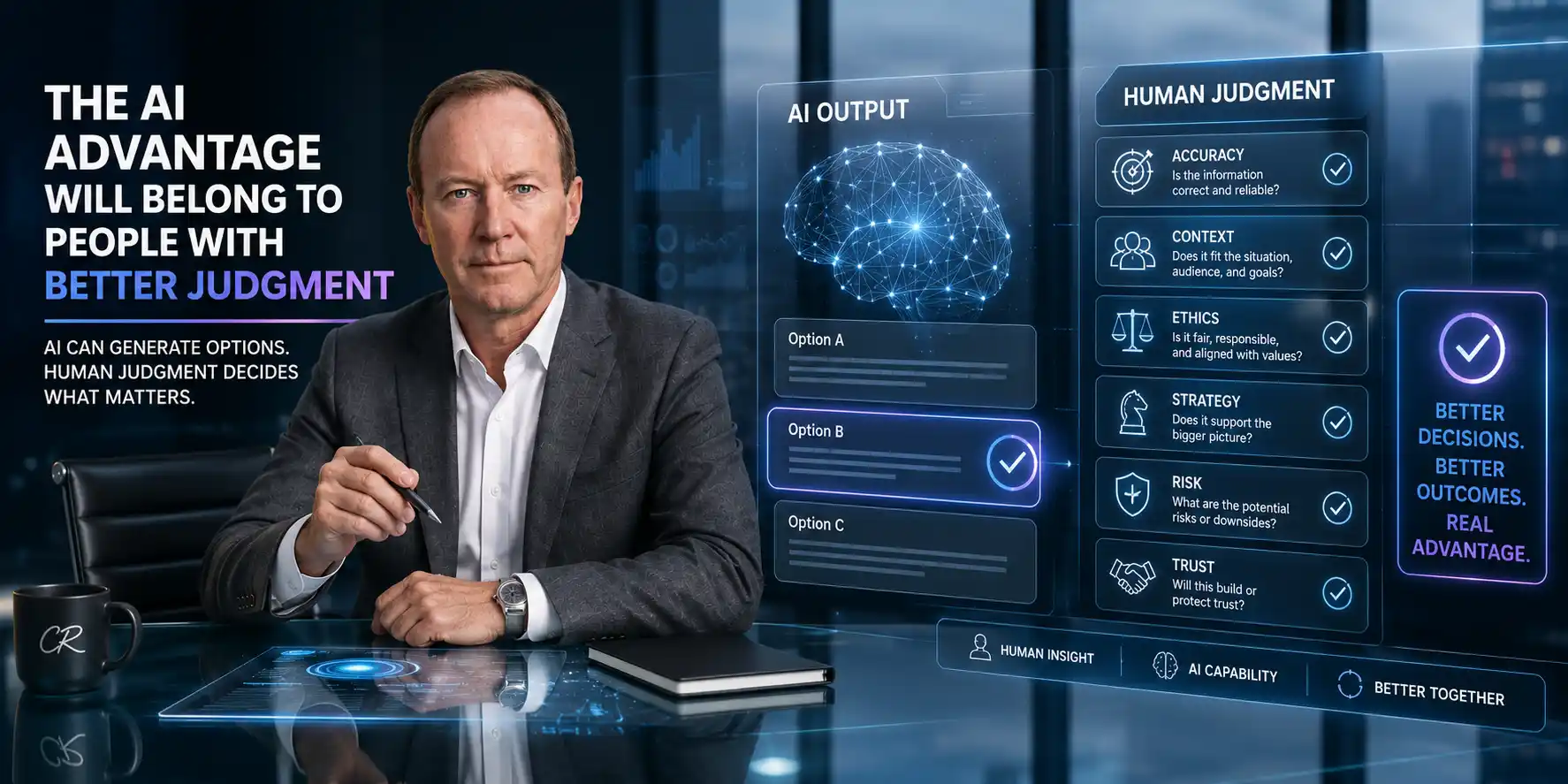
The AI Advantage Will Belong to People With Better Judgment
The real AI advantage will not belong only to the people with the best tools.
It will belong to the people with better judgment.
Artificial intelligence is becoming easier to access, easier to use, and easier to add into everyday work. People can now use AI to write, research, summarize, design, code, analyze, plan, automate, brainstorm, edit, translate, and create at a speed that was not possible before.
That creates enormous opportunity. But it also creates a serious challenge.
When more people have access to similar tools, the tool itself becomes less of an advantage. The difference comes from how people use it. More specifically, the difference comes from how people judge the output, frame the problem, understand the context, manage the risk, and decide what should happen next.
AI can generate options. Human judgment decides what matters.
Why Judgment Matters More in the AI Era
Judgment is the ability to evaluate what is useful, accurate, ethical, relevant, appropriate, and aligned with a larger goal.
That matters because AI can produce polished work that still needs careful review. It can generate confident answers that are incomplete. It can create content that sounds good but lacks depth. It can summarize information without fully understanding the situation. It can suggest decisions without knowing the human consequences.
This is why the AI era will not eliminate the need for human thinking. It will raise the standard for it.
The World Economic Forum’s Future of Jobs Report 2025 highlights that technology skills such as AI and big data are growing quickly, while human skills such as analytical thinking, resilience, leadership, and collaboration remain critical core skills. That combination is important. The future is not only technical. It is technical and human.
AI may help people move faster, but judgment determines whether they are moving in the right direction.
AI Output Is Not the Same as Good Work
One of the biggest mistakes people make with AI is confusing output with value.
AI can produce pages of text, dozens of ideas, multiple visual directions, strategic summaries, product descriptions, emails, research notes, social posts, scripts, and reports. But more output does not automatically mean better work.
Good work requires purpose. It requires relevance. It requires accuracy. It requires context. It requires taste. It requires understanding of the audience, timing, tone, trust, brand, business objective, and risk.
AI can produce something that looks complete before it is actually useful.
That is where judgment comes in.
The people who get the most value from AI will not be the ones who accept the first answer. They will be the ones who know how to question, refine, reject, improve, and direct the work until it serves a real purpose.
Better Questions Create Better AI
AI performance often depends on the quality of the question, the context provided, and the outcome being pursued.
A weak prompt may produce a generic answer. A better-framed problem can produce a more useful starting point. But even strong prompting is only part of the story.
Better judgment starts before the prompt.
It starts with understanding the real problem.
People need to ask:
- What are we actually trying to solve?
- Who is this for?
- What does success look like?
- What context does the AI need?
- What constraints should guide the answer?
- What risks need to be avoided?
- What information should not be trusted without verification?
- What part of this still requires human experience?
These are not just prompting questions. They are strategic questions.
That is why the AI advantage belongs to people who can think clearly before they ask AI to think with them.
AI Needs Context
Context is one of the biggest reasons human judgment matters.
AI can process language, patterns, documents, instructions, and data, but it does not automatically understand your business, your audience, your reputation, your timing, your values, your market, or the consequences of a decision.
A message may be technically accurate but wrong for the moment. A recommendation may sound logical but ignore the relationship involved. A visual concept may be polished but not aligned with the brand. A business idea may seem interesting but fail because it does not fit the customer, market, or trust environment.
Human judgment brings context to the system.
In the future of work, people who understand context will be more valuable because AI will make generic execution cheaper. Context, judgment, and direction will become stronger differentiators.
AI Needs Verification
AI can be useful, but it should not be trusted blindly.
Anyone using AI seriously needs a verification habit. That means checking facts, reviewing sources, testing assumptions, comparing outputs, identifying missing context, and deciding whether the work is reliable enough to use.
The National Institute of Standards and Technology created the AI Risk Management Framework to help improve the ability to incorporate trustworthiness considerations into the design, development, use, and evaluation of AI systems. That word — trustworthiness — is important.
AI systems need to be evaluated. Outputs need to be reviewed. Risks need to be understood. The more important the decision, the more careful the verification should be.
This does not mean people should avoid AI. It means they should use it responsibly.
Good judgment asks, “Can this be trusted?” before asking, “Can this be published, sent, used, or acted on?”
AI Needs Ethical Judgment
AI also needs ethical judgment.
Just because AI can create something does not mean it should be used. Just because a task can be automated does not mean it should be removed from human review. Just because a message can be personalized does not mean it should cross boundaries of privacy, manipulation, or trust.
Ethical judgment matters in areas such as data privacy, bias, intellectual property, transparency, accountability, impersonation, deepfakes, misinformation, and customer trust.
The OECD has warned that if AI is not used in a trustworthy way, it can create risks for workers’ rights and safety, including privacy concerns, increased work intensity, bias, discrimination, and accountability issues through its work on AI risks and incidents.
That is why the AI advantage cannot be only about speed. It has to include responsibility.
People and businesses that use AI without ethical judgment may create short-term efficiency but long-term trust problems.
Taste Is a Form of Judgment
Taste is often underestimated in business and technology conversations.
But in the age of AI, taste becomes more important.
Taste is the ability to recognize what is strong, clear, appropriate, original, elegant, useful, and emotionally right for the audience. It is the ability to know when something is too much, too little, too generic, too cold, too confusing, or too disconnected from the goal.
AI can generate options quickly. Taste helps decide which option deserves attention.
This matters in writing, design, branding, media, product development, presentations, user experience, strategy, and leadership communication.
As AI makes production easier, quality control becomes a bigger advantage. People who can judge quality will stand out in a world filled with average output.
Judgment Turns AI Into a System
AI becomes more valuable when it is part of a system, not just a one-off tool.
A system includes the problem, data, prompt, workflow, human review, verification, quality control, publishing process, feedback loop, and improvement cycle.
McKinsey’s research on the race to deploy AI and raise skills argues that organizations need to focus both on improving human capital and accelerating technology adoption to gain the full productivity benefits of generative AI and other technologies.
That is a systems point. The value of AI does not come only from deployment. It comes from how AI is integrated into human capability, workflow design, training, leadership, and decision-making.
Judgment is what keeps the system useful.
The Best AI Users Will Be Editors, Directors, and Decision-Makers
The best AI users will not simply be operators. They will be editors, directors, and decision-makers.
The editor knows what to cut, improve, clarify, and verify.
The director knows what outcome is needed and how the pieces should work together.
The decision-maker knows what trade-offs matter and what risks are acceptable.
These roles require judgment.
In a world where AI can produce more options than people can use, the ability to choose becomes more valuable. The future will not reward people simply for generating more. It will reward people who know what to do with what is generated.
Better Judgment Creates Better AI Workflows
AI workflows should be designed around judgment points.
That means identifying where humans need to review, approve, verify, redirect, or reject outputs. It also means deciding what should not be automated and what requires special care.
A better AI workflow might include:
- Clear problem definition before using AI
- Good source material and context
- Defined quality standards
- Fact-checking and source review
- Human editing and taste review
- Risk and ethics review
- Audience and brand alignment
- Final human approval before publication or action
This is not about slowing everything down. It is about making AI useful in the right way.
Speed without judgment creates noise. Speed with judgment creates leverage.
AI Judgment Is a Future Work Skill
AI judgment will become one of the most important future work skills.
People will need to know how to work with AI, but also how to question it. They will need to understand where AI is useful, where it is weak, where it creates risk, and where human direction is still essential.
This applies to leaders, creators, consultants, educators, marketers, designers, writers, analysts, founders, advisors, and professionals across many fields.
AI judgment includes:
- Knowing when to use AI
- Knowing when not to use AI
- Knowing how to frame a problem
- Knowing how to verify output
- Knowing how to judge quality
- Knowing how to protect trust
- Knowing how to manage risk
- Knowing how to connect AI to a larger system
This is one of the clearest examples of why future literacy matters. People do not need only tool literacy. They need judgment literacy.
The Connection Between AI Judgment and Wealth Creation
AI judgment also connects to wealth creation.
People who use AI with better judgment can build better systems, stronger content, clearer products, better customer experiences, more useful digital assets, stronger authority, and more resilient businesses.
People who use AI without judgment may create more content but less trust. More activity but less value. More automation but weaker relationships.
The future digital economy will reward people who can use technology to create real value. That requires judgment.
AI can help people build faster. Judgment helps them build something worth owning.
How to Build Better AI Judgment
AI judgment can be developed through practice.
Start with these habits:
- Define the outcome first. Know what you are trying to achieve before using AI.
- Provide context. Give AI the information, constraints, and audience details it needs.
- Compare outputs. Do not trust the first answer automatically.
- Verify important claims. Check facts, sources, numbers, dates, and legal or financial claims.
- Edit aggressively. Improve clarity, tone, structure, and usefulness.
- Protect trust. Do not publish or send AI-assisted work that could damage credibility.
- Build workflows. Use AI inside repeatable systems, not random experiments.
- Stay responsible. Consider privacy, bias, IP, disclosure, and human consequences.
Better AI judgment is not about being anti-AI. It is about being more serious about the value AI can create when used well.
Final Thought
The AI advantage will not belong only to people who use the newest tools or know the cleverest prompts.
It will belong to people who can think clearly, ask better questions, judge quality, verify claims, understand context, manage risk, protect trust, and turn AI into useful systems.
AI can create output. Human judgment creates value.
That is why better judgment may become one of the most important advantages in the age of artificial intelligence.
Explore More
Read more on the Curtis Randall B-Log, explore future-focused education on Sights.com, or connect through the Contact page.

About the Author
Curtis Randall is an award-winning creative executive and future systems thinker helping people and businesses understand and adapt to the future of work, creativity, technology, digital ownership, and wealth creation. Through CurtisRandall.com and Sights.com, Curtis explores the systems shaping how people work, create, own, and build value in a rapidly changing world.
Connect with Curtis: LinkedIn · YouTube · Instagram · X · TikTok · Facebook · Threads