
Table of Contents
How Ai is Changing the Creative Workflow
Artificial intelligence is no longer a futuristic concept sitting on the edge of the creative industries. It is here now, and it is already changing how writers, designers, video editors, marketers, musicians, and content creators work every single day. What once felt experimental has quickly become practical. AI tools are helping people brainstorm faster, design smarter, edit quicker, and scale content production in ways that would have seemed impossible only a few years ago.
LEARN AI IMAGE AND VIDEO
Want to become a professional AI Creative? Check out Open Art AI platform. With access to all the AI genereators and tools you will ever need.
For creatives, this shift is exciting, uncomfortable, inspiring, and disruptive all at once. Some see AI as a threat to originality. Others see it as the most powerful creative assistant ever invented. The truth is somewhere in the middle. AI is not replacing creativity itself, but it is changing the workflow around creativity in a major way. It is reshaping how ideas are born, how projects are developed, and how finished work gets produced and distributed.
In the past, creative work often followed a familiar pattern. You started with a blank page, an empty canvas, or a rough concept. Then came the long process of ideation, drafting, revising, polishing, and producing. That workflow still exists, but AI is compressing many of those stages. Tasks that once took hours can now take minutes. Early drafts can appear instantly. Visual concepts can be generated on demand. Editing can be automated. Variations can be produced at scale.
This does not mean the human creative no longer matters. In fact, human judgment may matter more than ever. Taste, direction, storytelling, emotional intelligence, and brand understanding are still deeply human strengths. What AI changes is the amount of friction between the idea and the execution. It reduces the time spent on repetitive production steps and increases the time available for higher-level thinking.
The End of the Blank Page Problem
One of the biggest ways AI is changing the creative workflow is by attacking the most frustrating part of the process: starting. For many creatives, the hardest moment is not the final polish. It is the blank page. It is the pressure of generating the first idea, the first headline, the first draft, or the first visual direction.
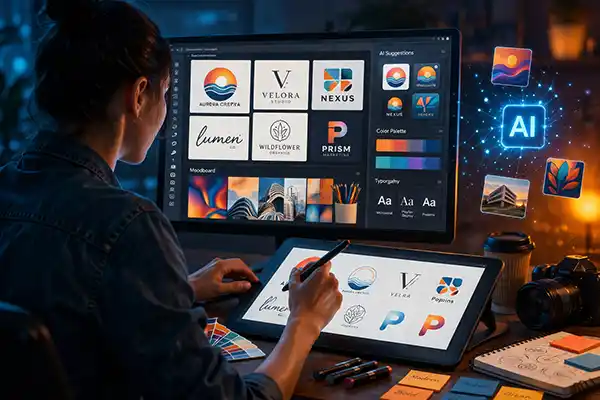
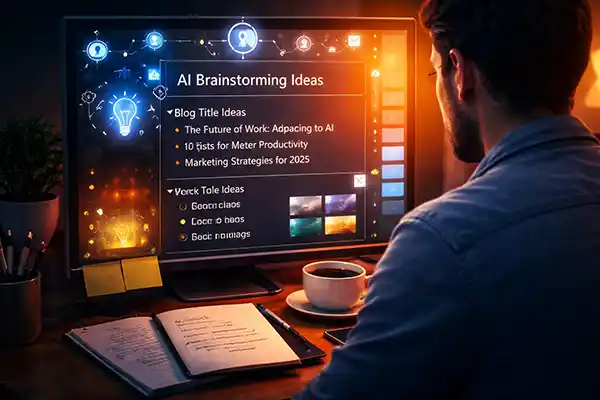
AI tools are now acting like idea engines. A writer can ask for blog outlines, headline options, or hooks for a script. A designer can generate moodboard directions, style references, or brand concepts. A video creator can brainstorm titles, thumbnail text, and content structures in seconds. Instead of waiting for inspiration to appear, creatives can now begin with momentum.
This is important because the creative process often depends on movement. Once a creator has something to react to, the work becomes easier. AI gives creatives something to push against, refine, reject, or build on. It turns a blank page into a working draft, and that alone can transform productivity.
From Solo Creation to Creative Direction
Another major shift is that creatives are moving from being pure makers to becoming directors of systems and outputs. In a traditional workflow, the creator often had to manually execute every part of a project. Today, AI can handle parts of the execution, allowing the creator to focus more on direction.
That means the role of the creative professional is evolving. Instead of asking, “How do I make this from scratch?” the better question is often, “How do I guide this toward the best result?” This is a major change. The creative is no longer just the builder. The creative is also the strategist, the editor, the curator, and the decision-maker.
For example, a designer may use AI to generate multiple visual directions for a campaign, then choose the strongest elements and refine them into a polished brand asset. A writer may generate several introductions for an article, combine the strongest ideas, and then rewrite them with a more original voice. A music producer may use AI to explore mood, genre, or composition ideas before shaping the final piece with human emotion and experience.
In this new workflow, the value of the creative lies not just in making, but in choosing well. Taste becomes a competitive advantage.
LEARN AI IMAGE AND VIDEO
Want to become a professional AI Creative? Check out Open Art AI platform. With access to all the AI genereators and tools you will ever need.
Speed Is Becoming a Creative Superpower
Speed has always mattered in business, marketing, and media, but AI has turned speed into a much bigger advantage. Creative teams and solo creators are now expected to move quickly, test quickly, and adapt quickly. AI supports this by dramatically reducing production time.
A blog post draft can be created in minutes. Social media captions can be generated instantly. Video transcripts can be cleaned up automatically. Image concepts can appear in seconds. Audio cleanup, translation, subtitle generation, and content repurposing can all happen much faster than before.
This acceleration changes more than just deadlines. It changes how creatives think about output. Instead of spending all of their energy creating one version of something, they can create many versions, compare performance, and optimize based on real-world feedback. That means the workflow becomes more iterative and less precious. Creatives can experiment more because the cost of experimentation has dropped.
For businesses and personal brands, this is powerful. The faster a creative team can go from concept to content, the faster it can respond to trends, market opportunities, and audience behavior. AI is helping close the gap between inspiration and publication.
More Iteration, More Experimentation
One of the most underrated effects of AI is how much it encourages iteration. In the past, creating multiple versions of a concept could be expensive and time-consuming. Today, AI makes variation almost effortless. This has a huge impact on the creative workflow.
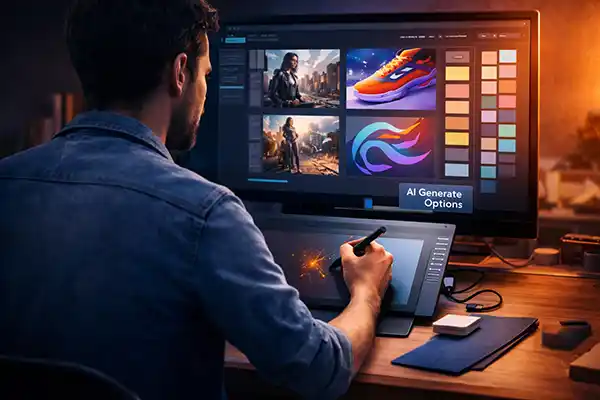
A content creator can test ten video title ideas instead of two. A marketer can produce multiple ad versions for different audiences. A designer can explore different layouts, color directions, and typography treatments before settling on the final direction. A writer can compare tones, structures, and intros without starting from scratch every time.
This matters because strong creative work rarely appears in its best form on the first try. It improves through iteration. AI makes iteration easier, and that means better work can emerge faster. Instead of locking into the first decent idea, creatives can keep pushing until they find the strongest one.
In this way, AI is not just a speed tool. It is an exploration tool. It expands the number of possibilities a creative can realistically consider during a project.
AI Is Lowering the Barrier to Entry
AI is also changing who gets to create. Many forms of creative production once required years of technical training or expensive software expertise. While skill still matters, AI tools are making many creative tasks more accessible to beginners and small teams.
Someone with a strong idea but limited design experience can now generate brand concepts, layouts, and social media visuals. A solo entrepreneur can create marketing copy, video scripts, and image prompts without hiring a full team. A musician can explore composition ideas without starting in a fully equipped studio. A small business owner can build content faster than ever before.
This democratization is exciting, but it also means competition is increasing. When more people can create content, more content floods the market. That makes originality, clarity, and quality even more important. AI can help almost anyone produce content, but not everyone will know how to produce meaningful content. That is where human creativity still stands apart.
The Human Role Is Becoming More Valuable, Not Less
There is a common fear that AI will replace creatives entirely. While some repetitive roles and production tasks may change dramatically, the deeper human side of creativity is still essential. AI can generate, but it does not truly care. It does not understand your lived experience. It does not feel the emotional weight of a story. It does not know your audience the way you do.
What humans bring to the workflow is context. Humans understand nuance, culture, timing, identity, emotion, and meaning. Humans know when something feels flat, forced, or off-brand. Humans know when an idea connects and when it simply fills space.
This means the best creative workflows going forward will likely be hybrid. AI will do more of the rapid drafting, organizing, formatting, and generating. Humans will do more of the guiding, shaping, storytelling, and deciding. The creative workflow is becoming a partnership between speed and judgment.
Personalization at Scale
Another major shift created by AI is personalization. Brands and creators are no longer limited to a single message for a broad audience. AI allows content to be adapted for different customer segments, platforms, styles, and purposes much more efficiently.
A single campaign idea can become multiple headlines, multiple email versions, multiple ad angles, multiple captions, and multiple visuals. A YouTube creator can turn one core idea into a full content ecosystem: a long-form video, short clips, a blog post, an email, social posts, and thumbnails tailored to different audience interests.
This changes the workflow from one-to-one creation into one-to-many creation. Instead of producing one asset and hoping it works for everyone, creatives can produce a family of assets that all support the same message in different ways. AI becomes the engine that scales the idea without forcing the human to manually rebuild it each time.
The Risks: Sameness, Laziness, and Creative Dilution
Of course, not every change is positive. AI also introduces creative risks. The easier it becomes to generate content, the easier it becomes to create generic content. When too many people use the same tools in the same way, the results can start to look and sound the same. That is a real danger.
There is also a risk of creative laziness. If a creator accepts the first AI output without refinement, the work may become shallow, repetitive, or forgettable. Audiences can sense when content lacks a real point of view. The tool may generate words, images, or ideas, but it cannot replace originality of perspective.
This is why the strongest creatives will not be the ones who simply use AI. They will be the ones who use AI well. They will know how to prompt clearly, edit aggressively, shape outputs with intention, and inject real personality into the final result. They will use AI to amplify their voice, not erase it.
The Future of the Creative Workflow
Looking ahead, the creative workflow will likely become even more fluid, connected, and systemized. AI tools will continue to merge with writing platforms, editing suites, design apps, audio tools, and marketing systems. The line between ideation, production, and optimization will continue to blur.
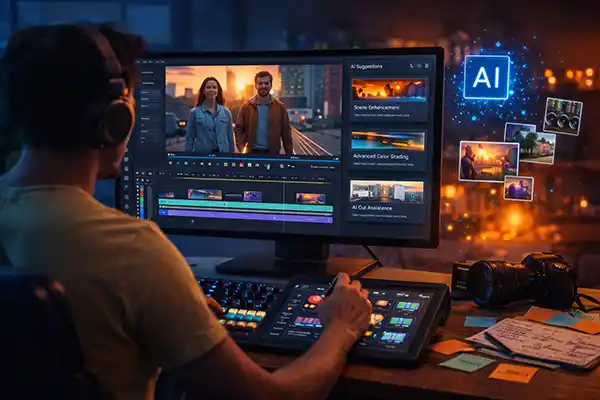
We may see workflows where an idea begins as a voice note, becomes a blog outline, turns into a video script, generates visuals, creates social posts, and feeds into ad campaigns almost automatically. The human creative will oversee this process, refine the message, protect the brand, and ensure the final content actually means something.
That is the real future: not humans versus AI, but humans using AI to create with more speed, flexibility, and reach than ever before.
Conclusion
AI is changing the creative workflow in profound ways. It is reducing friction, accelerating production, enabling experimentation, and opening creative opportunities to more people. At the same time, it is forcing creatives to become more intentional about what makes their work unique.
The future belongs to creatives who can combine human imagination with AI efficiency. The tools are getting faster. The workflows are getting smarter. But the need for vision, taste, and emotional intelligence is not going away. If anything, those qualities are becoming even more valuable.
AI is not the end of creativity. It is the beginning of a new creative era. The question is not whether the workflow is changing. It already has. The real question is how you will use these tools to create work that still feels human, memorable, and original.

Online Education | The Future of Education.
The future of online education holds immense potential and transformative possibilities. As technology continues to advance and connectivity becomes more accessible, online education is poised to revolutionize how we learn and acquire knowledge.
LEARN AI IMAGE AND VIDEO
Want to become a professional AI Creative? Check out Open Art AI platform. With access to all the AI genereators and tools you will ever need.