
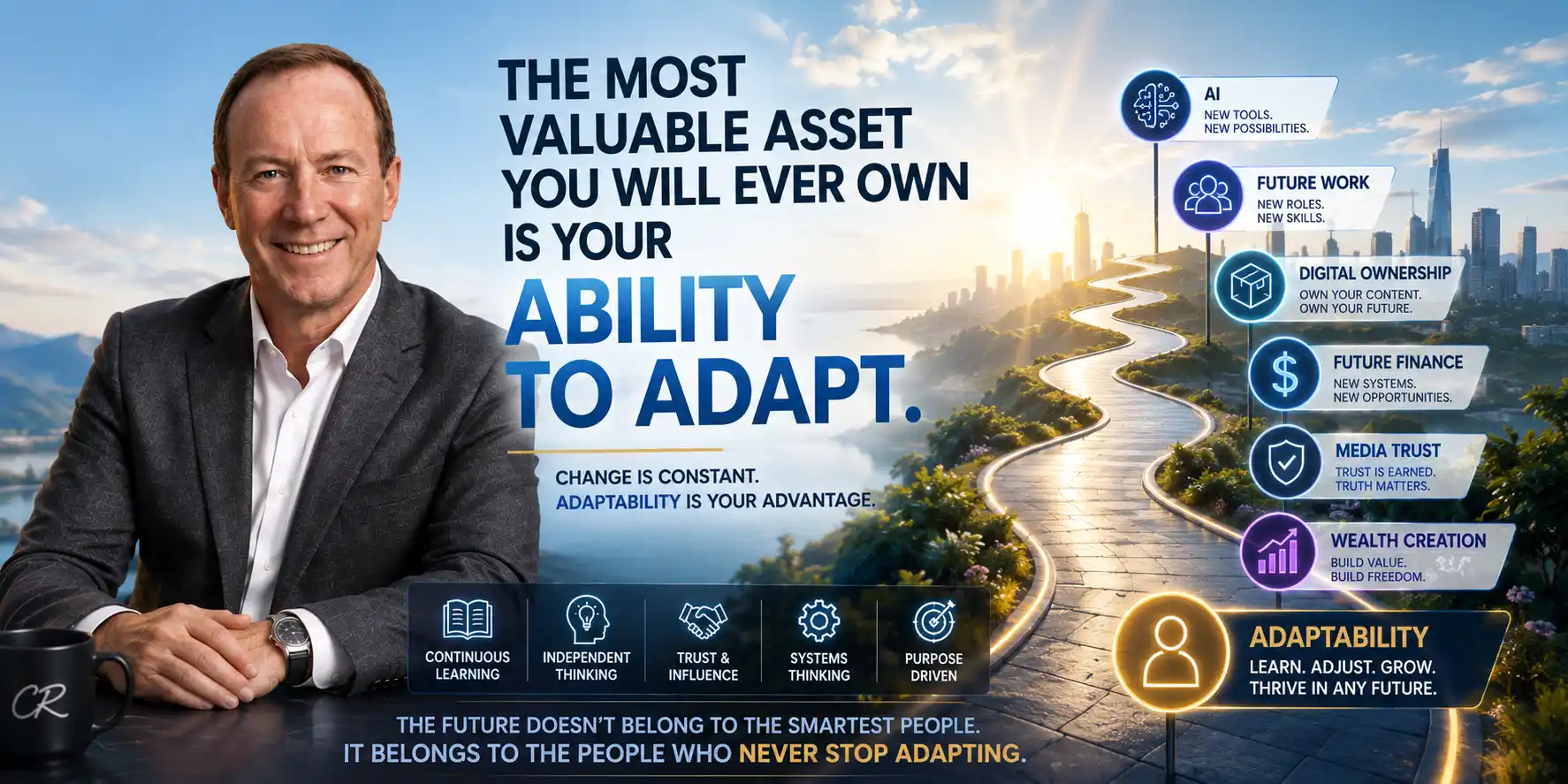
The Most Valuable Asset You Will Ever Own Is Your Ability to Adapt
The most valuable asset you will ever own may not be a job, a title, a tool, a platform, a credential, a cryptocurrency, a business idea, or even a piece of technology.
It may be your ability to adapt.
That may sound simple, but it is becoming one of the most important ideas in the future digital economy. Artificial intelligence is changing how work gets done. Digital ownership is changing how people think about assets. Future finance is changing how money moves. Media is changing how trust is built. Creator platforms are changing how people publish, teach, and build audiences. Asset tokenization is changing how ownership may be represented. Automation is changing productivity. Robotics, spatial computing, blockchain, and emerging technologies will continue reshaping what is possible.
The common thread is change.
The people who do well in the next decade will not be the people who predict everything perfectly. They will be the people who learn faster, adjust earlier, think more clearly, and build stronger systems around uncertainty.
Technology will continue to evolve. Markets will continue to shift. Careers will continue to change. But people who know how to adapt will always have a way forward.
Change Is No Longer Occasional
For much of the past, people could think of change as something that happened in waves. A new industry arrived. A new technology changed part of the economy. A new platform became popular. A new skill became valuable.
Today, change feels more continuous.
AI tools improve quickly. Software changes constantly. Media platforms shift algorithms. Search behavior changes. Financial tools become more digital. Business models evolve. Skills become outdated faster. New opportunities appear before most people understand the old ones.
This is why adaptability matters.
If change is occasional, preparation can be occasional. But if change is continuous, learning must become continuous as well.
UNESCO describes futures literacy as a capability that helps people better understand the role the future plays in what they see and do. That idea matters because how people imagine the future affects how they prepare, plan, and act today. UNESCO
Adaptability begins with that kind of future literacy. It begins with understanding that the future is not something to fear or blindly chase. It is something to study, question, prepare for, and participate in.
Every Major Technology Changes Human Opportunity
Every major technology changes opportunity.
The internet changed how people access information, build businesses, publish ideas, and connect globally. Smartphones changed how people communicate, shop, work, learn, create, and consume media. Social media changed influence, marketing, personal brands, politics, culture, and distribution. Cloud computing changed how companies scale. Streaming changed entertainment. E-commerce changed retail. AI is now changing knowledge work, creativity, research, decision-making, automation, and productivity.
Blockchain and tokenization may change how people think about ownership, verification, and programmable value. Future finance may change how money moves, how assets are represented, and how people interact with financial systems. Robotics and automation may change physical work. Spatial computing may change interfaces and experience.
The lesson is not that every new technology should be embraced without question. Some technologies are overhyped. Some fail. Some create risks. Some are useful only in specific contexts.
The lesson is that people need to understand how new technologies change systems of opportunity.
Adaptable people do not simply ask, “What is the new tool?” They ask, “What does this change? What becomes easier? What becomes harder? What becomes more valuable? What becomes less valuable? What should I learn now?”
Adaptability Is the New Career Security
For many people, career security used to mean finding a stable job, developing a reliable skill, and building a long-term path inside a company or industry.
That model still exists in some places, but it is becoming less dependable as the only strategy.
Roles change. Tools change. Business models change. Customer behavior changes. Entire industries are reorganized by technology. AI can automate parts of knowledge work. Platforms can change how people are discovered. Markets can shift faster than career plans.
The World Economic Forum’s Future of Jobs Report 2025 emphasizes that technology, AI, automation, and broader economic shifts are reshaping jobs and skills, while analytical thinking, resilience, flexibility, leadership, and AI-related skills are becoming important for future work. World Economic Forum
That means career security increasingly comes from adaptability.
A person who can learn, unlearn, and relearn has more options. A person who can transfer skills across industries has more resilience. A person who can understand new tools and connect them to real problems has more value. A person who can build authority and owned assets has more independence.
Adaptability does not guarantee success. Nothing does. But it gives people a better chance of staying relevant as the world changes.
Stop Building Your Future Around One Tool
One of the biggest mistakes people make is building their future around one tool.
A tool can be useful. A platform can create opportunity. A piece of software can increase productivity. An AI system can improve workflow. But tools change. Platforms change. Features change. Pricing changes. Algorithms change. What feels powerful today may become normal tomorrow.
The stronger strategy is to build around deeper capabilities.
Build around thinking. Build around communication. Build around judgment. Build around leadership. Build around systems. Build around trust. Build around learning. Build around ownership.
Those capabilities transfer across tools.
If you understand how to think strategically, you can use many tools. If you understand how to communicate clearly, you can adapt across platforms. If you understand systems, you can build workflows around new technologies. If you understand trust, you can build authority in a noisy world.
Tools are temporary advantages. Adaptability is a long-term advantage.
AI Makes Adaptability More Important
AI is one of the clearest reasons adaptability is becoming essential.
AI can help people produce, analyze, summarize, automate, design, write, code, research, and plan. It can increase speed and reduce friction. It can help individuals and businesses do work that previously required larger teams or more resources.
But AI also changes expectations.
If AI can help produce average content quickly, then average content becomes less valuable. If AI can automate repetitive tasks, then people need to move toward higher-value judgment. If AI can generate options, then humans need to become better at deciding which options matter.
The OECD has described AI as a transformative general-purpose technology that is reshaping economies, societies, work, and digital life, while emphasizing the importance of skills and lifelong learning in the AI age. OECD
That is the real AI message. People do not only need to learn tools. They need to adapt how they think, work, create, and make decisions.
Adaptability Is Not Panic
Adaptability does not mean chasing every trend.
It does not mean reacting to every headline. It does not mean buying every new tool, joining every platform, following every influencer, or restructuring your life every time something changes.
Real adaptability is calmer than that.
Adaptability means paying attention without panicking. It means learning without becoming overwhelmed. It means experimenting without losing direction. It means staying open without becoming careless. It means understanding risk without becoming frozen by fear.
Adaptability is not frantic movement. It is thoughtful adjustment.
The goal is not to become someone who changes direction every week. The goal is to become someone who can keep their core values and long-term direction while adjusting the systems they use to move forward.
The Future Belongs to Continuous Learners
The future belongs to continuous learners.
That does not mean people need to live in school forever. It means learning becomes part of how they work and live. Reading, researching, experimenting, building, publishing, testing, reflecting, and improving become ongoing habits.
The person who waits until they are forced to learn is already behind. The person who builds learning into their life has more time to adjust.
Continuous learning is especially important because the future digital economy is connected across categories. AI connects to work. Work connects to income. Income connects to wealth creation. Wealth creation connects to ownership. Ownership connects to digital assets. Digital assets connect to finance. Media connects to trust. Trust connects to authority. Authority connects to opportunity.
The adaptable person learns across those connections.
They do not need to become an expert in everything. But they need enough understanding to make better decisions.
Adaptability Requires Systems Thinking
Adaptability becomes stronger when it is supported by systems thinking.
Systems thinking helps people understand how different parts of life and work connect. Instead of looking at AI, media, finance, ownership, content, work, and wealth as separate subjects, systems thinking asks how they influence each other.
For example, AI changes content creation. Content creation changes media. Media changes trust. Trust changes authority. Authority changes opportunity. Opportunity changes income. Income can support wealth creation. Wealth creation is stronger when supported by ownership.
This is why adaptability is not just a mindset. It is also a method.
People who understand systems can adjust more intelligently because they see where change is happening and what it may affect next.
Digital Ownership Makes Adaptability More Powerful
Adaptability becomes more powerful when it is connected to ownership.
If everything you build depends on platforms you do not control, your adaptability is limited. If your audience only exists on social media, an algorithm change can affect your reach. If your knowledge only lives inside a job, a role change can reduce your leverage. If your ideas are not documented, your authority is harder to build.
Digital ownership gives people more flexibility.
A website, email list, content library, digital product, framework, intellectual property, course, newsletter, community, or personal authority hub can give people more options. These owned assets can help people adjust when platforms, jobs, markets, or technologies change.
This is one of the reasons I continue to build CurtisRandall.com as my personal authority hub and Sights.com as a broader education platform for the future digital economy.
Adaptability is stronger when you own more of the systems that support your future.
The Ability to Adapt Is Also a Wealth Creation Asset
Adaptability is directly connected to wealth creation.
Wealth creation is not only about income. It is about building value, protecting value, owning assets, understanding risk, creating options, and making better decisions over time.
An adaptable person can learn new skills. They can adjust income models. They can turn knowledge into digital products. They can use AI to improve productivity. They can build owned media. They can understand new financial systems. They can evaluate digital assets with more caution. They can move away from outdated models before they are forced to.
This does not mean every adaptable person becomes wealthy. It means adaptability improves the ability to recognize and respond to opportunity.
In the future digital economy, wealth creation will increasingly reward people who can combine skills, systems, ownership, technology, trust, and learning.
Adaptability is what allows those layers to keep evolving.
Authority Comes From Adapting Publicly and Usefully
Authority is also connected to adaptability.
People trust voices that help them understand change. They look for people who can explain what is happening, why it matters, what is risky, what is useful, and how to think about the future without falling into hype or fear.
That kind of authority does not come from pretending to know everything. It comes from learning continuously, documenting your thinking, building a body of work, and helping others make sense of what is changing.
This is why authority content matters. Articles, videos, talks, frameworks, newsletters, podcasts, and books can all help turn adaptation into public value.
If you are learning about the future, documenting what you are learning, and helping others understand it, you are not only adapting. You are building authority.
Adaptability Requires Emotional Resilience
Adaptability is not only intellectual. It is emotional.
Change can be uncomfortable. It can challenge identity. It can make people feel behind. It can create uncertainty around careers, income, skills, status, and confidence.
This is why emotional resilience matters.
People need the ability to stay steady while learning new things. They need to accept that being a beginner again is part of growth. They need to understand that uncertainty does not mean failure. They need to avoid comparing their chapter one to someone else’s chapter ten.
Adaptability is easier when people stop treating change as a personal threat and start treating it as a signal to learn.
What Adaptable People Do Differently
Adaptable people do not have all the answers. They have better habits.
They pay attention to signals. They ask better questions. They test ideas. They update their assumptions. They build skills before they urgently need them. They document what they learn. They build assets instead of only doing tasks. They use tools without becoming dependent on one tool. They stay curious without becoming distracted.
Most importantly, adaptable people do not wait for permission to begin.
They start small. They learn one tool. They write one article. They build one page. They create one product. They test one workflow. They publish one idea. They improve one system.
Small adaptations compound.
How to Build Your Ability to Adapt
Your ability to adapt can be developed like a skill.
Start with these practical habits:
- Build future literacy: Study the forces shaping work, technology, ownership, finance, media, and wealth creation.
- Learn continuously: Set aside regular time to read, experiment, and improve your skills.
- Use AI thoughtfully: Learn how AI can support your work, but keep human judgment in control.
- Document your knowledge: Turn experience into articles, notes, frameworks, videos, and products.
- Build owned assets: Create a website, content library, email list, product, or knowledge hub you control.
- Practice systems thinking: Look at how different trends connect instead of studying them in isolation.
- Stay financially literate: Understand how future finance, digital payments, digital assets, and risk are evolving.
- Protect trust: Build authority through useful content, transparency, consistency, and good judgment.
Adaptability is not built in one dramatic move. It is built through repeated decisions to learn, adjust, and build.
Do Not Just Prepare for the Future. Build Toward It.
There is a difference between preparing for the future and building toward it.
Preparing can be passive. Building is active.
Do not only read about AI. Use it to improve a workflow. Do not only think about digital ownership. Build a website or content library. Do not only talk about wealth creation. Turn knowledge into an asset. Do not only worry about media trust. Publish something useful and credible. Do not only follow future finance. Learn the basics before the systems become normal.
The future is not something people should only wait for.
It is something people can build toward through better learning, better systems, better ownership, and better decisions.
The Future Will Keep Changing
The future will keep changing.
AI will evolve. Blockchain will evolve. Finance will evolve. Media will evolve. Careers will evolve. Platforms will evolve. Consumer behavior will evolve. Skills will evolve. Business models will evolve.
That can feel intimidating, but it can also be freeing.
If everything is changing, then no one has a permanent monopoly on the future. New people can learn. New voices can emerge. New systems can be built. New businesses can form. New careers can be created. New authority can be earned.
Adaptability gives people permission to begin again without seeing that as failure.
The future belongs to people who keep moving with purpose.
Final Thought
The most valuable asset you will ever own is your ability to adapt because everything around you will continue to change.
Your tools will change. Your industry may change. Your work may change. Your platforms may change. Your opportunities may change. Your audience may change. The way people create value may change.
But if you can learn, think clearly, build trust, create value, own your knowledge, and adjust your systems, you will always have a way forward.
Your greatest asset is not AI. It is not crypto. It is not your job title. It is not one platform, one tool, or one trend.
Your greatest asset is your ability to adapt.
That is the skill that helps you survive change, understand opportunity, build ownership, and create value in the future digital economy.
Explore More
Read more on the Curtis Randall B-Log, explore future-focused education on Sights.com, or connect through the Contact page.

About the Author
Curtis Randall is an award-winning creative executive and future systems thinker helping people and businesses understand and adapt to the future of work, creativity, technology, digital ownership, and wealth creation. Through CurtisRandall.com and Sights.com, Curtis explores the systems shaping how people work, create, own, and build value in a rapidly changing world.
Connect with Curtis: LinkedIn · YouTube · Instagram · X · TikTok · Facebook · Threads