
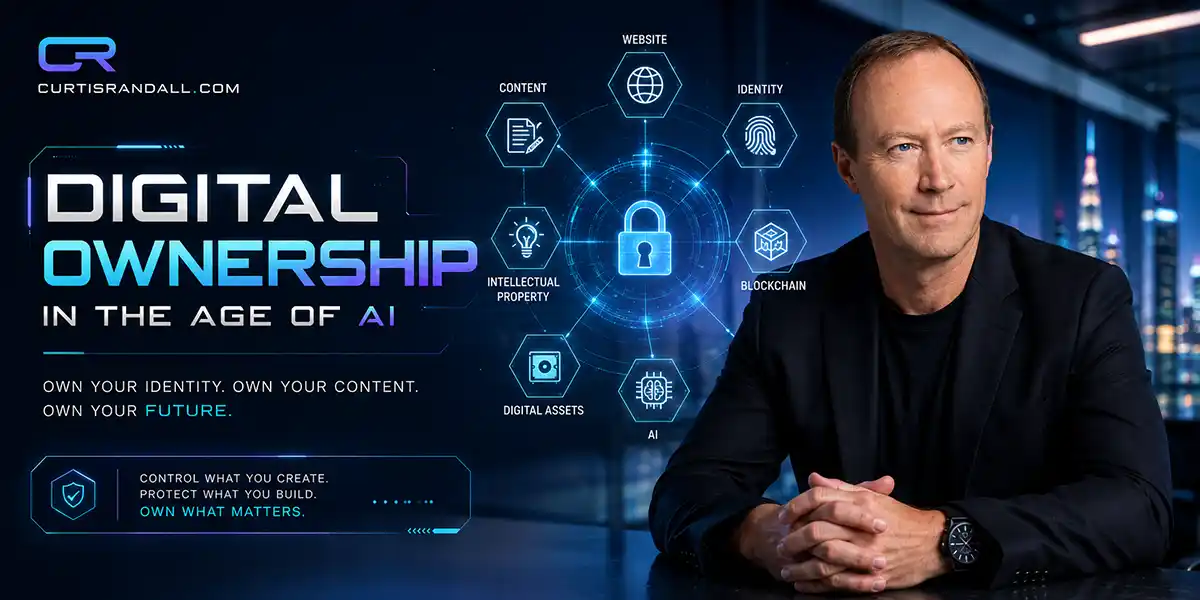
Why Digital Ownership Matters in the Age of AI
Digital ownership is becoming one of the most important ideas in the age of artificial intelligence.
For years, people built their careers, businesses, brands, audiences, and content on platforms they did not control. They posted on social media, uploaded videos, built followings, published through marketplaces, and depended on algorithms for visibility.
That worked for a while. It still works in many ways. But AI is changing the game.
AI is making content easier to generate. It is making automation more accessible. It is making impersonation easier. It is changing how people search for information. It is reshaping how businesses communicate. It is challenging ideas around authorship, originality, identity, and intellectual property.
In that world, ownership matters more.
People and businesses will need to think carefully about what they own, what they control, what they are building, what they are giving away, and what systems they are depending on.
That is why digital ownership is no longer just a technology topic. It is a future-of-work topic, a creator economy topic, a business strategy topic, and a wealth creation topic.
What Digital Ownership Really Means
Digital ownership is the ability to control, protect, use, transfer, or benefit from digital assets and digital relationships.
That can include a website, domain name, email list, content library, intellectual property, digital products, online courses, brand assets, customer data, creative work, software workflows, private communities, newsletters, memberships, digital identities, and blockchain-based assets.
It also includes something less obvious: control over your digital reputation.
In the age of AI, your words, images, voice, likeness, ideas, expertise, and public identity may become more valuable — and more vulnerable. That makes ownership and control more important than ever.
Digital ownership is not just about owning files. It is about owning the systems that give you options.
AI Makes Content Easier to Create — and Easier to Replace
AI can help people create faster than ever. It can write drafts, generate images, summarize research, edit video, support design, build code, automate customer service, and help turn ideas into finished work.
That is powerful. But it also creates a new challenge.
When content becomes easier to produce, average content becomes less valuable. The internet will not have a shortage of articles, images, videos, posts, and generic advice. It will have too much of it.
This means people will need more than content output. They will need trust, point of view, authority, original thinking, brand, relationships, and owned distribution.
The OECD notes that AI adoption by firms has continued to expand across OECD countries where data is available, with reported firm-level AI use more than doubling between 2023 and 2025. That kind of adoption shows how quickly AI is moving into the systems of business and work.
As AI spreads, the people who own their platforms, audiences, ideas, and intellectual property will be in a stronger position than people who only create inside systems controlled by others.
Rented Platforms Are Useful, But They Are Not Ownership
Social platforms are valuable. YouTube, LinkedIn, Instagram, TikTok, Facebook, X, podcast platforms, and marketplaces can help people reach audiences they could never reach on their own.
But these platforms are rented land.
You can build attention there, but you do not fully control the rules. Algorithms can change. Accounts can be restricted. Reach can fall. Monetization can shift. Platform priorities can change. Search behavior can change. AI-generated summaries may reduce traffic to original sources. Competitors can copy your style, format, and message faster than ever.
That does not mean people should avoid platforms. It means platforms should be used strategically.
Use platforms for reach. Build ownership for resilience.
Your website, your domain, your email list, your customer relationships, your digital products, your content library, your frameworks, your intellectual property, and your brand authority become the foundation.
That is one reason I continue to treat CurtisRandall.com as my personal authority hub and Sights.com as a broader education platform for the future digital economy.
Your Website Is Still One of the Most Important Digital Assets
In a world obsessed with social media, the website can feel old-fashioned. I think that is a mistake.
A website is one of the clearest forms of digital ownership. It gives you a place to organize your ideas, publish authority content, build search visibility, connect your work, capture leads, sell products, show credibility, and create a long-term home for your reputation.
Social media is where people may discover you. Your website is where they should understand you.
This becomes even more important in the age of AI search. If AI systems summarize the web, people and businesses need clear, structured, trusted content that explains who they are, what they know, what they offer, and why they matter.
A strong website is not just a brochure. It is a knowledge base, trust engine, publishing system, product platform, and digital asset.
Intellectual Property Is Becoming More Complicated
AI is creating new questions around intellectual property.
Who owns AI-assisted work? What happens when AI models are trained on creative material? How should creators protect their original ideas? How should businesses manage AI-generated content? What does originality mean when tools can imitate style, structure, voice, or visual direction?
The World Intellectual Property Organization has published guidance on generative AI and intellectual property, including issues around copyright, trademarks, training data, AI-generated outputs, and risk management for organizations.
This is not a small issue. It affects creators, businesses, publishers, designers, photographers, musicians, educators, software companies, media brands, and anyone building content or knowledge assets.
The solution is not fear. The solution is better awareness, better documentation, better policies, better licensing, better attribution, and smarter ownership systems.
People need to know what they are creating, what tools they are using, where source material comes from, what rights they have, and how their work may be reused.
Identity Is Becoming an Ownership Issue
Digital ownership is also about identity.
AI can generate text in someone’s style. It can create synthetic images. It can clone voices. It can make fake videos. It can imitate brands, executives, creators, and public figures. This creates serious questions around trust and impersonation.
The U.S. Federal Trade Commission has taken steps to address impersonation fraud, including a rule against government and business impersonation and a proposed rule aimed at combating AI-enabled impersonation of individuals.
This matters because a person’s name, face, voice, reputation, brand, and authority are increasingly part of their digital value.
For professionals and businesses, identity protection will become part of brand protection. People will need to be more careful about where their likeness appears, how their content is used, what accounts are official, and how audiences can verify what is real.
In the age of AI, authenticity is not just a personal quality. It is an asset.
Blockchain Is One Part of the Digital Ownership Conversation
Blockchain is often discussed through crypto prices, speculation, hype cycles, and market volatility. That is understandable, but it is not the whole story.
The more important idea is that blockchain introduced a different way to think about digital ownership, verification, transfer, custody, and programmable value.
In the long term, blockchain-based systems may play a role in digital identity, tokenized assets, creator royalties, proof of ownership, memberships, credentials, smart contracts, payments, and financial infrastructure.
That does not mean every blockchain project is useful. Many are not. It does not mean there is no risk. There is significant risk. It does mean the underlying ownership conversation is important.
On Sights.com, I continue to explore blockchain and crypto through education rather than hype. The point is not to chase every trend. The point is to understand how digital ownership may evolve.
Digital Ownership Supports Wealth Creation
Digital ownership matters because wealth creation is increasingly connected to assets, systems, and control.
A person who only posts content on platforms may build visibility, but they may not build ownership. A person who turns expertise into articles, email lists, frameworks, courses, digital products, communities, books, consulting systems, and intellectual property is building something more durable.
That does not mean every asset will become valuable. It does not mean success is automatic. It means ownership gives people more options.
Wealth creation in the future digital economy will not only come from jobs or investments. It will also come from the ability to create value, organize knowledge, build trust, own assets, protect identity, and use technology wisely.
This is why I see digital ownership as a core part of future literacy.
What People Should Start Owning
The idea of digital ownership can feel abstract, so it helps to make it practical.
People and businesses should start by asking what they currently control and what they depend on.
Here are a few places to begin:
- Your domain: A clear website domain gives your work a stable home.
- Your website: Your site should explain who you are, what you know, what you offer, and what you believe.
- Your email list: Direct audience relationships matter more as platforms become more unpredictable.
- Your content library: Articles, videos, podcasts, guides, and resources can become long-term assets.
- Your frameworks: Original thinking should be named, organized, and protected.
- Your digital products: Knowledge can become books, courses, templates, kits, reports, and tools.
- Your identity: Names, images, voice, brand assets, and official accounts need clearer protection.
- Your data and relationships: Customer relationships and community trust should not depend only on third-party platforms.
This is not about abandoning social platforms. It is about using them without becoming completely dependent on them.
The goal is simple: build reach on platforms, but build value in assets you own.
The New Rule: Do Not Just Create, Own
The age of AI will produce more content than the world knows what to do with.
That means the advantage will not go to people who simply create more. It will go to people who create with purpose, build trust, protect their ideas, organize their knowledge, and own the systems around their work.
Do not just create posts. Build a content library.
Do not just chase followers. Build direct relationships.
Do not just use AI tools. Build AI-assisted systems.
Do not just publish ideas. Turn ideas into assets.
Do not just build visibility. Build ownership.
Final Thought
Digital ownership matters in the age of AI because the digital world is becoming more powerful, more automated, more synthetic, and more competitive.
AI will change how content is created. It will change how people search. It will change how businesses communicate. It will change how identity, trust, intellectual property, and authority are understood.
In that environment, people and businesses need more than access. They need ownership.
The future will reward people who understand how to use technology, build trust, protect identity, create assets, and own more of their digital future.
That is why digital ownership matters now.
Explore More
Read more future-focused articles on the Curtis Randall B-Log, explore the broader future digital economy on Sights.com, or reach out through the Contact page.

About the Author
Curtis Randall is an award-winning creative executive and future systems thinker helping people and businesses understand the future of work, technology, digital ownership, and creativity. Through CurtisRandall.com, and Sights.com, Curtis explores the systems shaping how people work, create, own, and build value in a rapidly changing world.
Connect with Curtis: LinkedIn · YouTube · Instagram · X · TikTok · Facebook · Threads