
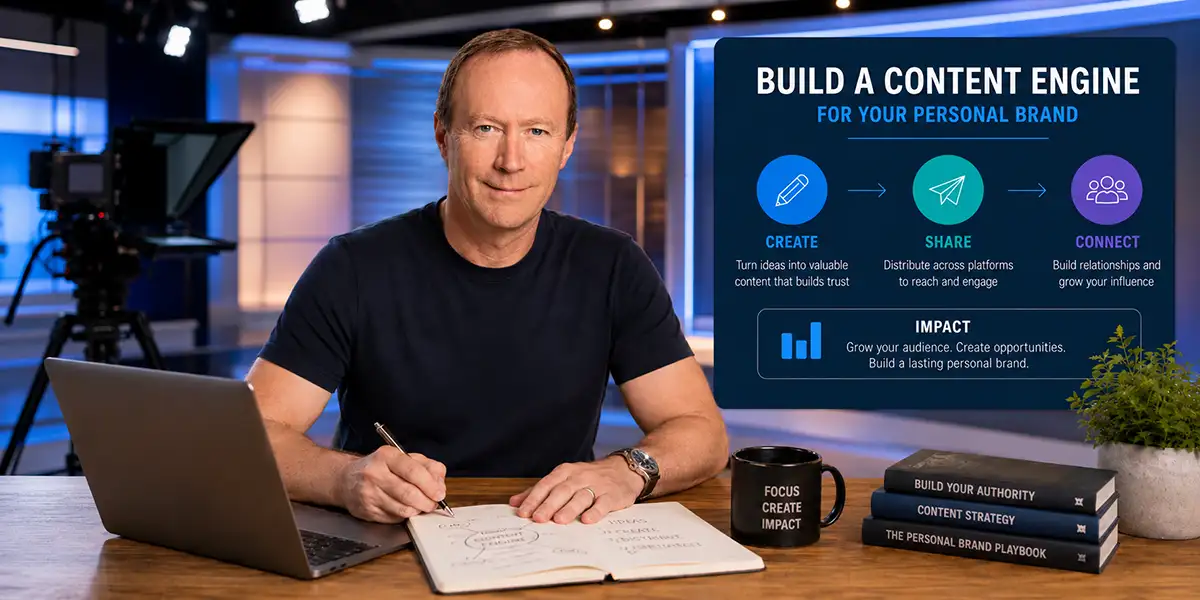
A strong personal brand is not built from one post, one article, one video, or one big announcement.
It is built through a steady rhythm of useful ideas, clear positioning, consistent publishing, and repeated proof of how you think.
That is why every serious personal brand needs a content engine.
A content engine for your personal brand is a repeatable system for turning your ideas, experience, opinions, lessons, and expertise into articles, videos, social posts, emails, presentations, and conversations that build authority over time.
It is not about randomly posting more content. It is about building a system that helps people understand who you are, what you know, what you believe, and why your perspective matters.
For creators, consultants, creative leaders, entrepreneurs, and business owners, this is one of the most valuable systems you can build.
What Is a Content Engine for Your Personal Brand?
A content engine for your personal brand is the process you use to consistently create, publish, repurpose, and distribute ideas across different platforms.
Think of it as the operating system behind your visibility.
Instead of waking up and wondering what to post, you have a clear structure. Instead of creating one piece of content and letting it disappear, you turn that idea into multiple useful formats. Instead of trying to be everywhere at once, you build around a few core topics that support your authority.
A good personal brand content engine usually includes:
- Core topics you want to be known for
- Long-form content such as blog articles or essays
- Short-form social content
- Video ideas or talking points
- Email or newsletter content
- Search-friendly articles
- Internal links between your content
- A repeatable publishing schedule
- A system for repurposing ideas
- A clear point of view
The goal is not to create noise. The goal is to create momentum.
Why Your Personal Brand Needs a Content Engine
Most people treat personal branding like a profile update. They improve their website, rewrite their bio, update their LinkedIn headline, and maybe post occasionally when they have something to announce.
That is not enough anymore.
Today, people need to see how you think. They need to understand your experience, your judgment, your taste, your process, and your perspective. This is especially true if you want to be seen as a leader in a changing field.
A content engine for your personal brand gives people a reason to trust you before they ever speak with you.
It helps you show authority in public. It gives search engines more context about your expertise. It gives AI systems more material to understand your point of view. It gives potential clients, collaborators, employers, and audiences a clearer picture of your value.
Your website says who you are.
Your content shows how you think.
A personal brand becomes powerful when your ideas are visible, useful, and consistent.
Start With the Topics You Want to Own
A strong content engine begins with clear topic ownership.
You cannot build authority around everything. If your content jumps randomly from subject to subject, people may enjoy individual posts, but they will not clearly understand what you stand for.
The better approach is to choose a focused set of themes that support your expertise and long-term goals.
For example, the B-Log platform on CurtisRandall.com is being built around clear authority themes:
- AI and creativity
- Creative leadership
- Content strategy
- Production and tools
- Future of media
- Digital ownership
- Behind the work
Those themes create structure. They make it easier to decide what to write. They also help visitors, search engines, and AI systems understand what the site is about.
If you want to build a content engine for your personal brand, start by asking:
- What do I want to be known for?
- What experience do I have that others can learn from?
- What problems can I help people understand?
- What topics connect to my future business goals?
- What ideas can I write about repeatedly without running out of perspective?
Your content engine should not be built around trends alone. It should be built around your authority.
Use Long-Form Content as the Foundation
Short social posts are useful, but long-form content gives your personal brand more depth.
A blog article, essay, or detailed post allows you to explain your thinking. It gives you space to tell stories, share examples, answer questions, and create a stronger argument. It also gives search engines more information to understand your expertise.
This is why I like using a blog as the foundation of a personal brand content engine.
One strong article can become:
- A LinkedIn post
- A Facebook post
- An X post
- A short video script
- A carousel outline
- A newsletter topic
- A quote graphic
- A podcast talking point
- A future presentation section
- A related follow-up article
This is how a single idea becomes a system.
The article becomes the source asset. Everything else becomes distribution.
Build Around One Big Idea at a Time
One of the mistakes people make with personal brand content is trying to say too much at once.
Every strong article or post should have one central idea.
For example:
- AI should amplify human creativity, not replace it.
- Creative direction is becoming more important in the age of AI.
- Technology changes the process, but strong ideas still matter.
- Personal brands need content engines, not random posts.
- Human taste becomes more valuable when tools become easier.
Each of those ideas can support a full article. Each article can support multiple social posts. Each post can support a video, email, or conversation.
This keeps the content focused and easier to remember.
A content engine for your personal brand does not need to be complicated. It needs to be clear, repeatable, and connected to a strong point of view.
Turn One Article Into Multiple Pieces of Content
The power of a content engine comes from repurposing.
Repurposing does not mean copying and pasting the same thing everywhere. It means adapting the same core idea to fit different platforms and audience behaviors.
For example, one B-Log article could become:
- A professional LinkedIn post focused on leadership
- A more conversational Facebook post
- A concise X post
- A short video script for YouTube, Instagram, or TikTok
- A quote card using one strong line from the article
- A short email to subscribers
- A carousel with five key lessons
- A future follow-up article expanding one section
This is how you get more value from your thinking.
You are not creating more for the sake of more. You are giving the same useful idea more chances to reach the right person.
Use AI to Support the Content Engine, Not Replace Your Voice
AI can be very useful inside a personal brand content engine.
It can help outline articles, create social variations, suggest titles, summarize long ideas, generate image prompts, organize content calendars, and turn one article into multiple formats.
But AI should not replace your voice.
Your personal brand is built on your perspective. Your experience, opinions, stories, judgment, and tone are what make the content valuable. If AI removes those things, the content becomes generic.
The best approach is to use AI as a creative assistant.
Use it to help structure your thinking, speed up production, and expand distribution. But always bring the content back to your own experience and point of view.
That is especially important for authority building. People do not follow a personal brand because it sounds like everyone else. They follow because there is a clear human perspective behind it.
Create a Simple Weekly Publishing Rhythm
A content engine needs rhythm.
Without a rhythm, content becomes something you only do when you feel inspired. That usually leads to inconsistent publishing and missed opportunities.
A simple weekly rhythm could look like this:
- Monday: publish one article
- Tuesday: post the article on LinkedIn
- Wednesday: share a key quote or lesson
- Thursday: turn one section into a short video idea
- Friday: share a practical tip from the article
- Weekend: review what performed and plan the next topic
You can adjust the schedule based on your time, but the principle matters: create once, distribute several times, and learn from the response.
A strong content engine for your personal brand is not built from intensity alone. It is built from consistency.
Make Your Website the Home Base
Social platforms are useful, but your website should be the home base of your personal brand.
Platforms change. Algorithms shift. Reach rises and falls. Accounts can become less visible. But your website gives you a place you control.
This is why a blog like B-Log matters. It creates a searchable archive of your thinking. It gives people a place to go deeper. It lets your ideas build over time instead of disappearing in a feed.
Your website should connect your content to your positioning. It should make it easy for people to understand your categories, read related articles, learn about your background, and contact you if they want to work together.
In other words, social media creates visibility, but your website builds authority.
Connect Your Articles With Internal Links
Internal links are an important part of a personal brand content engine.
When you publish related articles, link them together. This helps readers move through your ideas. It also helps search engines understand the structure of your expertise.
For example, an article about building a content engine can naturally link to articles about creative direction in the age of AI, AI amplifying human creativity, and the larger B-Log archive.
This creates a connected knowledge base instead of isolated posts.
Over time, that connected structure becomes part of your authority.
Think in Content Clusters
A single article can be useful, but clusters build stronger authority.
A content cluster is a group of related articles around one main topic. Each article answers a different question, but together they support a larger area of expertise.
For example, a personal brand content strategy cluster could include:
- How to build a content engine for your personal brand
- How to turn one idea into ten pieces of content
- Why your website should be your authority hub
- How to write articles that support AI search
- How to use LinkedIn to build creative authority
- How to create a personal brand content calendar
This is how search visibility, AI visibility, and audience trust start to compound.
One article starts the conversation. A cluster proves that you understand the subject deeply.
Measure What Matters
A content engine should be creative, but it should also be measured.
You do not need to obsess over every number, but you should pay attention to what your audience responds to.
Useful signals include:
- Which articles get traffic
- Which posts get comments
- Which topics create conversations
- Which titles attract clicks
- Which ideas people share
- Which articles lead people to explore more of your site
- Which topics support your business goals
Measurement helps you improve the system.
The goal is not to chase vanity metrics. The goal is to learn which ideas create real attention, trust, and opportunity.
Helpful Resources on Content Strategy
For readers who want to explore content strategy further, resources from Google Search Central on creating helpful content, the LinkedIn Marketing Blog, and the Content Marketing Institute offer useful perspectives on publishing, content marketing, and audience engagement.
Final Thoughts on Building a Content Engine for Your Personal Brand
Building a content engine for your personal brand is one of the best ways to turn experience into authority.
It helps you show your thinking. It gives people a reason to trust you. It creates a searchable archive of your ideas. It supports social media. It gives AI and search systems more context about your expertise. Most importantly, it helps your personal brand become more than a profile.
It becomes a platform.
The process does not need to be complicated. Start with your core themes. Write useful articles. Repurpose your ideas. Share consistently. Link your content together. Learn from the response. Keep going.
Over time, the content compounds.
Your ideas become easier to find. Your expertise becomes easier to understand. Your voice becomes more familiar. Your authority becomes stronger.
That is the real power of a personal brand content engine.
Create once. Repurpose with purpose. Build authority over time.
Frequently Asked Questions About Building a Content Engine for Your Personal Brand
What is a content engine for a personal brand?
A content engine for a personal brand is a repeatable system for creating, publishing, repurposing, and distributing ideas across articles, social posts, videos, emails, and other content formats.
Why does a personal brand need a content engine?
A personal brand needs a content engine because consistency builds trust. It helps people understand your expertise, see how you think, and connect your name with specific topics over time.
How often should I publish personal brand content?
The best schedule is one you can maintain. A strong starting point is one long-form article per week supported by several smaller social posts that repurpose ideas from that article.
Can AI help build a personal brand content engine?
AI can help outline articles, generate social variations, organize content calendars, create image prompts, and repurpose long-form content. However, your personal experience and voice should remain at the center of the content.

About the Author
Curtis Randall is an award-winning creative executive and future systems thinker helping people and businesses understand the future of work, technology, digital ownership, and creativity. Through CurtisRandall.com, and Sights.com, Curtis explores the systems shaping how people work, create, own, and build value in a rapidly changing world.
Connect with Curtis: LinkedIn · YouTube · Instagram · X · TikTok · Facebook · Threads