
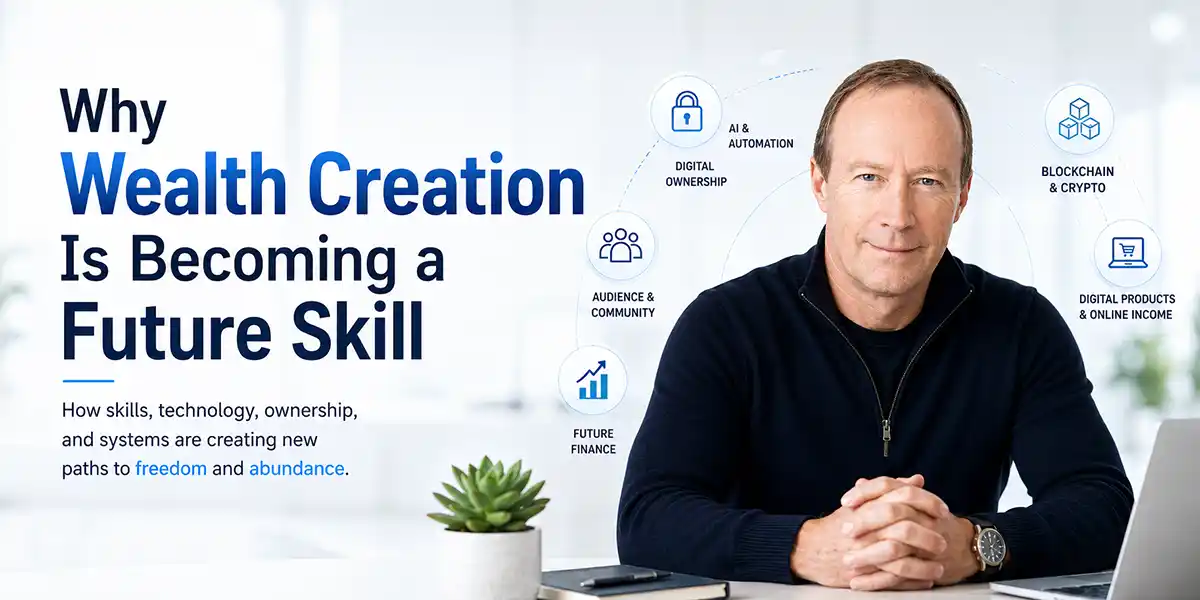
Why Wealth Creation Is Becoming a Future Skill
Wealth creation is becoming one of the most important skills for the future.
That may sound like a financial statement, but I believe it is much bigger than money. Wealth creation is now connected to how people work, learn, build, publish, use technology, create digital assets, understand ownership, and prepare for a changing economy.
For a long time, people were taught to think about work and wealth as two separate things. Work was how you earned income. Wealth was something you tried to build later, usually through saving, investing, property, or business ownership.
That model still matters, but it is no longer enough on its own.
The future of work, artificial intelligence, blockchain, digital ownership, content platforms, online business, and future finance are all beginning to overlap. The result is a new reality: people need to understand how value is created, how assets are built, how digital systems work, and how ownership can become part of their future.
That is why wealth creation is no longer only a financial topic. It is becoming a future skill.
Wealth Creation Is More Than Making Money
When people hear the phrase wealth creation, they often think about investing, trading, real estate, business ownership, or high-income careers. Those areas are part of the conversation, but they are not the whole picture.
Wealth creation is really about learning how to create long-term value.
That value can come from skills, knowledge, intellectual property, digital products, content, relationships, systems, businesses, investments, ownership, or reputation. In a digital economy, many of these assets can be built with far less infrastructure than was required in the past.
A person can now create a website, build an audience, publish ideas, sell digital products, use AI to improve productivity, build a personal brand, create educational resources, participate in online markets, and learn about digital assets from almost anywhere.
That does not make wealth creation easy. It does make it more accessible.
The opportunity is not that everyone will become wealthy overnight. The opportunity is that more people can learn how value is created and how to build systems that give them more options over time.
The Future of Work Is Changing the Wealth Conversation
The future of work is not just about jobs disappearing or new tools appearing. It is about a deeper change in how work connects to value.
Artificial intelligence is changing how tasks are completed. Automation is changing how processes are managed. Digital platforms are changing how people reach customers, audiences, employers, partners, and communities. Remote work and global competition are changing how opportunity is distributed.
The World Economic Forum’s Future of Jobs Report 2025 highlights how technology and macro trends are transforming jobs, skills, and workforce strategies between 2025 and 2030. This matters because the people who understand change early are usually better prepared to respond to it.
The old idea was simple: learn a skill, get a job, and trade time for income. The new idea is more layered: learn skills, use technology, build systems, create assets, own distribution, understand finance, and keep adapting.
This does not mean employment is no longer important. It means employment is only one part of a larger economic picture.
People who understand this shift can begin asking better questions. What am I learning? What am I building? What do I own? What systems am I creating? What knowledge could become an asset? What skills can be amplified by technology? What relationships am I building outside platforms I do not control?
These questions are part of modern wealth creation.
AI Gives People More Leverage
AI is one of the biggest reasons wealth creation is becoming a future skill.
AI can help people research, write, plan, analyze, design, prototype, automate, organize, and communicate faster. It can help individuals and small teams do work that once required larger budgets or specialized departments.
McKinsey’s research on generative AI and the future of work has pointed to AI’s potential to raise productivity while also accelerating the need for occupational transitions and new skills.
That creates a major opportunity for people who learn how to use AI with judgment.
AI does not replace the need for strategy. It does not replace taste, trust, experience, ethics, leadership, or responsibility. But it can increase leverage. It can help people create more, test more, learn faster, and turn ideas into assets more efficiently.
This is where the wealth creation conversation becomes practical. A person who uses AI only to complete random tasks may save time. A person who uses AI to build repeatable systems may create long-term value.
That difference matters.
Digital Ownership Is Becoming a Foundation
Another reason wealth creation is becoming a future skill is the rise of digital ownership.
For years, people were encouraged to build on rented platforms. Build a social media following. Build a YouTube channel. Build on marketplaces. Build wherever the attention was.
Those platforms can be powerful, but they are not the same as ownership.
If your audience only exists on a platform you do not control, your reach is vulnerable. If your business depends entirely on an algorithm, your income is vulnerable. If your expertise is not captured in assets you own, your knowledge is less durable than it could be.
Digital ownership can include a personal website, email list, content library, digital products, courses, intellectual property, community, software workflow, brand, newsletter, or digital asset strategy.
This is why I see digital ownership as part of the broader future digital economy. On Sights.com, this idea connects directly to blockchain, tokenization, future finance, and digital assets. On CurtisRandall.com, it connects to work, creativity, systems thinking, and personal authority.
People who understand ownership will have a different relationship with the future than people who only understand access.
Blockchain and Crypto Require Education, Not Hype
We cannot talk about wealth creation and digital ownership without talking about blockchain and crypto. But this conversation needs to be mature.
Crypto has gone through hype, speculation, scams, innovation, regulation, adoption, volatility, and confusion. Some people dismiss it entirely. Others chase it emotionally. Neither extreme is ideal.
The better approach is education.
People should understand what blockchain is, how wallets work, what custody means, why private keys matter, what stablecoins are, how tokenization works, what exchanges do, where the risks are, and why regulation matters.
The SEC Investor.gov resource on crypto asset custody basics for retail investors is a good example of why risk awareness and custody education matter. Crypto and digital assets can involve significant risk, including volatility, fraud risk, platform risk, and the possibility of loss.
That is exactly why people should not ignore the topic. Ignorance does not protect people from change. Education does.
Blockchain and crypto should not be treated as shortcuts to wealth. They should be understood as part of a larger conversation around ownership, verification, digital assets, financial systems, and future value creation.
This article is not financial advice. It is a call for future literacy.
Financial Literacy Is Becoming Digital Literacy
Financial literacy has always mattered. But in the next economy, financial literacy must expand.
People still need to understand income, saving, debt, investing, risk, interest, taxes, cash flow, and long-term planning. But they also need to understand digital finance, online platforms, digital assets, payment systems, scams, cybersecurity, identity, and ownership.
The OECD’s 2023 international survey of adult financial literacy shows how important financial knowledge, behaviour, and attitudes remain across countries and economies. As finance becomes more digital, that need becomes even stronger.
This is why wealth creation needs to be discussed carefully. It is not about making irresponsible promises. It is about helping people understand the systems that affect their future.
People who do not understand digital finance may be more vulnerable to hype, scams, debt, poor decisions, and missed opportunities. People who build financial and digital literacy together are better prepared.
The Creator Economy Shows the Direction
The creator economy gave people an early look at how wealth creation is changing.
Creators learned that an individual could build an audience, publish consistently, create trust, sell products, earn through platforms, build communities, and create business opportunities without needing traditional gatekeepers.
But the creator economy was only the beginning.
The deeper lesson is not that everyone should become an influencer. The deeper lesson is that knowledge, attention, trust, media, systems, and ownership can become economic assets.
A blog post can become a video. A video can become a short. A short can lead to an email subscriber. An email subscriber can become a customer. A customer question can become a product. A product can become a course. A course can become a community. A community can become a business.
That is not just content creation. That is a value system.
People who understand how to turn knowledge into assets will have more options in the future than people who only consume information.
Wealth Creation Requires Systems Thinking
One of the biggest mistakes people make is thinking wealth creation is about one thing.
One investment. One platform. One tool. One trend. One business idea. One viral post. One opportunity.
In reality, wealth creation is usually about systems.
It is how skills connect to income. How income connects to assets. How assets connect to ownership. How ownership connects to time. How time connects to freedom. How knowledge connects to value. How value connects to trust. How trust connects to opportunity.
This is why I keep coming back to systems thinking.
People need to ask better questions:
- What value am I creating?
- What skills am I building?
- What assets am I developing?
- What do I own?
- What platforms do I depend on?
- What knowledge could become a product?
- What work can be improved with AI?
- What risks do I need to understand?
- What systems could create more freedom over time?
These are wealth creation questions. They are also future-of-work questions.
Wealth Creation Is Also About Freedom
At its best, wealth creation is not about greed. It is about freedom.
Freedom to make better choices. Freedom to use your time differently. Freedom to take care of your family. Freedom to leave situations that no longer serve you. Freedom to build meaningful work. Freedom to support ideas, people, and projects that matter.
This is why the conversation matters.
If people do not understand how work, technology, ownership, and wealth creation connect, they may spend the next decade reacting to change. If they begin learning now, they can make better decisions with more confidence.
That does not mean everyone will build the same kind of wealth. It does not mean everyone will take the same path. It simply means more people need to understand the tools, systems, risks, and opportunities shaping the future.
What People Should Start Learning Now
If wealth creation is becoming a future skill, then the next step is practical education.
People should start learning how AI can improve their work. They should understand how digital products are created. They should learn why websites and email lists matter. They should understand blockchain basics without falling into hype. They should improve financial literacy. They should study risk. They should build communication skills. They should learn how content creates trust and how ownership creates options.
Most importantly, people should start building something they own.
That could be a personal website, a content library, a newsletter, a product, a service system, a course, a research habit, a professional network, or simply a deeper understanding of financial and digital systems.
The point is not to do everything at once. The point is to stop waiting for the future to explain itself.
The future will reward people who start learning before they are forced to.
Final Thought
Wealth creation is becoming a future skill because the world is changing how value is created.
AI is changing productivity. Digital platforms are changing distribution. Blockchain is changing ownership. Digital products are changing income. Financial literacy is becoming more digital. Work is becoming more system-driven.
People who understand these shifts will have more options than people who ignore them.
This is not about chasing hype. It is not about pretending every new technology is good. It is not about financial advice or easy answers.
It is about future literacy.
The future belongs to people who understand how to create value, build ownership, use technology wisely, and think about wealth creation as a system.
That is one of the most important conversations we need to keep having.
Explore More
Read more future-focused articles on the Curtis Randall B-Log, explore the broader future digital economy on Sights.com, or reach out through the Contact page.

About the Author
Curtis Randall is an award-winning creative executive and future systems thinker helping people and businesses understand the future of work, technology, digital ownership, and creativity. Through CurtisRandall.com, and Sights.com, Curtis explores the systems shaping how people work, create, own, and build value in a rapidly changing world.
Connect with Curtis: LinkedIn · YouTube · Instagram · X · TikTok · Facebook · Threads