
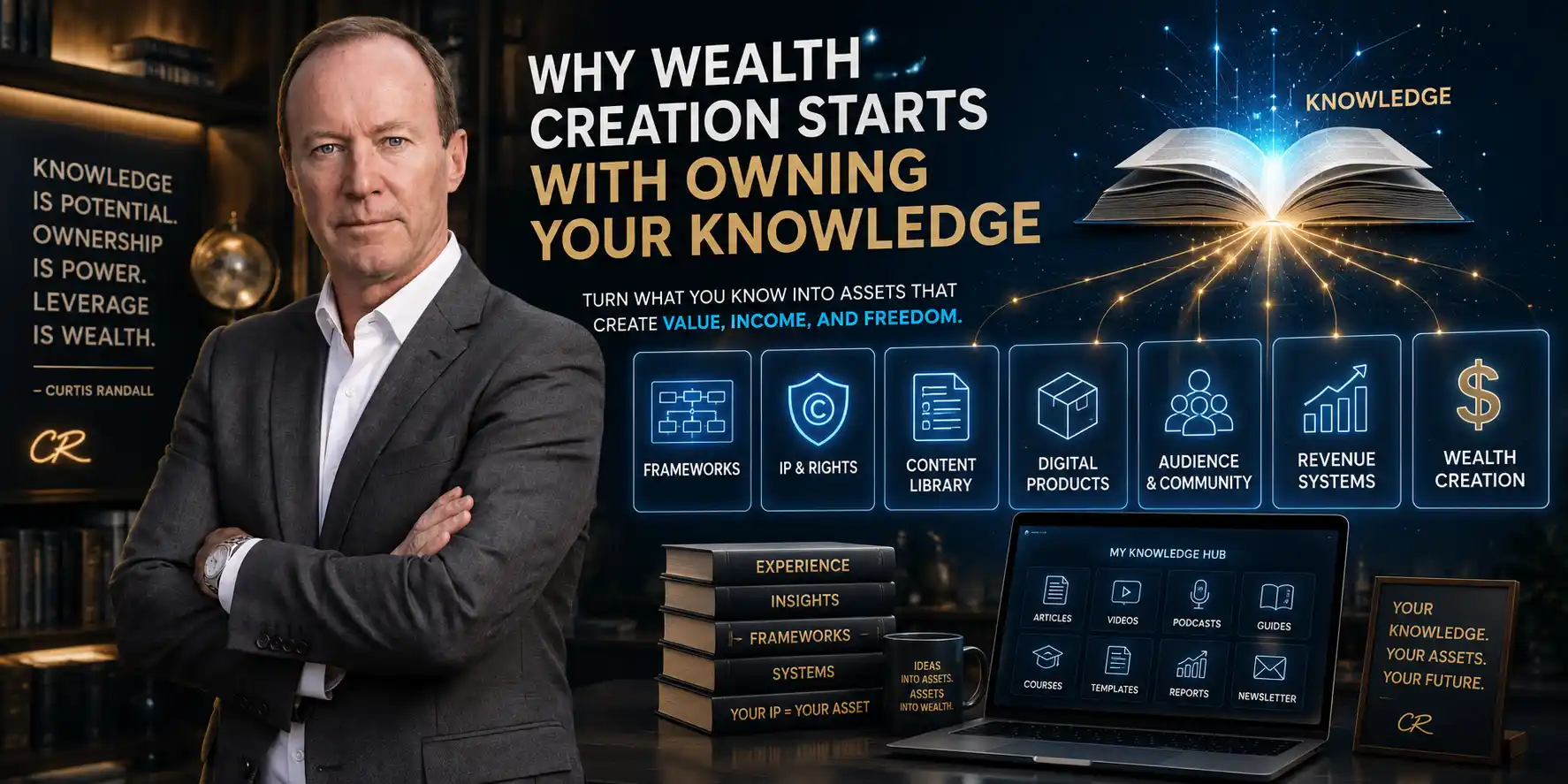
Why Wealth Creation Starts With Owning Your Knowledge
Wealth creation increasingly starts with owning your knowledge.
That may sound simple, but it is a major shift in how people need to think about work, value, expertise, and opportunity in the future digital economy.
For many years, people used knowledge mainly to earn income. You learned a skill, gained experience, got a job, served clients, solved problems, and traded your time and expertise for money.
That model still matters. But it is no longer enough.
In a digital economy, knowledge can become more than something you use in the moment. It can become an asset. It can become content, frameworks, books, courses, digital products, newsletters, articles, videos, talks, consulting systems, intellectual property, and owned media.
The difference is ownership.
If your knowledge only lives inside your head, your job, your client work, or someone else’s platform, it may create income but not long-term value. If your knowledge is organized, published, protected, and packaged, it can begin to work for you over time.
That is why wealth creation starts with owning your knowledge.
Knowledge Is One of the Most Underused Assets People Have
Most people know more than they realize.
They have experience, lessons, processes, mistakes, insights, stories, frameworks, instincts, professional judgment, personal perspective, and practical knowledge that could help others. But much of that knowledge remains unused as an asset.
It stays trapped in emails, meetings, client calls, conversations, notebooks, hard drives, unfinished drafts, or years of experience that have never been documented.
That is a problem because undocumented knowledge is hard to scale.
If you explain the same idea repeatedly but never turn it into an article, guide, framework, or product, the value disappears after each conversation. If you solve the same problem for clients but never build a repeatable system around it, the value stays dependent on your time. If you have useful experience but never publish it, people may never discover your thinking.
Knowledge becomes more powerful when it is captured.
The Digital Economy Rewards Organized Knowledge
The digital economy rewards people who can organize what they know into useful formats.
A person with knowledge can turn that knowledge into articles, videos, newsletters, podcasts, books, courses, templates, reports, workshops, frameworks, and consulting systems. A business can turn internal expertise into training, customer education, content libraries, product documentation, lead magnets, and intellectual property.
This matters because information is abundant, but useful organization is rare.
People do not only need more information. They need clarity. They need structure. They need someone to explain what matters, what is connected, what is practical, and what should be ignored.
The OECD’s Digital Economy Outlook 2024 highlights how digital transformation depends on foundations such as innovation, trust, skills, and lifelong learning. That is important because knowledge only becomes more valuable when people keep learning and turn that learning into useful capability.
In other words, the future does not only reward what you know. It rewards how well you can organize, apply, share, and own what you know.
Owning Your Knowledge Is Different From Having Experience
Experience is valuable, but experience alone is not the same as ownership.
You may have years of professional experience, but if that experience has not been documented, structured, and turned into assets, it may only create value when you are actively working.
Owning your knowledge means turning experience into something that can be found, understood, reused, shared, sold, taught, licensed, or built upon.
That could be a body of articles. It could be a named framework. It could be a course. It could be a book. It could be a workshop. It could be a product. It could be a set of templates. It could be a newsletter. It could be a content library. It could be a consulting method.
The key is that your knowledge starts becoming an owned asset instead of a temporary service.
Experience earns more when it becomes structured. Knowledge compounds when it becomes owned.
AI Makes Knowledge Ownership More Important
Artificial intelligence makes knowledge ownership more important, not less.
AI can generate content quickly. It can summarize information, draft articles, create outlines, organize ideas, produce images, write scripts, assist with research, and support workflows. That creates opportunity, but it also creates more noise.
When generic content becomes easy to create, original knowledge becomes more valuable.
Your lived experience, judgment, point of view, frameworks, client lessons, mistakes, examples, and way of explaining ideas become important differentiators. AI can help you produce and organize, but it cannot replace the value of real perspective.
The World Economic Forum’s Future of Jobs Report 2025 skills outlook highlights how skills are expected to shift as advanced technologies such as machine learning and generative AI reshape work. That shift makes it even more important for people to document what they know and keep developing skills that remain valuable as tools change.
AI should not make people passive. It should push them to become better owners of their own thinking.
Your Knowledge Can Become Intellectual Property
One of the most important reasons to own your knowledge is that knowledge can become intellectual property.
Intellectual property can include original writing, training materials, frameworks, methods, visual systems, books, courses, guides, templates, brand language, presentations, scripts, and creative works.
For professionals, creators, consultants, educators, advisors, and businesses, intellectual property can become a long-term asset. It can support products, licensing, speaking, training, consulting, media, publishing, and business development.
The World Intellectual Property Organization has noted that the rise of generative AI is accelerating the need for strong copyright infrastructure to protect creators while allowing innovation to continue through its work on artificial intelligence and intellectual property.
That matters because people are entering an era where content, ideas, voice, likeness, style, and expertise may become easier to copy, imitate, remix, or automate.
Owning your knowledge means being more intentional about what you create, where you publish it, how you document it, and how it becomes part of your body of work.
A Content Library Is a Knowledge Asset
One of the simplest ways to start owning your knowledge is to build a content library.
A content library is more than a collection of posts. It is an organized body of thinking. It can include articles, videos, podcasts, guides, reports, newsletters, talks, case studies, and frameworks.
A social post may disappear quickly in a feed. A content library can continue building authority over time. It can help search engines, AI systems, clients, partners, followers, and readers understand what you know and what you stand for.
This is why owned publishing still matters.
Social platforms are useful for distribution. Your own website is better for ownership.
That is one of the reasons I continue to build the Curtis Randall B-Log as a personal authority hub, while also developing Sights.com as a broader education platform for the future digital economy.
If your knowledge is only scattered across social feeds, it is harder to find, harder to trust, and harder to turn into something valuable.
Frameworks Turn Knowledge Into Something People Can Use
Frameworks are one of the most powerful ways to turn knowledge into an asset.
A framework takes complex experience and turns it into a clear structure. It gives people a way to understand a problem, make decisions, or take action.
For example, instead of simply saying that people need to understand work, AI, digital ownership, finance, and media, you can organize those ideas into a future digital economy framework. Instead of only saying creators need to build assets, you can create a creator ownership stack. Instead of only saying people need wealth literacy, you can explain the new wealth stack.
Frameworks make knowledge easier to teach, remember, repeat, and build upon.
They also strengthen authority because they show that you are not just reacting to trends. You are organizing ideas into a useful point of view.
That is how knowledge begins to become intellectual property.
Digital Products Package Knowledge Into Value
Digital products are another way knowledge becomes an asset.
A digital product might be a guide, checklist, workbook, template, course, report, playbook, video training, resource library, prompt system, workshop, or paid newsletter.
The value of a digital product is not that it is digital. The value is that it helps someone solve a problem, understand a subject, save time, make a decision, learn a process, or move forward with more confidence.
Digital products can create leverage because they allow knowledge to be delivered repeatedly without starting from zero every time.
This does not mean every digital product will succeed. It does not mean knowledge automatically becomes income. But it does mean that useful knowledge can be packaged into something that creates value beyond one conversation or one client engagement.
That is one reason digital products are becoming part of everyday wealth creation.
Owning Your Knowledge Builds Authority
Authority is built when people can see how you think.
If your knowledge is invisible, people may not understand your value. If your ideas are scattered, people may not see the connection. If your experience is undocumented, people may not know why they should trust you.
Owned knowledge changes that.
Articles, videos, frameworks, books, talks, and guides give people evidence of your thinking. They show your perspective, your judgment, your ability to explain, and your understanding of the bigger picture.
This matters in a world where AI can produce more content, but trust is harder to earn. People will increasingly look for voices with real experience, clarity, and a documented body of work.
Authority is not built by claiming expertise. It is built by demonstrating useful thinking over time.
Owning Your Knowledge Supports Wealth Creation
Owning your knowledge supports wealth creation because it helps turn experience into assets.
Those assets can support consulting, speaking, products, workshops, memberships, books, newsletters, licensing, client trust, business development, search visibility, media opportunities, and long-term authority.
In other words, knowledge ownership creates more paths.
A person who only sells time has limited leverage. A person who owns knowledge assets has more ways to create value. They can teach, publish, package, license, distribute, and scale their ideas.
That is why owning your knowledge is part of wealth creation. It does not replace income, investing, saving, or business ownership. It adds another layer to the system.
Knowledge becomes more valuable when it becomes structured, visible, useful, and owned.
The Knowledge Ownership Stack
A simple way to think about this is the knowledge ownership stack.
The stack includes:
- Experience: What you have learned through work, projects, mistakes, and real-world practice.
- Documentation: Capturing your ideas, lessons, processes, and observations.
- Structure: Turning knowledge into frameworks, categories, systems, and repeatable explanations.
- Publishing: Sharing your thinking through owned media, articles, videos, newsletters, books, or talks.
- Protection: Treating original ideas, frameworks, brand assets, and creative work as intellectual property.
- Packaging: Turning useful knowledge into products, services, workshops, courses, or guides.
- Distribution: Using platforms, search, email, social media, and partnerships to reach the right people.
- Ownership: Building assets you control instead of relying only on rented platforms.
This stack helps knowledge move from invisible experience to visible value.
Most People Give Away Their Knowledge Without Building Assets
One of the biggest mistakes people make is giving away knowledge without building anything around it.
They answer the same questions repeatedly. They share insights in conversations that are never documented. They post ideas that disappear. They solve problems but never turn the solution into a process. They advise others but never build a framework. They create value for platforms without building their own library.
Generosity is good. Sharing ideas is good. But if none of that knowledge is organized into owned assets, the long-term value may be lost.
The goal is not to hide your knowledge. The goal is to build with it.
Share ideas, but also organize them. Teach, but also document. Publish, but also own. Create, but also protect. Help people, but also build assets that allow your knowledge to keep creating value.
Your Website Should Become a Knowledge Home
Your website should not only be a place where people find your bio. It should become a home for your knowledge.
A strong website can organize your articles, categories, products, services, speaking topics, frameworks, resources, videos, newsletter, and contact path. It can show people what you think about and why it matters.
In the age of AI search, this becomes even more important. AI systems and search engines need clear, structured, credible content to understand your authority. People also need a reliable place to verify who you are and what you stand for.
Social platforms create discovery. Websites create structure.
That structure is part of digital ownership.
How to Start Owning Your Knowledge
Owning your knowledge does not need to be complicated. The first step is to begin capturing and organizing what you already know.
Start with these questions:
- What do people often ask me to explain?
- What problems have I solved repeatedly?
- What lessons have I learned the hard way?
- What frameworks do I use without even realizing it?
- What do I understand now that I wish I understood earlier?
- What knowledge could become an article, guide, video, or product?
- What ideas should live on my website instead of only on social media?
- What intellectual property am I creating without protecting or organizing it?
Then start building:
- Write authority articles around your core ideas.
- Create named frameworks for repeated lessons.
- Build a content library on your own website.
- Turn common questions into guides or resources.
- Use AI to help organize and repurpose your thinking.
- Protect original work where appropriate.
- Create a simple digital product from a useful process.
- Build an email list so your knowledge has a direct audience path.
The point is to stop letting knowledge disappear after each use.
Why This Matters for the Future Digital Economy
The future digital economy will reward people who can turn knowledge into assets.
AI will increase content production. Digital platforms will increase competition. Future work will require continuous learning. Digital ownership will become more important. Future finance will connect more closely to digital assets and intellectual property. Creator platforms will continue turning expertise into media, products, and communities.
In that environment, knowledge ownership becomes a serious advantage.
People who own their knowledge will be better positioned to build authority, products, trust, influence, and wealth creation systems. People who do not may find their expertise trapped inside jobs, platforms, or temporary conversations.
The future belongs to people who understand how to turn what they know into something useful, durable, and owned.
Final Thought
Wealth creation starts with owning your knowledge because knowledge is one of the few assets people already carry with them.
The challenge is not always finding something new. Sometimes the challenge is recognizing the value of what you already know and turning it into something structured, visible, useful, and ownable.
Experience can become content. Content can become authority. Authority can become trust. Trust can become opportunity. Opportunity can become products, services, speaking, consulting, partnerships, and assets.
The future will reward people who do not just use their knowledge, but own it, organize it, protect it, and turn it into value.
That is why wealth creation starts with owning your knowledge.
Explore More
Read more on the Curtis Randall B-Log, explore future-focused education on Sights.com, or connect through the Contact page.

About the Author
Curtis Randall is an award-winning creative executive and future systems thinker helping people and businesses understand and adapt to the future of work, creativity, technology, digital ownership, and wealth creation. Through CurtisRandall.com and Sights.com, Curtis explores the systems shaping how people work, create, own, and build value in a rapidly changing world.
Connect with Curtis: LinkedIn · YouTube · Instagram · X · TikTok · Facebook · Threads