
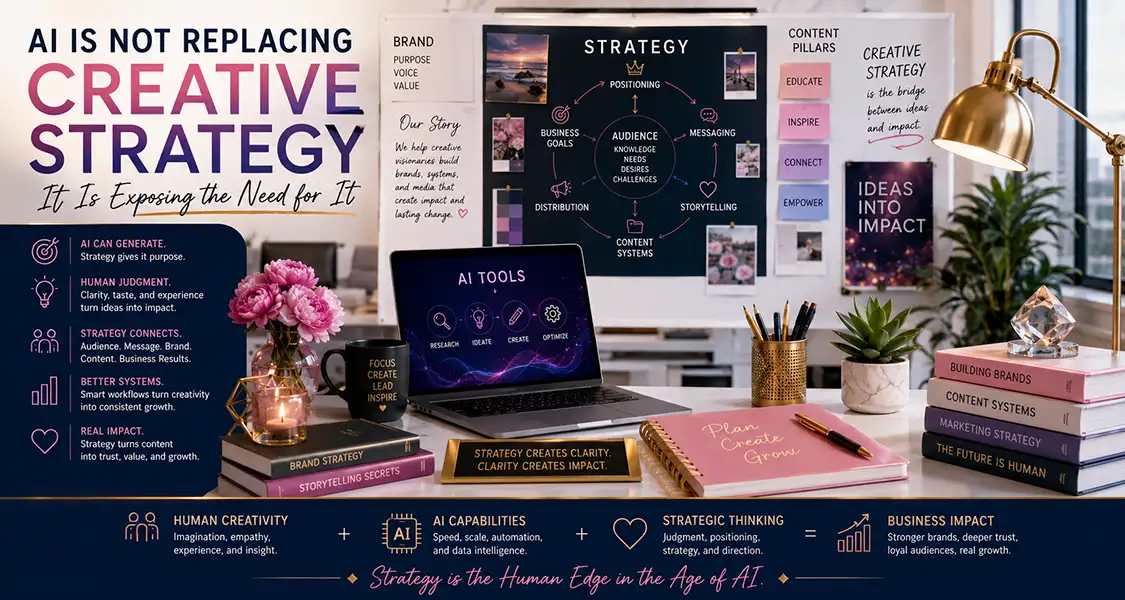
AI Is Not Replacing Creative Strategy — It Is Exposing the Need for It
AI is changing the creative world quickly. It can write drafts, generate images, summarize research, suggest headlines, produce video concepts, build outlines, create content variations, and help teams move faster than ever before.
Because of that, many people are asking the wrong question.
They ask, “Will AI replace creative work?”
A better question is, “What kind of creative work becomes more valuable when AI can produce more of the average work?”
The answer is creative strategy.
AI is not replacing creative strategy. It is exposing the need for it. As more businesses use AI to create more content, more visuals, more campaigns, more messages, and more ideas, the real advantage will not come from simply producing more. It will come from knowing what should be produced, why it matters, who it is for, and how it connects to business value.
That is where creative strategy becomes essential.
Creative Strategy Gives AI Direction
AI can generate options, but options are not strategy.
A business can ask AI for fifty headlines, ten campaign ideas, five video scripts, three email sequences, and a full month of social media content. That may sound productive, but it can quickly become noise if there is no clear direction behind it.
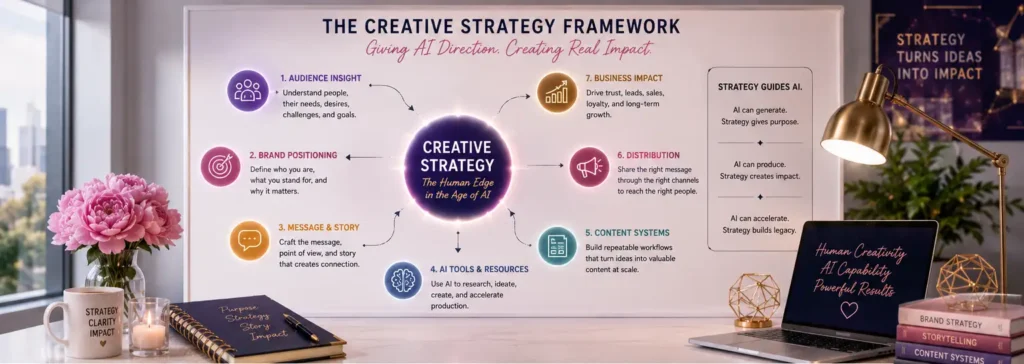
Creative strategy gives AI a purpose. It defines the goal, the audience, the message, the tone, the positioning, the offer, the story, and the outcome.
Without creative strategy, AI produces content. With creative strategy, AI supports communication, trust, clarity, and business growth.
That difference matters.
AI can help create faster, but creative strategy decides what deserves to be created.
The Problem Is Not a Lack of Content
Most businesses do not have a lack of content anymore. They have a lack of clarity.
They have websites that do not explain the offer clearly. They have social posts that do not build trust. They have videos that do not connect to a larger message. They have campaigns that look busy but do not move people toward action.
AI can increase the amount of content a business creates, but if the message is unclear, the extra content may only multiply the confusion.
This is why creative strategy is becoming more valuable. It helps businesses answer the questions that AI cannot answer on its own:
- What do we actually want to be known for?
- Who are we trying to help?
- What problem are we solving?
- Why should people trust us?
- What is our point of view?
- What message needs to be repeated?
- What action do we want people to take?
- How does this creative work support the business?
Those are not production questions. They are strategy questions.
AI Makes Average Execution Easier
AI will make average creative execution easier to produce.
Average copy, average images, average captions, average layouts, average concepts, and average content ideas will become faster, cheaper, and more common. That does not mean creative work loses value. It means the value moves.
The value moves away from basic production and toward higher-level thinking.
The value moves toward judgment, taste, clarity, positioning, storytelling, emotional intelligence, and business understanding.
In other words, the value moves toward creative strategy.
This is uncomfortable for people who only define creativity as making things. But it is a huge opportunity for people who understand that creativity is also about solving problems, shaping perception, creating meaning, and helping people make decisions.
Creative Strategy Connects the Business to the Audience
One of the most important roles of creative strategy is connection.
A business may have a strong product, a useful service, deep knowledge, or a powerful offer, but people still need to understand why it matters. They need to see themselves in the message. They need to feel that the business understands their problem, their desire, their hesitation, and their goal.
AI can help draft the words, but creative strategy shapes the meaning behind the words.
Creative strategy asks:
- What does the audience already believe?
- What do they need to understand?
- What emotion is connected to the problem?
- What would make the message feel relevant?
- What proof do they need?
- What story will help them see the value?
- What is the simplest way to explain the idea?
That is not just marketing. That is human understanding.
AI Needs Better Inputs, Not Just Better Prompts
There is a lot of focus on writing better prompts, and prompts do matter. But a prompt is only as strong as the thinking behind it.
If the business does not know its audience, message, offer, position, tone, and goal, then even a well-written prompt can produce content that feels generic.
The better input is not just a clever instruction. The better input is a clear strategy.
AI becomes more useful when it is given:
- A clear audience profile.
- A defined brand voice.
- A strong positioning statement.
- A specific business goal.
- A useful content structure.
- A clear offer.
- A repeatable workflow.
- A quality standard.
This is why creative strategy comes before AI production. The strategy gives the tool better context, and better context creates better output.
Creative Strategy Turns AI Into a System
Many businesses start with random AI experiments. Someone uses AI to write a post. Someone creates a few images. Someone asks for a campaign idea. Someone summarizes a meeting. Someone makes a quick video script.
That is a normal starting point, but it is not a system.
The next step is turning AI into a repeatable business process.
A creative strategy system can include:
- Brand voice rules.
- Content pillars.
- Campaign frameworks.
- Prompt libraries.
- Image direction guides.
- Video scripting templates.
- Content repurposing workflows.
- Human review checkpoints.
- Publishing schedules.
- Performance measurement.
When these pieces are connected, AI becomes part of a larger creative system instead of a scattered set of tools.
That is where the business value begins to grow.
The Human Role Moves Toward Judgment
As AI becomes more capable, the human role becomes more important in a different way.
The human role moves toward judgment.
Judgment is the ability to know what fits, what feels right, what should be removed, what needs to be stronger, what is off-brand, what is too generic, what is risky, and what will actually matter to the audience.
This is where creative experience becomes valuable. Experienced creative thinkers understand context. They understand tone. They understand why one idea feels powerful and another feels flat. They know when something is clear, when it is confusing, when it is emotionally empty, and when it has the potential to connect.
AI can help generate the raw material, but human judgment shapes it into something useful.
That is not a small role. That is the role that gives the work value.
Storytelling Becomes More Important, Not Less
AI can produce information quickly. But information alone does not create trust.
People connect with stories. They remember ideas that have meaning. They respond to messages that help them understand themselves, their problem, and the possibility of a better outcome.
That is why storytelling becomes more important in the AI era.
As more content is created, businesses will need stronger stories to stand out. They will need a clear narrative about who they help, what they believe, why they exist, and what future they are helping their audience move toward.
AI can help shape story options, but creative strategy decides which story is true, useful, and worth repeating.
Creative Strategy Protects the Brand
AI can help businesses move faster, but speed can also create risk.
A business can quickly publish content that is off-brand, inaccurate, unclear, repetitive, or too generic. It can create visuals that do not match the brand. It can produce messages that sound polished but lack personality. It can generate ideas that look impressive but do not support the business goal.
Creative strategy protects the brand by setting standards.
It defines what the brand should sound like, what it should look like, what it should avoid, what it should repeat, and how it should make people feel.
That becomes even more important when AI makes production easier. The easier it is to create, the more important it becomes to know what not to create.
The Creative Leader Becomes a Systems Builder
The creative leader of the future will not only be judged by the ability to create ideas. They will be judged by the ability to build creative systems.
That means understanding how ideas move through a business.
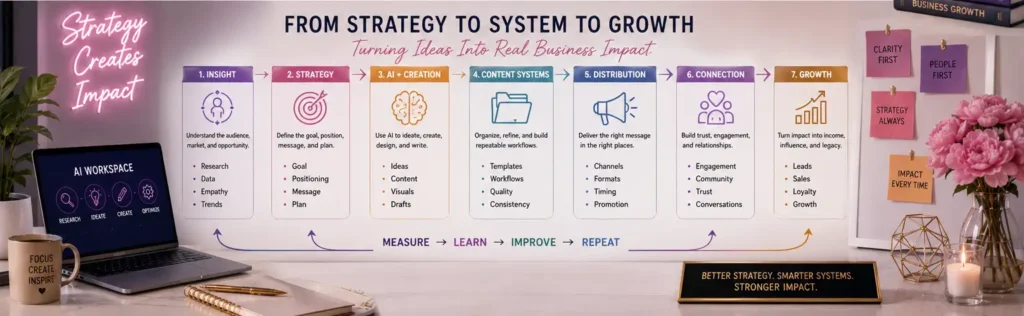
From insight to strategy. From strategy to message. From message to content. From content to distribution. From distribution to trust. From trust to business growth.
This is where creative strategy becomes a business function, not just a creative department function.
Businesses will need people who can connect AI tools with brand thinking, customer understanding, media strategy, content systems, and measurable outcomes.
That is a powerful opportunity for creative leaders, consultants, strategists, and business owners who are willing to move beyond production and into systems thinking.
How Businesses Can Strengthen Creative Strategy in the AI Era
Businesses do not need to stop using AI. They need to use it with better creative strategy.
A practical starting point is to define the strategy before asking AI to create the output.
- Clarify the goal: What business result should this support?
- Define the audience: Who is this for?
- Shape the message: What should people understand or remember?
- Set the tone: How should the brand sound and feel?
- Choose the format: What type of content best supports the idea?
- Build the workflow: How will AI help without removing human review?
- Measure the result: What will tell us if this worked?
This approach turns AI from a random production tool into part of a creative strategy system.
Final Thought
AI is not replacing creative strategy. It is making the need for creative strategy more obvious.
When everyone can create more, the advantage shifts to those who can create with more clarity, purpose, originality, and business direction.
Creative strategy is what turns AI output into meaningful communication. It is what connects tools to trust, content to audience, ideas to value, and creativity to business growth.
The future will not belong to the businesses that simply use AI to create more. It will belong to the businesses that use creative strategy to create what matters.
Want to follow this conversation? Read more on the Curtis Randall B-Log, explore resources on My Creative Gear, or connect through the Contact page.