

From Content Creation to Content Systems: The Real AI Business Opportunity
AI has made content creation faster than ever. A business can now draft articles, generate social posts, write emails, create outlines, produce video ideas, summarize research, and repurpose content in a fraction of the time it used to take.
That is powerful, but it also creates a problem.
If everyone can create more content, then more content is no longer the advantage.
The real opportunity is not simply content creation. The real opportunity is building content systems.
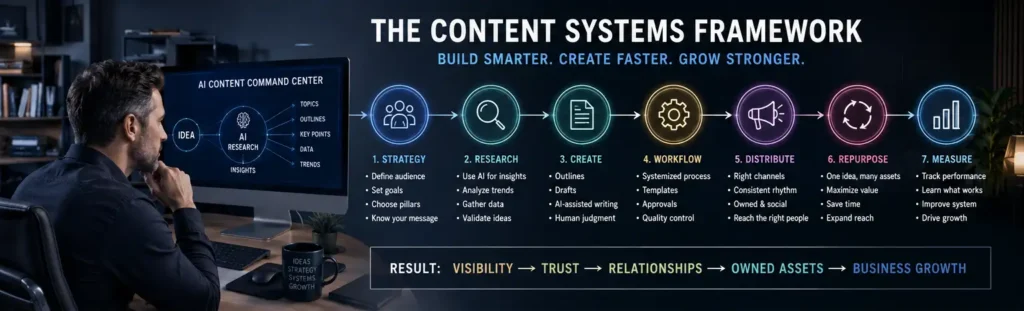
A content system turns ideas into visibility, visibility into trust, trust into relationships, and relationships into long-term business value. It gives content a purpose. It connects strategy, workflow, publishing, distribution, repurposing, measurement, and business growth.
In the AI business era, the companies and individuals who win will not be the ones producing the most random content. They will be the ones building the smartest systems around their ideas.
The Problem With Content Creation Alone
Most businesses already understand that content matters. They know they should post on social media, publish articles, send emails, create videos, and show up online. But many still approach content as a task instead of a system.
They ask, “What should we post today?” instead of asking, “What system are we building that helps the right people understand, trust, and remember us?”
That difference matters.
When content is only a task, it becomes inconsistent. It depends on mood, time, trends, pressure, and last-minute ideas. The business may post for a few weeks, disappear, come back with a campaign, then lose momentum again.
AI can make that process faster, but faster random content is still random content.
Without a system, AI may simply help a business create more disconnected pieces. More captions. More images. More emails. More articles. More posts. But if those pieces do not connect to a larger strategy, they may not build trust, authority, or business value.
What Is a Content System?
A content system is a repeatable process for turning ideas into useful communication that supports a business goal.
It is not just a calendar. It is not just a list of posts. It is not just a folder of prompts. A real content system connects the full journey from idea to outcome.
A strong content system includes:
- Clear content pillars.
- A defined audience.
- A consistent point of view.
- A repeatable workflow.
- A publishing rhythm.
- A distribution plan.
- A repurposing process.
- A quality review system.
- A way to measure results.
- A connection to products, services, offers, or business goals.
This is where content becomes more than content. It becomes a business asset.
AI Makes Content Systems More Powerful
AI is extremely useful inside a content system because it can speed up many parts of the process.
It can help with research, outlines, headlines, summaries, draft copy, idea expansion, social post variations, email subject lines, video scripts, image direction, repurposing, and performance analysis.
But AI works best when the system gives it direction.
For example, a business with no clear message may use AI to produce generic content. But a business with strong content pillars, a defined audience, and a clear point of view can use AI to produce more focused, more useful, and more consistent content.
AI does not replace the need for strategy. It increases the need for strategy because the volume of possible output is now almost unlimited.
The question is no longer, “Can we create something?”
The better question is, “What should we create, who is it for, how will it be used, and what system does it support?”
The Shift From Posts to Pillars
One of the most important shifts in building content systems is moving from random posts to content pillars.
Content pillars are the main topics a business wants to be known for. They create structure. They help the audience understand what the brand stands for. They also make content easier to plan, create, and repurpose.
For example, a future-focused business may have content pillars like:
- AI and technology.
- Creative strategy.
- Digital ownership.
- Future of work.
- Systems thinking.
- Business growth.
- Media and visibility.
With content pillars in place, every article, video, email, and social post has a stronger purpose. The business is not just posting. It is building recognition around ideas that matter.
This is also where AI becomes easier to use. Instead of asking AI for random content ideas, you can ask it to help expand a specific pillar into articles, videos, short posts, email topics, lead magnets, and campaign ideas.
That is the beginning of a real content system.
One Idea Should Become Many Assets
Most businesses do not get enough value from their best ideas.
They may write one article, post it once, and move on. Or they may record one video, publish it once, and then start thinking about the next topic.
A content system thinks differently.
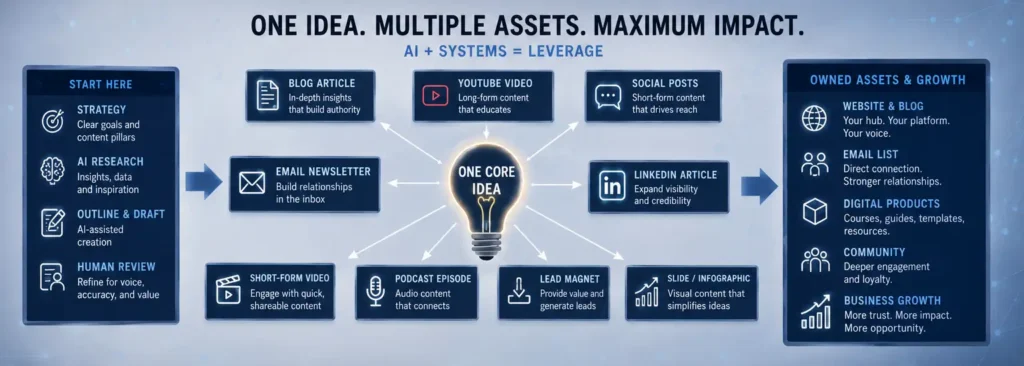
One strong idea should become many assets.
A single article can become:
- A LinkedIn post.
- A short X post.
- A YouTube video outline.
- A short-form video script.
- An email newsletter.
- A carousel or infographic.
- A podcast talking point.
- A lead magnet section.
- A consulting framework.
- A future product idea.
This is one of the biggest AI business opportunities. AI can help repurpose one core idea into multiple formats much faster than before.
But again, the value comes from the system. The system decides which formats matter, where they should go, how they should sound, and what role each piece plays.
Content Systems Build Trust Over Time
Trust is not usually built from one post, one video, or one article. Trust is built over time through consistent, useful communication.
When people see a business explain its ideas clearly again and again, they begin to understand what that business stands for. They begin to recognize its point of view. They begin to remember its message.
That is why content systems are so important.
A content system helps a business show up consistently without starting from zero every time. It creates a rhythm. It creates familiarity. It helps people move from awareness to trust.
AI can help produce the pieces, but the system creates the relationship.
Content Systems Support Digital Ownership
Content systems are also connected to digital ownership.
Many businesses rely too heavily on social platforms. They post on platforms they do not own, depend on algorithms they do not control, and build attention in places where the rules can change overnight.
Social platforms are useful, but they should not be the whole system.
A stronger content system uses social platforms to feed owned assets.
Owned assets can include:
- A website.
- A blog.
- An email list.
- A digital product library.
- A resource hub.
- A video archive.
- A podcast library.
- A community.
- A brand platform.
This matters because content should not only create attention. It should help build assets that last longer than a single post.
That is where content systems connect directly to digital ownership and long-term business value.
The Real AI Business Opportunity Is Workflow
Many people look at AI and focus only on the tools. They ask which platform is best, which model is better, which image tool looks strongest, or which writing tool creates the cleanest copy.
Those questions are useful, but they are not the whole opportunity.
The real AI business opportunity is workflow.
When AI is placed inside a strong workflow, it can help a business create more consistently, reduce friction, improve planning, speed up production, and make better use of its ideas.
A simple AI content workflow could look like this:
- Start with a business goal.
- Choose a content pillar.
- Define the audience and problem.
- Research the topic.
- Create an outline.
- Draft the main article or video.
- Review for voice, accuracy, and quality.
- Repurpose into social, email, and short-form content.
- Publish across the right channels.
- Measure response and improve the system.
This workflow is simple, but it is powerful. It turns AI from a random assistant into part of a repeatable business system.
Better Content Systems Create Better Business Options
Content systems do more than create visibility. They create options.
A strong content system can lead to consulting opportunities, speaking opportunities, digital products, courses, newsletters, communities, service offers, partnerships, and stronger authority in the market.
That is because content is often the first layer of trust.
People read, watch, listen, and follow before they buy, hire, partner, invite, or recommend. The content system helps them understand your thinking before they ever contact you.
This is why businesses should stop treating content as an obligation and start treating it as an asset-building system.
How to Start Building a Content System
Building a content system does not need to be complicated at the beginning. The goal is to create a repeatable structure that can improve over time.
Start with these steps:
- Define your audience. Know who you are trying to help.
- Choose your content pillars. Decide what you want to be known for.
- Create a weekly publishing rhythm. Start with one strong article, video, or newsletter each week.
- Use AI to support the workflow. Let AI help with research, outlines, drafts, repurposing, and summaries.
- Review everything with human judgment. Protect voice, accuracy, quality, and point of view.
- Repurpose every strong idea. Turn one piece into many useful formats.
- Build owned assets. Use content to strengthen your website, email list, products, and resource library.
- Measure and improve. Watch what connects and keep refining the system.
This approach gives content structure. It also gives AI a useful role inside the business.
Final Thought
AI has made content creation easier, but easier content is not the same as better business.
The real AI business opportunity is not simply creating more. It is building content systems that create trust, visibility, authority, relationships, owned assets, and long-term value.
Content creation is a task. Content systems are an asset.
The businesses that understand this shift will use AI not just to create faster, but to build smarter media systems that grow over time.
Want to follow this conversation? Read more on the Curtis Randall B-Log, explore resources on My Creative Gear, or connect through the Contact page.