
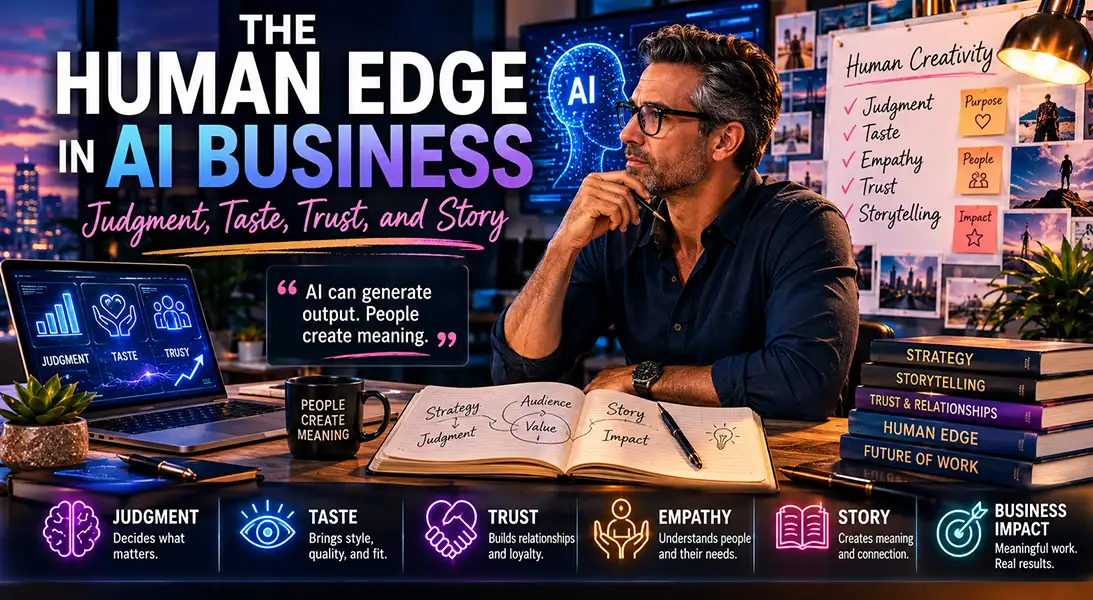
The Human Edge in AI Business: Judgment, Taste, Trust, and Story
AI is becoming more capable every day. It can write, design, summarize, analyze, generate, automate, and assist with work that once took hours, teams, and specialized skills.
For businesses, this creates a major opportunity. AI can help people move faster, reduce friction, explore ideas, produce content, and build smarter workflows.
But as AI becomes more powerful, one thing becomes even more important: the human edge.
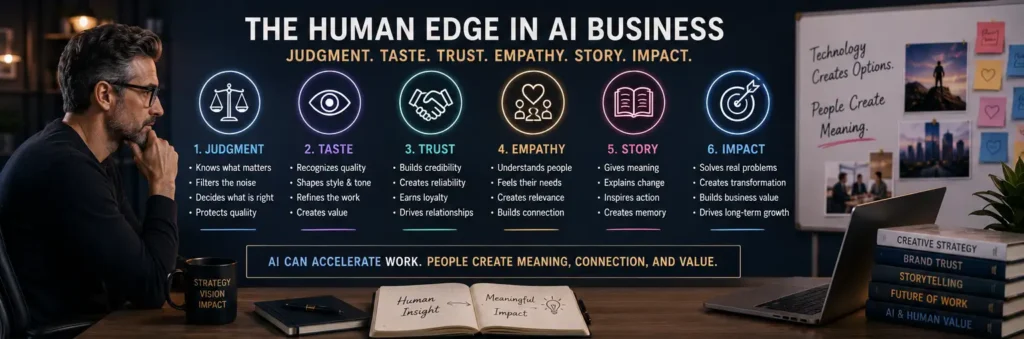
The human edge is not simply the ability to use AI tools. It is the ability to bring judgment, taste, trust, empathy, storytelling, and strategic direction to the work those tools help create.
AI can generate output. But people create meaning.
AI can produce options. But people decide what matters.
AI can accelerate work. But people build trust.
That is why the future of AI business will not only belong to people who know how to use tools. It will belong to people who know how to use tools with human intelligence.
The Human Edge in AI Starts With Judgment
Judgment is the ability to know what is useful, what is true, what fits, what should be removed, what should be improved, and what should never be published.
This matters because AI can generate a lot of material very quickly. It can produce headlines, articles, scripts, visuals, campaign ideas, sales copy, email sequences, social posts, summaries, and presentations. But more output creates a new problem.
Someone still has to decide what is good.
Someone has to decide what is accurate. Someone has to decide what is on-brand. Someone has to decide what feels generic. Someone has to decide what connects to the audience and what misses the point.
That is judgment.
In the AI business era, judgment becomes a leadership skill. It helps businesses avoid noise, protect quality, and turn AI-generated material into work that actually supports the brand, the customer, and the business goal.
AI Can Create Options, But Taste Creates Value
Taste is one of the most underrated business advantages.
Taste is not just about style. It is about knowing what feels right for the moment, the audience, the brand, the message, and the emotional tone of the work.
A person with strong taste can look at ten AI-generated options and understand which one has potential. They can see what feels flat, what feels forced, what feels too generic, what needs refinement, and what might connect if it is shaped properly.
AI can generate a polished image, but taste decides whether it feels premium or cheap. AI can write a strong sentence, but taste decides whether it sounds human or mechanical. AI can suggest campaign ideas, but taste decides which one has emotional power.
This is why creative experience still matters. People who have spent years building brands, producing media, developing stories, directing teams, shaping campaigns, and understanding audiences bring something deeper than prompt knowledge.
They bring taste.
Trust Is the Real Business Currency
AI can help businesses create faster, but faster content does not automatically create trust.
Trust comes from consistency, clarity, honesty, usefulness, proof, perspective, and experience. It comes from showing people that you understand their world, their problems, their goals, and their concerns.
A business can use AI to create hundreds of posts and still fail to build trust if the message feels empty or disconnected.
This is important because trust is one of the most valuable assets a business can build. People do not buy only because they saw content. They buy because they believe the business understands them and can help them solve a real problem.
AI can help support trust-building, but it cannot replace the human responsibility behind it.
Businesses need to use AI in ways that strengthen trust, not weaken it. That means reviewing accuracy, protecting brand voice, avoiding generic claims, being transparent when needed, and making sure the work actually serves the audience.
Empathy Makes AI Work More Human
Empathy is the ability to understand what another person may be feeling, needing, fearing, or trying to accomplish.
In business, empathy helps create better customer experiences, clearer messages, stronger offers, and more meaningful content.
AI can analyze patterns and generate language, but empathy helps determine what should be said, how it should be said, and what the audience needs to feel understood.
This matters because people are not only looking for information. They are looking for relevance. They want to know, “Is this for me? Does this person understand my problem? Can this business help me move forward?”
Empathy helps answer those questions.
A business that combines AI with empathy can create content that is faster and more thoughtful. It can build systems that are efficient without becoming cold. It can communicate at scale while still sounding human.
Storytelling Helps People Understand Change
Storytelling is one of the strongest parts of the human edge in AI business.
People use stories to understand change. They use stories to make sense of problems, decisions, identity, opportunity, and the future. A good story helps people see where they are, where they could go, and why the journey matters.
AI can help produce story drafts, structures, hooks, and examples. But human storytelling brings lived experience, emotion, perspective, meaning, and truth.
In a world where content becomes easier to generate, story becomes more important because story gives content a reason to be remembered.
Facts inform people. Stories move people.
Businesses that understand this will use AI to support storytelling, not flatten it. They will use AI to explore ideas, but they will use human experience to shape the message into something that connects.
The Human Edge Protects Originality
As more businesses use the same tools, originality becomes harder and more valuable.
AI can often produce work that sounds smooth, polished, and professional. But polished is not the same as original. A business can sound good and still sound like everyone else.
Originality comes from point of view. It comes from experience, perspective, risk, taste, values, and the ability to say something in a way that feels specific.
This is where businesses need human leadership. They need people who can ask:
- What do we actually believe?
- What do we see that others are missing?
- What experience gives us a different perspective?
- What should our audience remember about us?
- What is our unique way of explaining this?
Those questions protect originality. They help a business avoid becoming another generic voice in an AI-generated crowd.
AI Business Still Needs Leadership
One of the biggest misunderstandings about AI is that it removes the need for leadership.
It does not. It changes what leadership needs to focus on.
AI business needs leaders who can make decisions, set standards, guide teams, create systems, protect quality, and connect technology to value.
That means asking better questions before using AI:
- What problem are we solving?
- What outcome are we trying to create?
- What should AI support?
- Where is human review required?
- What standards protect trust?
- How does this create value for the audience?
- How does this support the business model?
AI can be a powerful engine, but leadership decides where the engine should go.
The Human Edge Is Not Anti-AI
The human edge is not about rejecting AI. It is about using AI wisely.
The businesses that succeed will not be the ones pretending AI does not matter. They will also not be the ones blindly automating everything without thought.
The strongest businesses will combine AI capability with human intelligence.
They will use AI for speed, research, production, variation, automation, and analysis. They will use human creativity for judgment, taste, trust, empathy, storytelling, ethics, and strategic direction.
That combination is powerful because it gives businesses both leverage and meaning.
How to Build the Human Edge Into AI Workflows
The human edge should not be left to chance. It should be built into the workflow.
A strong AI business workflow should include human checkpoints at the most important stages:
- Before creation: Define the audience, goal, strategy, and message.
- During creation: Guide the AI with clear context and strong direction.
- After generation: Review for accuracy, originality, tone, and brand fit.
- Before publishing: Check whether the work builds trust and supports the business goal.
- After publishing: Measure what connected and improve the system.
This approach helps businesses use AI without losing the human qualities that make the work valuable.
Final Thought
The future of AI business will not be defined only by faster tools. It will be defined by better judgment.
AI can create more, but people must decide what matters. AI can generate options, but people must bring taste. AI can help scale communication, but people must build trust. AI can support content, but people must tell stories that mean something.
The human edge is not disappearing. It is becoming more important.
The businesses that combine AI capability with judgment, taste, trust, and story will create work that is not only faster, but more meaningful, more memorable, and more valuable.
Want to follow this conversation? Read more on the Curtis Randall B-Log, explore resources on My Creative Gear, or connect through the Contact page.