
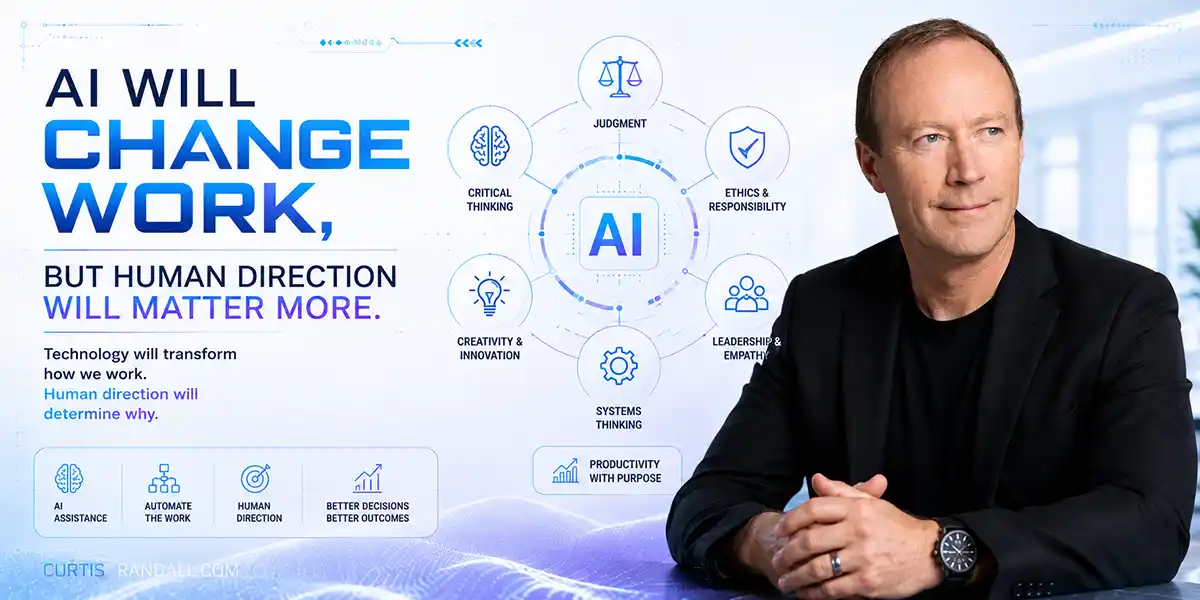
AI Will Change Work, But Human Direction Will Matter More
Artificial intelligence will change work. That part is no longer a serious debate.
AI is already changing how people research, write, design, code, communicate, analyze, automate, plan, serve customers, create content, and make decisions. It is moving into offices, creative workflows, business operations, education, finance, healthcare, marketing, media, and almost every knowledge-based industry.
But the bigger question is not whether AI will change work. The bigger question is what humans will still be responsible for when the tools become more powerful.
My view is simple: AI will change work, but human direction will matter more.
The future will not belong only to people who know how to use AI tools. It will belong to people who know what to do with them. People who can ask better questions, define better outcomes, make better decisions, build better systems, and understand the human consequences of the technology they use.
AI can generate. Humans still need to direct.
AI Is Becoming Part of the Operating System of Work
For many people, AI still feels like a tool they open when they need help writing something, brainstorming ideas, or summarizing information. That is useful, but it is only the beginning.
AI is becoming part of the operating system of work itself.
It can support research, automate repetitive tasks, improve customer communication, generate reports, analyze data, help build presentations, support software development, create images, draft documents, organize knowledge, and speed up decision-making. Over time, more work will happen through AI-assisted systems rather than isolated AI tools.
The World Economic Forum’s Future of Jobs Report 2025 highlights how AI, information processing, robotics, automation, and other technology shifts are expected to reshape jobs, skills, and workforce strategies. The message is clear: people and businesses need to prepare for a new kind of work environment.
But preparation does not mean using AI randomly. It means understanding how AI changes the system around the work.
Productivity Is Not the Same as Direction
One of the main promises of AI is productivity. AI can help people move faster, reduce repetitive work, generate options, and complete tasks more efficiently.
There is evidence that AI can improve productivity in certain workplace settings. A study by Erik Brynjolfsson, Danielle Li, and Lindsey Raymond on generative AI at work found that access to an AI conversational assistant increased productivity for customer support agents, with particularly notable gains for less experienced and lower-skilled workers.
That is important. Productivity matters.
But productivity alone is not direction.
AI can help you write faster, but it cannot decide what you should stand for. It can help you create more content, but it cannot decide what message will build trust. It can generate ideas, but it cannot decide which ideas deserve to exist. It can analyze data, but it cannot fully understand your values, relationships, brand, culture, timing, or long-term goals.
Speed is useful only when it is moving in the right direction.
This is why human direction becomes more important as AI becomes more powerful.
The Human Role Moves Upstream
As AI takes on more execution-level work, the human role moves upstream.
Instead of only doing tasks, people will need to spend more time defining problems, setting direction, designing systems, reviewing outputs, managing risk, applying judgment, and deciding what matters.
This changes the nature of value.
The most valuable people will not simply be the fastest producers. They will be the clearest thinkers. They will know how to frame a problem, guide an AI system, evaluate quality, protect trust, communicate meaning, and connect work to a larger objective.
In other words, the value moves from doing every step manually to understanding the system well enough to direct it.
This matters for individuals, teams, businesses, creators, consultants, leaders, and educators. Everyone will need to ask a better question: what is the human contribution when AI can assist with more of the work?
AI Needs Judgment
AI can produce confident outputs that are incomplete, biased, inaccurate, generic, or misaligned with the situation. That means human judgment is not optional.
Judgment is the ability to know what matters, what is missing, what is risky, what is appropriate, what is useful, and what should be rejected.
The OECD notes that AI can bring workplace benefits such as higher productivity, improved job quality, and stronger occupational safety and health, while also creating risks around automation, loss of agency, bias, discrimination, privacy, and transparency through its AI and work research.
This is exactly why human judgment matters. The more AI enters important workflows, the more people need to understand how to evaluate what it produces.
AI can assist with information. Humans need to decide what is responsible.
AI Needs Context
Context is one of the most underrated human advantages.
AI can process massive amounts of information, but it does not live inside your business, your community, your relationships, your history, your market timing, your reputation, your values, or your audience trust in the same way a human does.
Context helps people understand what is appropriate, what is sensitive, what is strategically useful, and what could create unintended consequences.
A technically correct answer can still be wrong for the situation. A polished message can still damage trust. A fast decision can still miss the human reality. A clever campaign can still feel tone-deaf. A data-driven recommendation can still ignore the relationship behind the decision.
This is why human direction matters. Someone needs to understand the world around the work.
AI Needs Taste and Quality Control
As AI-generated content increases, taste becomes more valuable.
Taste is the ability to recognize quality, clarity, originality, timing, emotional tone, visual balance, message strength, and audience fit. It is the difference between content that is technically complete and content that actually lands.
This matters because the internet is about to become even more crowded with average content. AI makes it easier to produce something. It does not automatically make that thing worth someone’s attention.
The people who win will not be the people who generate the most. They will be the people who know what to keep, what to improve, what to delete, what to publish, and what to build into something more valuable.
That is taste. That is quality control. That is human direction.
AI Needs Ethics
AI also raises ethical questions that cannot be ignored.
How should AI-generated work be disclosed? How should businesses protect customer data? How should creators handle intellectual property? How should leaders prevent bias? How should people avoid manipulation, misinformation, impersonation, and low-quality automation?
These questions are not side issues. They are central to whether AI builds trust or destroys it.
As AI becomes easier to use, the temptation will be to automate without thinking. But not everything that can be automated should be automated. Not everything that can be generated should be published. Not everything that can be optimized should be pursued.
Ethics is part of direction.
People and businesses that use AI responsibly will have an advantage because trust will become more valuable in a world full of synthetic output.
AI Needs Systems Thinking
One of the biggest mistakes people make with AI is treating it as a collection of tricks.
A prompt here. A tool there. A shortcut somewhere else. That may create small wins, but it does not create lasting advantage.
The bigger opportunity is systems thinking.
Systems thinking asks how AI fits into a larger workflow. What comes before the AI step? What happens after? Who reviews the result? What data is used? What risks exist? How is quality maintained? How does the output connect to the business goal? How does the system improve over time?
McKinsey has explored how generative AI can affect future jobs and workflows, including the need for upskilling, reskilling, and changes in how companies organize work. The point is not only that AI can perform tasks. The point is that AI can reshape workflows.
People who understand workflows will have a stronger advantage than people who only understand tools.
The Best AI Users Will Be Better Problem Framers
In the AI era, problem framing becomes a key skill.
The quality of AI output often depends on the quality of the question, context, constraints, examples, and direction provided. This means people need to become better at defining what they want before asking AI to produce it.
Better problem framers ask:
- What are we actually trying to solve?
- Who is this for?
- What outcome matters?
- What constraints should guide the work?
- What risks need to be avoided?
- What information does the system need?
- What does quality look like?
- How will we know if the answer is useful?
These questions are not technical tricks. They are leadership questions.
AI may produce the output, but humans still need to frame the problem.
Human Creativity Becomes More Strategic
AI will change creativity, but it will not remove the need for creative direction.
In fact, creative direction may become more important because there will be more options than ever. AI can generate dozens of headlines, layouts, scripts, images, concepts, and campaign directions quickly. But more options can also create more confusion.
Someone still needs to decide what is right.
That decision requires taste, experience, strategy, emotional intelligence, cultural awareness, brand understanding, and the ability to connect ideas to business outcomes.
This is where my background in creative leadership continues to shape how I see AI. The value was never only in making things. The real value was always in knowing what should be made, why it matters, who it is for, and how it should move people.
That kind of direction becomes even more important in the age of AI.
The Future Worker Becomes a Director of Systems
The future worker will increasingly become a director of systems.
That does not mean everyone becomes a manager. It means more people will need to understand how to coordinate tools, data, workflows, platforms, content, customers, automation, and human judgment.
A writer may direct an AI-assisted publishing system. A designer may direct a visual exploration system. A consultant may direct a research and strategy system. A teacher may direct a learning system. A founder may direct a business operating system. A creator may direct a media and product system.
This is a major shift. People will need to move beyond “I do the task” toward “I understand the outcome and can direct the system that produces it.”
That is where the future of work is heading.
What People Should Build Now
If AI will change work and human direction will matter more, then people should start building direction skills now.
Start with these areas:
- AI literacy: Understand what AI can do, what it cannot do, and where it creates risk.
- Problem framing: Learn how to define clear outcomes, context, and constraints.
- Systems thinking: Understand how tools fit into larger workflows.
- Judgment: Practice evaluating quality, accuracy, usefulness, and risk.
- Communication: Learn how to explain ideas clearly across people and platforms.
- Ethics: Understand privacy, bias, transparency, disclosure, and trust.
- Creative direction: Develop taste, point of view, and quality control.
- Ownership: Build assets, knowledge bases, websites, frameworks, and content libraries you control.
The future of work will not reward people who blindly use AI. It will reward people who use AI with direction.
This Is Also a Wealth Creation Conversation
AI and future work are also connected to wealth creation.
People who understand how to use AI wisely can create more leverage. They can build better systems, publish more effectively, improve services, create digital products, document expertise, automate parts of their work, and build assets around what they know.
But again, the advantage is not simply using AI. The advantage is using AI to create value that lasts.
That could mean building a website, email list, product library, course, consulting system, research process, media platform, or knowledge base. It could mean using AI to support a business instead of just producing more content. It could mean turning experience into assets instead of leaving it trapped in one job or one client relationship.
In the future digital economy, wealth creation will increasingly depend on the ability to combine human direction with intelligent tools.
Final Thought
AI will change work. It will change tasks, workflows, roles, expectations, productivity, and opportunity.
But AI does not remove the need for human direction. It increases it.
The more powerful the tools become, the more important it is to know what should be done, why it matters, who it affects, what risks exist, and what kind of future the work is helping to build.
AI can generate options. Human direction decides what matters.
That is why the future of work will not belong only to people who use AI. It will belong to people who can direct AI with judgment, creativity, ethics, systems thinking, and purpose.
Explore More
Read more future-focused articles on the Curtis Randall B-Log, explore the broader future digital economy on Sights.com, or reach out through the Contact page.

About the Author
Curtis Randall is an award-winning creative executive and future systems thinker helping people and businesses understand the future of work, technology, digital ownership, and creativity. Through CurtisRandall.com, and Sights.com, Curtis explores the systems shaping how people work, create, own, and build value in a rapidly changing world.
Connect with Curtis: LinkedIn · YouTube · Instagram · X · TikTok · Facebook · Threads