
The New Wealth Stack: Skills, Systems, Ownership, and Technology
Wealth creation is changing.
For a long time, people were taught to think about wealth through a fairly traditional lens: earn income, save money, invest wisely, buy assets, build a business, or own property. Those ideas still matter. They are not going away. But they are no longer the full picture.
The future digital economy is creating a new model of value creation. Artificial intelligence is changing how work gets done. Digital platforms are changing how people build audiences and businesses. Blockchain is changing how people think about ownership and verification. Digital products are changing how knowledge becomes income. Future finance is changing how people understand money, assets, risk, and opportunity.
This is why I believe people need a new way to think about wealth creation.
I call it the new wealth stack.
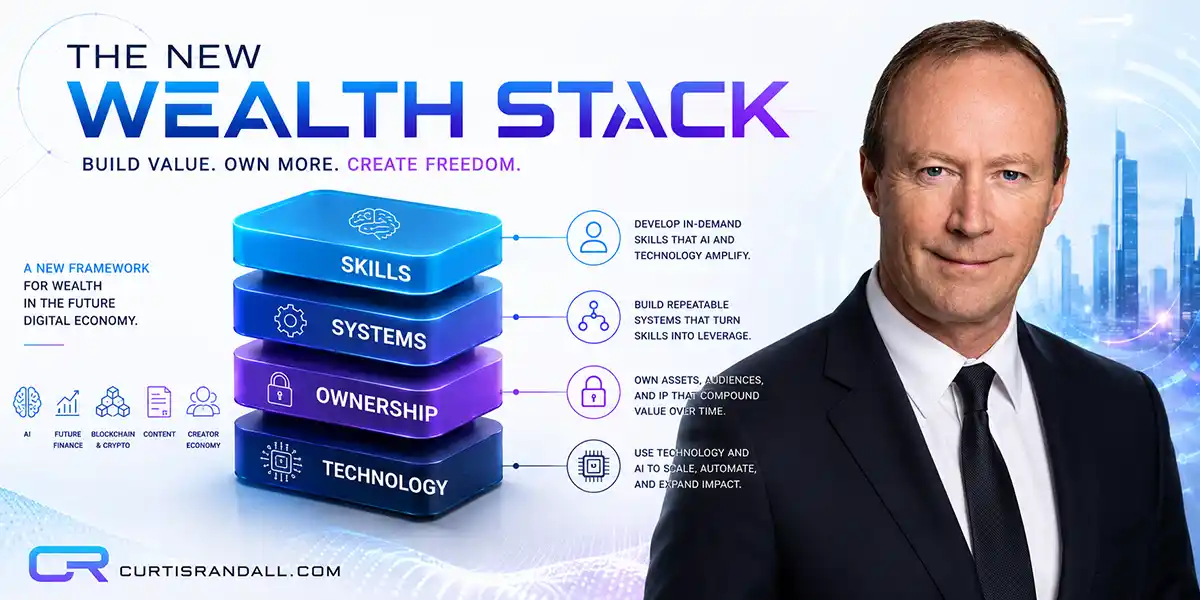
The new wealth stack is built on four layers: skills, systems, ownership, and technology. Each layer matters on its own, but the real power comes from how they connect.
The future will reward people who understand how to build skills, turn those skills into systems, use systems to create assets, and use technology to scale value.
What Is the New Wealth Stack?
The new wealth stack is a simple framework for understanding how people can create value in a changing economy.
It has four core layers:
- Skills: What you know how to do.
- Systems: How you turn skills into repeatable outcomes.
- Ownership: What you build and control over time.
- Technology: The tools and infrastructure that increase your leverage.
This framework matters because many people focus on only one layer. Some focus only on skills. Some focus only on tools. Some chase platforms. Some chase investments. Some chase trends. But wealth creation is rarely built from one isolated activity.
Wealth creation is usually built through connected systems.
A skill can create income. A system can make that income repeatable. Ownership can turn that system into an asset. Technology can increase the speed, scale, and reach of the asset.
That is the new wealth stack in action.
Layer One: Skills
Skills are still the foundation.
Even in an AI-powered world, people need useful skills. They need to know how to think, communicate, write, lead, sell, analyze, design, teach, manage, research, build, present, negotiate, and solve problems.
The mistake is assuming that technology makes skills less important. In reality, technology often makes strong skills more valuable because it gives skilled people more leverage.
A person who knows how to communicate clearly can use AI to produce, test, and refine ideas faster. A person who understands strategy can use AI to explore better options. A person who understands design can use AI tools to accelerate visual exploration. A person who understands business can use automation to improve workflows and reduce friction.
The World Economic Forum’s Future of Jobs Report 2025 highlights how changing technology, AI, automation, and economic shifts are transforming the skills needed for the future of work.
This is the first lesson of the new wealth stack: do not stop building skills.
But also do not stop at skills.
A skill by itself can help you earn. A skill connected to a system can help you build.
Why Skills Alone Are Not Enough
Many people become highly skilled but remain trapped inside one income model. They trade time for money. They depend on one employer, one client, one role, one platform, or one marketplace.
That can work for a while, but it can also create fragility.
If the job changes, income changes. If the client leaves, income changes. If the platform changes, visibility changes. If the market changes, demand changes.
This is why the next layer matters.
Skills need to become systems.
Layer Two: Systems
Systems are how skills become repeatable.
A system is a process, structure, workflow, method, framework, or operating model that helps produce a consistent result.
If you know how to write, a content system can turn writing into articles, videos, newsletters, social posts, lead magnets, and digital products. If you know how to teach, an education system can turn knowledge into lessons, courses, workshops, and paid resources. If you know how to consult, a client system can turn expertise into audits, strategy sessions, retainers, and frameworks.
This is where many people miss the opportunity.
They have knowledge, but no system. They have experience, but no process. They have ideas, but no publishing engine. They have expertise, but no product path. They have credibility, but no ownership structure.
Systems turn ability into leverage.
On CurtisRandall.com, this is one of the ideas I keep returning to: the future belongs to people who understand systems. On Sights.com, I explore this through the broader lens of the future digital economy.
A System Can Turn Knowledge Into Assets
One of the biggest differences between income and wealth is whether value disappears after the work is done.
If you are paid once for a task and nothing remains, that is income. Income matters, but it is limited.
If the work creates something reusable, sellable, searchable, teachable, or ownable, it can become an asset.
An article can become part of a content library. A process can become a framework. A framework can become a product. A product can become a course. A course can become a community. A community can become a business. A business can become an asset.
That is why systems are so important.
Systems help skills compound.
Layer Three: Ownership
Ownership is where the new wealth stack becomes more powerful.
Skills help you create value. Systems help you repeat value. Ownership helps you keep more of the value you create.
Ownership can take many forms. It can be a website, domain, email list, content library, digital product, intellectual property, course, book, framework, community, brand, business, software workflow, investment account, digital asset, or blockchain-based ownership position.
The key idea is control.
If everything you build lives only inside someone else’s platform, your future is more fragile. If your audience only exists on social media, your reach depends on algorithms. If your business depends on one marketplace, your income depends on rules you do not control. If your expertise is never turned into assets, your knowledge may not create the long-term value it could.
This is why digital ownership matters.
It gives people more control, more resilience, and more options.
Ownership Is Not the Same as Access
The digital world gives people access to more tools than ever. But access is not the same as ownership.
You can access a platform without owning the audience. You can access software without owning the system. You can post content without owning the distribution. You can rent attention without building an asset.
Ownership asks a different question: what remains when the platform changes?
Do you own your domain? Do you own your email list? Do you own your content library? Do you own your frameworks? Do you own your customer relationships? Do you own your intellectual property? Do you own assets that can keep creating value?
These questions are becoming more important in the age of AI, platform dependency, digital finance, and changing work.
The future will not only reward people who create. It will reward people who create and own.
Layer Four: Technology
Technology is the layer that increases leverage across the entire stack.
AI can improve productivity. Automation can reduce repetitive work. Websites can organize authority. Email platforms can build direct relationships. Content platforms can increase reach. Analytics can improve decisions. Blockchain can support new forms of verification and ownership. Digital payment systems can expand access to customers and markets.
But technology is not the starting point.
This is where many people get distracted. They chase tools before they understand the system. They buy software before they clarify the strategy. They use AI before they know what outcome they want. They explore crypto before they understand risk. They build content before they know what asset they are creating.
Technology should amplify direction, not replace it.
The OECD has noted that AI can bring benefits to the workplace, including higher productivity and improved job quality, while also creating an urgent need for skills development and adaptation through its future of work research.
That is the right way to think about technology. It creates opportunity, but people still need understanding, judgment, and practical systems.
AI Is Leverage, Not a Strategy
AI may be the most powerful technology layer in the new wealth stack, but it is not a strategy by itself.
AI can help research topics, draft content, organize ideas, create outlines, generate visuals, summarize information, support automation, improve customer communication, analyze data, and accelerate production.
McKinsey’s research on generative AI and future jobs and workflows explores how generative AI can affect productivity, skills, tasks, and the need for upskilling and reskilling.
The opportunity is real, but the lesson is not “use AI for everything.” The lesson is to use AI where it strengthens the stack.
Use AI to improve skills. Use AI to support systems. Use AI to help create assets. Use AI to increase speed, clarity, and production quality. But do not use AI as a substitute for thinking.
AI can help you move faster. It cannot decide what kind of future you should build.
Blockchain and Crypto Fit Inside the Ownership Layer
Blockchain and crypto should be understood inside the ownership layer of the new wealth stack.
The useful conversation is not only about prices, speculation, or hype. The more important conversation is about digital ownership, custody, verification, transfer, tokenisation, smart contracts, identity, and future finance.
This is why education matters. Digital assets can involve serious risks, including volatility, fraud risk, platform risk, custody risk, and the possibility of loss. The SEC’s Investor.gov resource on crypto asset custody basics is a useful reminder that people need to understand how crypto assets are held, protected, and transferred before they participate.
Blockchain and crypto should not be treated as shortcuts to wealth. They should be treated as part of a larger education around ownership and financial systems.
In the new wealth stack, crypto is not the whole story. It is one part of the ownership and future finance conversation.
The New Wealth Stack Is Not About Getting Rich Quickly
It is important to be clear: the new wealth stack is not about quick money, hype, or shortcuts.
There is no guaranteed path. There is risk in business, investing, digital products, platforms, AI tools, and crypto assets. People need education, discipline, patience, and good judgment.
The new wealth stack is about understanding how value is changing so people can make better decisions.
It is about learning useful skills. Building repeatable systems. Creating owned assets. Using technology wisely. Understanding risk. Building resilience. Creating more options over time.
That is a much more mature conversation than chasing trends.
How the Stack Works Together
The power of the new wealth stack is in the connection between the layers.
Here is a simple example.
A person has experience in a specific field. That is the skill layer. They begin documenting what they know through articles, videos, and guides. That becomes the system layer. They publish those ideas on a website they own and build an email list. That becomes the ownership layer. They use AI, automation, design tools, analytics, and digital commerce platforms to improve production, distribution, and monetization. That becomes the technology layer.
Over time, that person may build authority, products, a community, consulting offers, speaking opportunities, or educational resources.
The result is not just content. It is a value system.
This is what many people need to understand. The future is not only about having better tools. It is about building better stacks.
Why This Matters for People and Businesses
For individuals, the new wealth stack provides a way to think beyond job titles. It helps people ask what they know, what they can build, what they can own, and how technology can help them create more leverage.
For businesses, the same idea applies. A company needs skilled people, repeatable systems, owned assets, and smart technology. A business that depends only on paid attention, rented platforms, disconnected tools, or outdated workflows becomes vulnerable.
The stack creates clarity.
It helps people and businesses see where they are strong and where they are exposed. Maybe they have skills but no systems. Maybe they have systems but no ownership. Maybe they have technology but no strategy. Maybe they have assets but no distribution.
Once you can see the stack, you can improve it.
How to Start Building Your Own Wealth Stack
The new wealth stack does not need to be complicated. The best starting point is to ask better questions.
Start with the skills layer:
- What do I know that is useful to others?
- What skills are becoming more valuable in the future of work?
- What skills can AI amplify rather than replace?
Then look at the systems layer:
- How can I turn my knowledge into a repeatable process?
- What workflow can help me publish, teach, sell, or serve more consistently?
- What can I document so the value does not disappear after one use?
Then examine the ownership layer:
- Do I own my domain, website, audience relationship, and content library?
- What digital products, frameworks, assets, or intellectual property can I build?
- Where am I too dependent on platforms I do not control?
Then apply the technology layer:
- How can AI help me move faster without lowering quality?
- What automation can reduce repetitive work?
- What digital tools help me create, publish, sell, protect, or measure value?
These questions will not build wealth overnight. But they can change how you think about work, opportunity, ownership, and the future.
The Future Belongs to People Who Build Better Stacks
The future will not reward people simply for being busy. It will reward people who understand how value is created and how systems connect.
Skills matter. Systems matter. Ownership matters. Technology matters. But the real advantage is understanding how they work together.
This is why the new wealth stack is important. It gives people a practical way to think about wealth creation in the future digital economy.
Not as hype. Not as speculation. Not as a promise. But as a framework for building value, resilience, and freedom over time.
Final Thought
The new wealth stack is built on skills, systems, ownership, and technology.
Skills help you create value. Systems help you repeat value. Ownership helps you keep value. Technology helps you scale value.
That is the opportunity of the future digital economy.
The future belongs to people who understand how to build skills, create systems, own assets, and use technology wisely.
That is how wealth creation is changing. And that is why the new wealth stack matters.
Explore More
Read more future-focused articles on the Curtis Randall B-Log, explore the broader future digital economy on Sights.com, or reach out through the Contact page.

About the Author
Curtis Randall is an award-winning creative executive and future systems thinker helping people and businesses understand the future of work, technology, digital ownership, and creativity. Through CurtisRandall.com, and Sights.com, Curtis explores the systems shaping how people work, create, own, and build value in a rapidly changing world.
Connect with Curtis: LinkedIn · YouTube · Instagram · X · TikTok · Facebook · Threads