
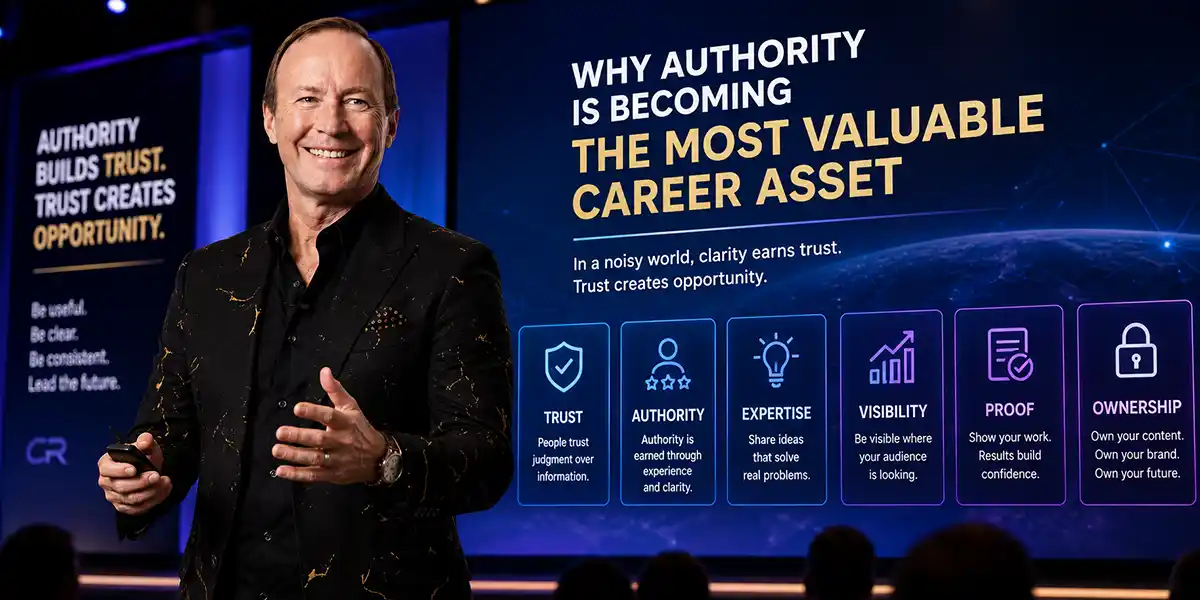
Why Authority Asset Is Becoming the Most Valuable Career Asset
Authority Asset is becoming one of the most valuable career assets a person can build.
In the past, career value was often defined by experience, job title, education, resume history, company reputation, client list, or technical skill. Those things still matter. But in a digital, AI-powered, platform-driven world, they are no longer enough on their own.
People need to be trusted before they are chosen. They need to be understood before they are hired. They need to be visible before they are invited. They need to show how they think before others decide whether they want to work with them.
That is where authority comes in.
Authority is not the same as popularity. It is not the same as attention. It is not the same as having a large following. Authority is the trust people place in your judgment, experience, clarity, and point of view.
In the future of work, authority will matter more because people and businesses are surrounded by more information, more content, more automation, more noise, and more uncertainty than ever before.
What Makes Authority a Career Asset?
A career asset is something that continues to create opportunity over time.
A skill can be a career asset. A network can be a career asset. A reputation can be a career asset. A body of work can be a career asset. A personal brand can be a career asset. Authority brings many of these together.
Authority becomes an asset when your name, ideas, experience, content, and judgment begin to create opportunity before you enter the room.
It can lead to clients, consulting, speaking invitations, partnerships, media opportunities, product sales, advisory roles, leadership opportunities, and stronger professional trust.
That is why authority is more than image. It is infrastructure.
It gives people a reason to listen, a reason to trust, and a reason to come back.
AI Is Making Authority More Important
Artificial intelligence is changing how information is created, distributed, and consumed.
AI can help generate articles, images, summaries, videos, outlines, research notes, emails, reports, and social posts. That creates leverage, but it also creates saturation.
When more people can produce content quickly, the internet does not automatically become more useful. It becomes louder. More content does not always mean more clarity. More output does not always mean more trust.
This is why authority matters.
People will need trusted voices. They will need people who can explain change clearly, filter noise, apply judgment, and connect ideas to real-world decisions.
The World Economic Forum’s Future of Jobs Report 2025 highlights analytical thinking, resilience, flexibility, agility, leadership and social influence, and AI and big data among important future skills. That is important because authority is built from more than knowledge. It is built from the ability to think clearly, adapt, communicate, and influence responsibly.
AI may make content easier to produce, but it makes trusted human judgment more valuable.
Attention Is Not Authority
One of the biggest mistakes people make is confusing attention with authority.
Attention is being noticed. Authority is being trusted.
Attention can come from controversy, entertainment, repetition, trends, or platform mechanics. Authority comes from consistency, clarity, proof, experience, usefulness, and judgment.
Attention can disappear quickly. Authority tends to compound.
This distinction matters in the future digital economy because platforms reward attention, but careers are built on trust. A person can have visibility without credibility. A person can have followers without influence. A person can create content without creating confidence.
Authority is what turns visibility into opportunity.
Trust Is Becoming More Valuable in a Noisy World
Trust is becoming more valuable because people are overloaded with information.
They see more content than they can process. They hear more claims than they can verify. They face more tools, platforms, opinions, trends, and risks than they can evaluate alone.
The 2025 Edelman Trust Barometer surveyed 33,000 respondents across 28 countries, showing how seriously trust is being studied across institutions, business, media, and society. Edelman
In a low-trust, high-noise environment, authority becomes a filter.
People look for someone who can explain what matters, what is changing, what is risky, what is useful, and what they should pay attention to next.
This is where authority becomes valuable. It reduces uncertainty. It creates confidence. It helps people make decisions.
Thought Leadership Is Becoming a Business Development Tool
Authority is not only useful for career positioning. It can also become a business development tool.
When someone consistently shares useful ideas, explains complex topics clearly, and demonstrates how they think, they make it easier for others to trust them before a sales conversation ever happens.
The 2025 Edelman-LinkedIn B2B Thought Leadership Impact Report describes thought leadership as a strategic tool for building trust, driving alignment, and opening doors where ads and traditional sales methods can fall short. Edelman and LinkedIn
That point matters for executives, consultants, founders, advisors, creators, professional service providers, and experts. Authority content can help people understand your thinking before they decide whether to reach out.
In other words, authority can shorten the distance between visibility and trust.
Authority Needs a Point of View
Authority is not built by repeating what everyone else is saying.
It requires a point of view.
A point of view does not mean being loud or extreme. It means having a clear way of seeing the world. It means connecting your experience, observations, research, and judgment into a perspective that helps others understand something better.
For me, that perspective is increasingly centered on the systems shaping the future digital economy: future work, artificial intelligence, digital ownership, future finance, creator economy, media, and wealth creation.
Those subjects are not separate. They are connected. AI changes work. Work connects to income. Income connects to ownership. Ownership connects to wealth creation. Media builds trust. Trust creates opportunity. Technology changes the systems around all of it.
Authority grows when people can clearly see what you stand for and why your perspective matters.
Authority Needs Proof
Authority also needs proof.
Proof can come from experience, results, case studies, awards, client history, projects, frameworks, articles, talks, videos, research, testimonials, products, or a consistent body of work.
People do not trust authority just because someone claims it. They trust authority when they can see evidence of thinking, experience, and contribution.
This is one reason a personal authority hub matters. Pages like Awards, long-form B-Log articles, speaking topics, project pages, and content libraries help create context around your expertise.
Authority is not only what you say about yourself. It is what your body of work proves over time.
Authority Needs Ownership
Authority becomes more powerful when it is connected to digital ownership.
If all of your authority exists only inside social feeds, it is fragile. Social platforms are useful for reach, but they are not enough. Algorithms change. Posts disappear. Reach fluctuates. Platforms prioritize different formats. Audiences become harder to contact directly.
Owned authority means building assets you control.
That can include your website, domain, email list, article library, frameworks, digital products, books, courses, newsletters, videos, podcasts, and intellectual property.
This is why I treat CurtisRandall.com as my personal authority hub and Sights.com as a broader education platform for the future digital economy. Social platforms help distribute ideas. Owned platforms help preserve and organize them.
Authority becomes stronger when people can find, understand, and return to your best thinking.
Media Noise Makes Clear Voices More Valuable
The media environment is becoming more fragmented.
People get information from news sites, social platforms, newsletters, podcasts, short videos, influencers, AI summaries, search engines, private communities, and recommendation systems. That creates choice, but it also creates confusion.
The Reuters Institute’s Digital News Report 2025 describes traditional news media as struggling with declining engagement, low trust, and stagnant digital subscriptions. That broader environment matters because people are looking for clearer, more reliable voices in a fragmented media world.
This creates an opportunity for people who can communicate clearly and responsibly.
Authority is not about pretending to know everything. It is about becoming useful in a world where people need clarity.
Authority Makes You Easier to Understand
One practical benefit of authority is that it makes you easier to understand.
People are busy. They do not have time to decode who you are, what you know, what you believe, what you offer, and why they should trust you.
Authority content helps answer those questions before someone asks them.
A clear body of work can show your perspective, your subjects, your experience, your values, your communication style, and your ability to guide others. That makes it easier for the right people to say, “This person understands the issues I care about.”
In a world of AI-generated sameness, clarity becomes a differentiator.
Authority Supports Career Freedom
Authority can also create more career freedom.
When people trust your thinking, you are less dependent on constantly proving yourself from zero. Your ideas can travel ahead of you. Your articles can introduce you. Your videos can explain your perspective. Your website can show your credibility. Your frameworks can demonstrate your value.
That can lead to advisory work, speaking, consulting, partnerships, media opportunities, products, communities, and new forms of income.
This connects directly to wealth creation. Authority is not just about reputation. It can become a value system. It can support products, services, opportunities, and ownership.
The point is not to become famous. The point is to become trusted for something useful.
How to Build Authority as a Career Asset
Building authority does not happen overnight. It comes from repeated signals of clarity, usefulness, and credibility.
Here are practical starting points:
- Choose your lane: Be clear about the subjects you want to be known for.
- Develop a point of view: Do not only report trends. Explain what they mean.
- Publish consistently: Articles, videos, newsletters, podcasts, and talks create a body of work.
- Build owned media: Use social platforms for reach, but organize your best thinking on a website you control.
- Show proof: Use experience, projects, awards, case studies, frameworks, and examples.
- Create useful frameworks: Authority grows when people can understand and repeat your ideas.
- Connect ideas clearly: Help people see patterns, not just isolated facts.
- Build trust before selling: Make your thinking valuable before asking for attention or business.
Authority is built when people repeatedly experience your clarity.
Authority Is Not About Ego
There is sometimes discomfort around the word authority because people associate it with ego, status, or self-promotion.
That is not the kind of authority I mean.
Real authority is service. It helps people understand something they are struggling to make sense of. It brings clarity to complexity. It reduces uncertainty. It shares experience. It creates trust. It gives people better language for the future they are trying to navigate.
In that sense, authority is not about being above people. It is about being useful to people.
The Future Belongs to Trusted Guides
The next decade will be shaped by AI, automation, digital ownership, future finance, creator platforms, changing work, and new media systems.
Most people will not have the time or energy to study all of it deeply. They will look for trusted guides who can help them understand what matters.
That creates an important opportunity for people who can explain the future with clarity and responsibility.
The trusted guide will become more valuable because the world is becoming harder to navigate.
This is why authority is becoming a career asset. It helps people know why they should listen to you, what you stand for, and how your thinking can help them move forward.
Final Thought
Authority is becoming one of the most valuable career assets because trust is becoming harder to earn and more important to keep.
AI will create more content. Platforms will create more noise. Media will become more fragmented. Work will continue changing. People will need clearer voices, stronger judgment, and trusted guidance.
The future will reward people who can turn experience into clarity, clarity into trust, and trust into opportunity.
That is why authority matters. And that is why authority is becoming one of the most valuable career assets a person can build.
Explore More
Read more on the Curtis Randall B-Log, explore future-focused education on Sights.com, or connect through the Contact page.

About the Author
Curtis Randall is an award-winning creative executive and future systems thinker helping people and businesses understand and adapt to the future of work, creativity, technology, digital ownership, and wealth creation. Through CurtisRandall.com and Sights.com, Curtis explores the systems shaping how people work, create, own, and build value in a rapidly changing world.
Connect with Curtis: LinkedIn · YouTube · Instagram · X · TikTok · Facebook · Threads