
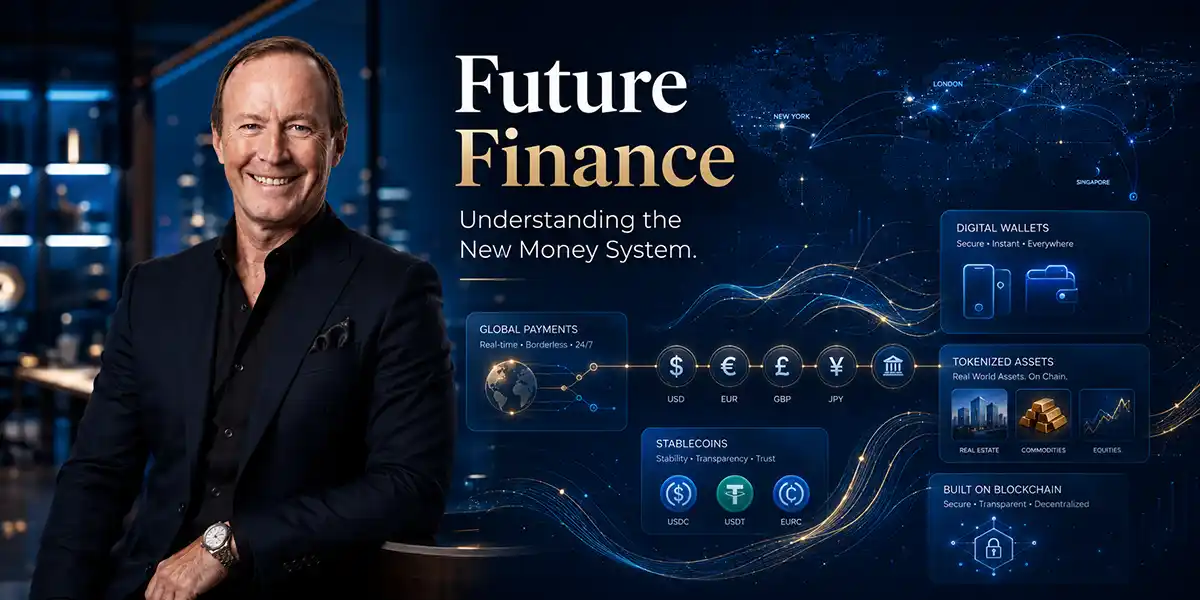
Future Finance: Why Everyone Needs to Understand the New Money System
Future finance is no longer something only bankers, investors, technologists, or policy experts need to understand.
The way money moves is changing. The way people pay is changing. The way assets are represented is changing. The way financial services are delivered is changing. Digital wallets, stablecoins, tokenisation, blockchain infrastructure, online investing platforms, AI finance tools, embedded payments, and digital banking are all becoming part of a larger shift.
This does not mean the old financial system disappears overnight. It does not mean every new technology is better. It does not mean every crypto project is useful. But it does mean people need to understand where money, ownership, and technology are heading.
That is why future finance matters.
The new money system will affect work, business, investing, payments, digital ownership, wealth creation, and everyday financial decision-making. People who understand it will be better prepared. People who ignore it may find themselves reacting to changes they could have seen coming.
What Is Future Finance?
Future finance is the evolution of money, payments, assets, banking, investing, ownership, and financial infrastructure through digital technology.
It includes traditional finance becoming more digital. It includes financial technology making services faster and more accessible. It includes blockchain-based systems introducing new models of ownership and settlement. It includes AI tools helping people analyze information, manage workflows, detect fraud, and personalize financial services.
Future finance is not one technology. It is a system of change.
That system includes:
- Digital payments
- Digital wallets
- Stablecoins
- Tokenised assets
- Blockchain rails
- AI financial tools
- Online investing platforms
- Embedded finance
- Digital banking
- Financial literacy for a digital world
The important point is that money is becoming more programmable, more connected, more data-driven, more platform-based, and more digital.
Why the New Money System Matters
Most people interact with money every day, but very few stop to think about the systems behind it.
When you tap a phone to pay, move money between apps, receive money online, buy digital products, invest through a platform, hold crypto assets, or subscribe to a creator business, you are participating in a changing financial system.
The financial system is no longer only about banks, cards, cash, and investment accounts. It is increasingly connected to software, identity, data, platforms, apps, automation, blockchain infrastructure, and digital ownership.
This matters because financial systems shape opportunity. They influence who can participate, how fast money moves, what assets people can access, how businesses get paid, how creators monetize, how investors manage risk, and how people build wealth over time.
If work is becoming digital, ownership is becoming digital, and business is becoming digital, then finance must also become part of the future digital economy conversation.
Digital Payments Are the First Layer
For many people, the most visible change in finance is digital payments.
People no longer only pay with cash or physical cards. They use phones, watches, apps, online checkout systems, payment links, subscriptions, peer-to-peer transfers, creator platforms, digital wallets, and embedded payment tools.
This shift has made payments more convenient, but it has also created new risks. People need to understand privacy, fraud, scams, fees, overspending, data collection, platform dependency, and cybersecurity.
The OECD’s work on digital payments and digital financial literacy highlights that higher levels of digital financial literacy can help consumers understand both the benefits and risks of using digital payments. That is important because convenience can make money feel invisible, and invisible money can lead to careless decisions.
Digital payments are not just a technical upgrade. They are a behavioral shift.
Digital Wallets Are Becoming Financial Hubs
Digital wallets are also becoming more important.
At first, many people thought of digital wallets as a way to store cards on a phone. But wallets can become much more than that. They can hold payment methods, loyalty cards, digital IDs, tickets, credentials, crypto assets, tokenized assets, memberships, and eventually more forms of digital ownership.
This matters because wallets may become one of the main interfaces people use to interact with the new money system.
In traditional finance, accounts were often centered around banks. In future finance, wallets may become the interface layer that connects payments, identity, assets, access, rewards, ownership, and financial services.
That does not mean every wallet will be safe or useful. It means people need to understand what wallets do, how they store information, what they control, who operates them, what protections exist, and what risks are involved.
Stablecoins Are Changing the Payments Conversation
Stablecoins are one of the most important areas to watch in future finance.
A stablecoin is a digital asset designed to maintain a stable value, often by being linked to a fiat currency such as the U.S. dollar. In theory, stablecoins can allow value to move faster, cheaper, and more globally than some traditional payment systems.
But stablecoins are not all the same. Their design, reserves, governance, regulation, issuer quality, transparency, and redemption rights matter enormously.
This is why stablecoins should not be discussed only as crypto assets. They should be discussed as part of the future of payments, financial infrastructure, and digital money.
The opportunity is speed and programmability. The risk is trust, regulation, reserves, liquidity, and system design.
People need to understand both sides.
Tokenisation Could Change How Assets Are Represented
Tokenisation is another major future finance idea.
Tokenisation is the process of representing an asset or financial claim as a digital token on a shared ledger or blockchain-based system. In simple terms, it can turn something like money, bonds, real estate interests, funds, securities, or other financial claims into programmable digital representations.
The Bank for International Settlements has described tokenisation as part of a next-generation monetary and financial system, including the potential combination of tokenised central bank reserves, tokenised commercial bank money, and tokenised government bonds within trusted financial infrastructure.
The IMF has also written about tokenization as a shift that allows money, securities, and derivatives to be represented as programmable digital tokens recorded on shared ledgers.
This is important because tokenisation could affect settlement, liquidity, transparency, access, and how financial markets operate. It may also create new risks around governance, regulation, cyber security, interoperability, and market structure.
The key takeaway is not that every asset should be tokenised. The key takeaway is that financial infrastructure is being reimagined.
Blockchain Is Infrastructure, Not Just Speculation
Blockchain is often discussed through price speculation, market cycles, and crypto headlines. That is understandable, but it is too narrow.
The more important future finance question is whether blockchain-based systems can support new forms of settlement, digital ownership, verification, custody, smart contracts, and programmable value.
Some projects will fail. Some will be poorly designed. Some will be speculative. Some will be regulated out of existence. But some of the underlying ideas may become part of future financial infrastructure.
That is why blockchain education matters.
People do not need to believe every claim made by the crypto industry. They do need to understand what blockchain is trying to solve, where it may be useful, where it creates risk, and how it connects to digital ownership and future finance.
AI Will Also Reshape Finance
Artificial intelligence is becoming part of the new money system as well.
AI can help financial institutions detect fraud, analyze risk, automate customer support, personalize services, improve compliance workflows, process data, and support decision-making. For individuals, AI tools may help with budgeting, research, education, scenario planning, and financial organization.
The World Economic Forum’s Future of Jobs Report 2025 highlights AI and information processing technologies as major forces reshaping work and skills. Finance will not be separate from that shift.
However, AI in finance also raises concerns. People need to think about bias, privacy, transparency, data quality, overreliance, fraud, cybersecurity, and the limits of automated advice.
AI can support better financial decisions, but it should not replace personal responsibility, professional guidance, or risk awareness.
Future Finance Requires Better Financial Literacy
The more digital finance becomes, the more financial literacy matters.
People still need to understand the basics: income, expenses, savings, debt, interest, investing, taxes, risk, diversification, time horizon, and long-term planning.
But now they also need to understand digital wallets, online scams, phishing, platform risk, crypto custody, payment security, subscriptions, financial apps, digital identity, stablecoins, tokenised assets, and AI-driven financial tools.
This is where many people are vulnerable. They may be comfortable using apps, but not fully understand the financial risks behind them. They may use crypto platforms without understanding custody. They may invest through digital tools without understanding risk. They may use payment apps without understanding privacy or fraud exposure.
Future finance is not only about new technology. It is about helping people make better decisions in a more digital financial world.
The New Money System Creates Opportunity and Risk
It is important to be balanced.
The new money system can create opportunity. Payments can become faster. Digital tools can become more accessible. Financial products can become more flexible. Tokenisation may improve certain market processes. AI may help people and institutions analyze information more effectively. Digital ownership may create new forms of value.
But the same system can create risk. Scams can move faster. Fraud can become more sophisticated. Bad actors can exploit confusion. Platforms can fail. Private keys can be lost. Poorly designed tokens can collapse. Regulation can change. AI tools can give inaccurate or misleading outputs.
This is why education has to come before participation.
Future finance should not be approached with fear, but it should also not be approached with blind optimism.
The right approach is informed caution.
Why Businesses Need to Understand Future Finance
Businesses need to understand future finance because payments, customer behavior, financial tools, and digital ownership are all changing.
A business may need to accept new payment methods. It may need to protect customer data. It may need to understand subscriptions, digital wallets, international payments, creator commerce, online fraud, AI-assisted finance tools, and tokenisation opportunities.
For digital businesses, this becomes even more important. Online products, memberships, courses, subscriptions, creator platforms, and digital services all depend on payment infrastructure and trust.
Future finance is not just a back-office issue. It is part of customer experience, business model design, trust, growth, and resilience.
Why Individuals Need to Understand Future Finance
Individuals need to understand future finance because more of their financial lives will happen through digital systems.
People will use digital wallets, online banks, investing apps, payment platforms, subscription services, digital identity systems, AI tools, crypto platforms, and global marketplaces. They will also increasingly build income through digital work, creator businesses, remote services, digital products, and online assets.
This creates a new responsibility.
People need to know how money moves, where risk lives, what they control, what they do not control, and how technology changes financial behavior.
Future finance is not just about investing. It is about everyday decision-making in a digital economy.
The Connection Between Future Finance and Wealth Creation
Future finance connects directly to wealth creation.
Wealth creation is not only about making more money. It is about building value, protecting value, owning assets, understanding risk, and making better decisions over time.
In the future digital economy, wealth creation may include income from work, digital products, online businesses, content systems, intellectual property, investing, digital assets, ownership positions, and technology-enabled opportunities.
That means people need financial literacy, digital literacy, and systems thinking together.
Money is becoming more digital. Assets are becoming more digital. Work is becoming more digital. Ownership is becoming more digital.
People who understand those connections will be better prepared for the future.
What People Should Start Learning Now
The best way to prepare for future finance is not to chase every new trend. It is to build a stronger foundation.
Start by learning:
- How digital payments work
- How digital wallets are used
- How to spot financial scams and phishing attempts
- How stablecoins work and what risks they carry
- What tokenisation means
- How blockchain custody works
- How AI may affect financial tools
- How digital platforms influence spending and investing behavior
- How to protect accounts, passwords, devices, and identity
- How to connect financial literacy with digital ownership
This kind of education does not make someone an expert overnight. But it helps people become more prepared, less vulnerable, and more thoughtful about the systems they use.
Final Thought
Future finance is about more than new apps, faster payments, stablecoins, tokenisation, or blockchain systems.
It is about the new money system that is forming around digital technology, ownership, platforms, data, AI, and financial infrastructure.
This system will create opportunity, but it will also create risk. That is why people need education, not hype. They need curiosity, not fear. They need financial literacy, digital literacy, and systems thinking.
The future of finance belongs to people who understand how money, technology, ownership, and value are becoming connected.
That is why everyone needs to understand the new money system.
Explore More
Read more on the Curtis Randall B-Log, explore future-focused education on Sights.com, or connect through the Contact page.

About the Author
Curtis Randall is an award-winning creative executive and future systems thinker helping people and businesses understand and adapt to the future of work, creativity, technology, digital ownership, and wealth creation. Through CurtisRandall.com and Sights.com, Curtis explores the systems shaping how people work, create, own, and build value in a rapidly changing world.
Connect with Curtis: LinkedIn · YouTube · Instagram · X · TikTok · Facebook · Threads