
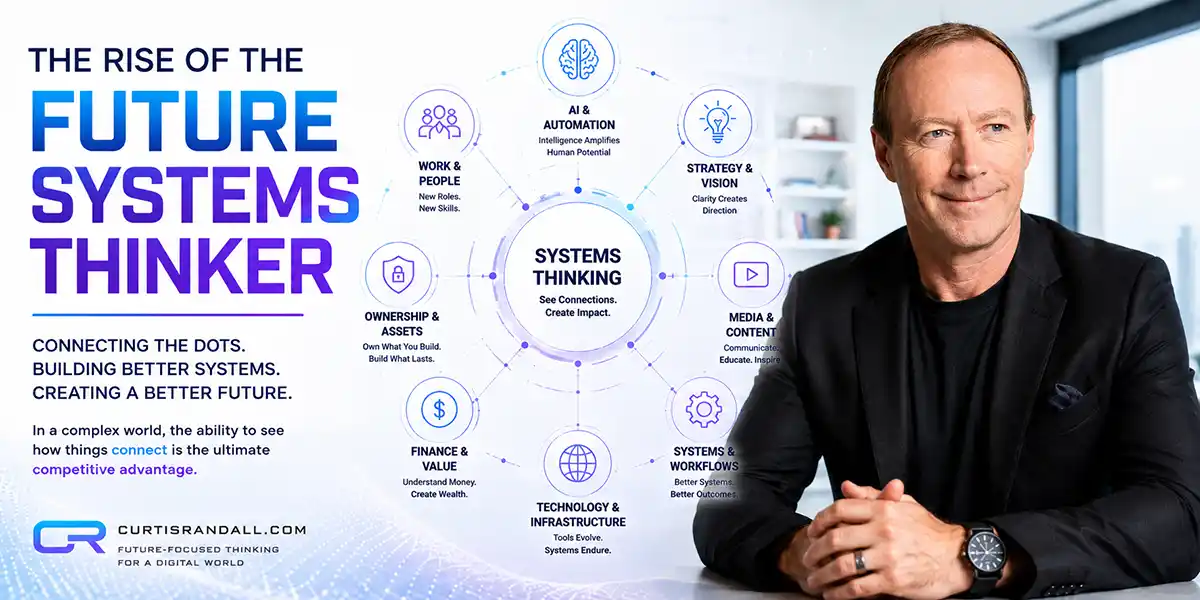
The Rise of the Future Systems Thinker
The future of work is not only changing because of artificial intelligence. It is changing because the world itself is becoming more connected, more digital, more automated, and more complex.
Jobs are no longer shaped by one skill, one tool, or one industry in isolation. Today, work increasingly sits at the intersection of technology, communication, ownership, strategy, systems, and human judgment.
This is why I believe one of the most valuable people in the coming years will be the future systems thinker.
The future systems thinker is not simply a specialist in one area. They are a person who can see how things connect. They understand how AI affects workflows, how content supports authority, how ownership creates leverage, how technology changes behavior, and how better systems create better outcomes.
In a world filled with powerful tools, rising complexity, and constant disruption, the people who can connect the dots will become incredibly valuable.
What Is a Future Systems Thinker?
A future systems thinker is someone who understands how multiple forces work together to shape results. Instead of looking at problems in isolation, they look at the wider system around the problem.
They ask questions like:
- How does this technology affect the workflow?
- How does this workflow affect people?
- How does this change the business model?
- How does ownership affect long-term value?
- How do media, trust, and communication influence results?
- What happens if one part of the system changes?
That way of thinking is becoming more important because the modern economy is no longer made up of simple, isolated parts. AI connects to productivity. Productivity connects to business. Business connects to digital assets. Digital assets connect to ownership. Ownership connects to wealth creation. Wealth creation connects to education, behavior, technology, and access.
The future systems thinker sees the whole picture.
Why the Future Systems Thinker Matters Now
The need for the future systems thinker is growing because we are entering a new operating environment.
Artificial intelligence is not just another tool. It is changing how information is gathered, how tasks are completed, how decisions are supported, and how businesses operate. At the same time, digital ownership is becoming more important, personal brands are turning into digital assets, and new forms of media and finance are transforming how value is created.
The World Economic Forum’s Future of Jobs Report 2025 makes it clear that technological change, AI, automation, and broader economic shifts are reshaping work and the skills people need to stay relevant.
But many people still approach this shift in fragments. They ask how to use AI. They ask how to build content. They ask how to stay visible. They ask how to monetize expertise. These are all useful questions, but they often miss the bigger issue.
The bigger issue is how all of these parts fit together.
That is why systems thinking matters more now than ever before.
The Future Systems Thinker Sees Connections Others Miss
One of the most important strengths of the future systems thinker is the ability to see connections other people miss.
For example, many people look at AI and think only about productivity. A future systems thinker sees much more. They see that AI affects skills, team structure, creative direction, trust, quality control, customer expectations, digital products, and long-term business models.
Many people look at content and think only about marketing. A future systems thinker sees that content can also be authority, distribution, education, community building, brand development, intellectual property, and a digital asset.
Many people look at blockchain or crypto and think only about speculation. A future systems thinker sees digital ownership, tokenisation, transfer of value, smart contracts, and future finance.
This broader perspective creates better decisions. It reduces short-term thinking. It helps people build stronger foundations instead of chasing disconnected tactics.
Systems Thinking Is Becoming a Core Future Work Skill
As the future of work evolves, systems thinking is becoming a core skill rather than a nice extra.
The OECD’s research on the future of work shows that technology, labor markets, education, and institutions are being reshaped in ways that demand adaptability and a broader view of change. In other words, people need more than technical skill. They need the ability to understand change across systems.
That means knowing how different pieces affect each other:
- How AI changes team roles
- How automation changes workflow design
- How digital media changes trust and authority
- How ownership affects resilience and long-term value
- How technology influences decision-making
- How strategy shapes what tools should be used
The people who understand those relationships will be better equipped for leadership, consulting, entrepreneurship, education, media, and advisory roles.
A Future Systems Thinker Understands AI Beyond the Hype
One of the reasons the future systems thinker will be so valuable is because AI is creating both opportunity and confusion.
There is a tendency to talk about AI as if it is the answer to everything. But AI is not a strategy. It is a capability. Its value depends on the system around it.
McKinsey’s work on generative AI and future jobs and workflows highlights the potential for major productivity changes, while also making clear that work, tasks, and organizational systems will need to adapt.
A future systems thinker understands this. They do not simply ask, “What tool should I use?” They ask:
- What problem are we solving?
- Where does AI fit in the workflow?
- Who checks the output?
- What human judgment is still required?
- What risks are introduced?
- How does this improve the system rather than just speed up one task?
This is a much more mature approach to AI, and it is the kind of thinking businesses increasingly need.
The Future Systems Thinker Connects Creativity and Strategy
For years, many organizations separated creativity from strategy, and strategy from systems. That divide makes less sense in the world we are moving into.
Today, content creation, media, business growth, AI workflows, customer experience, and authority building are all deeply connected. Creativity still matters, but creativity without direction often leads to waste. Strategy still matters, but strategy without execution often goes nowhere. Systems still matter, but systems without human understanding can become rigid and lifeless.
The future systems thinker brings these worlds together. They understand that great outcomes often come from combining human creativity, structured thinking, better tools, and a long-term view of value.
That is why this way of thinking is not only useful for businesses. It is also valuable for creators, founders, educators, consultants, media leaders, and anyone building a modern authority platform.
Ownership Is Part of Systems Thinking
A strong future systems thinker also understands ownership.
Many people focus on producing work without thinking about what they actually own. They post content on platforms they do not control. They build audiences without capturing relationships. They create value without turning it into assets.
Systems thinking changes that perspective. It asks where value lives, who controls it, and what remains over time.
This is why digital ownership matters. A website, an email list, a content library, a framework, a product, a course, a community, or intellectual property can all become part of a long-term value system. These are not just outputs. They are assets.
If you want to build resilience in the future digital economy, you need to think beyond activity and toward ownership.
On the B-Log, I often return to this idea: the future will reward people who not only create, but also organize, own, and direct what they create.
The Future Systems Thinker Builds Better Decisions
Another reason the future systems thinker matters is because better systems lead to better decisions.
When people think in fragments, they often optimize the wrong thing. They may focus on speed but ignore trust. They may focus on scale but ignore quality. They may focus on visibility but ignore ownership. They may adopt tools without understanding behavior. They may build workflows that are efficient but not meaningful.
Systems thinking introduces balance. It helps people see trade-offs, dependencies, and consequences. It forces better questions. It improves alignment between goals, tools, people, and outcomes.
In a business context, this can improve strategy. In a media context, it can improve authority. In a personal context, it can improve career direction and wealth creation.
Why the Future Systems Thinker Will Be an Authority Figure
As the world becomes more complex, authority will shift toward people who can explain complexity clearly.
That is one of the reasons the future systems thinker is not just a useful operator, but also a powerful authority figure.
People are looking for guidance. They want help understanding how AI connects to work, how digital assets create opportunity, how technology is changing industries, and how they can build resilience in uncertain times.
The people who can translate these changes clearly and strategically will stand out.
This is also why authority content matters. Articles, videos, talks, interviews, podcasts, and frameworks all help document a point of view. They turn insight into assets and trust into opportunity.
That is part of the work I am building through CurtisRandall.com and Sights.com — helping people understand the systems shaping the future digital economy.
How to Become a Future Systems Thinker
Becoming a future systems thinker does not mean you need to know everything. It means you need to learn how to connect things better.
Here are a few practical starting points:
- Study relationships, not just topics. Learn how AI connects to business, media, education, ownership, and work.
- Think in workflows. Stop looking only at tools. Understand the full process around them.
- Develop strategic curiosity. Ask why something matters, not just how it works.
- Build a broad knowledge base. Technology, content, finance, behavior, and communication increasingly overlap.
- Practice long-term thinking. Look at how today’s decisions create tomorrow’s opportunities or risks.
- Create frameworks. Turning knowledge into frameworks improves clarity and authority.
- Own your ideas. Publish them, organize them, and build assets around them.
The future systems thinker is not passive. They are intentional. They learn continuously, connect ideas clearly, and build structures that help others move forward.
The Future Systems Thinker and Wealth Creation
This type of thinking also connects directly to wealth creation.
Why? Because wealth is increasingly created through systems, not isolated activity.
Skills matter, but skills become more powerful when they are part of repeatable systems. Content matters, but content becomes more valuable when it becomes an owned media library. Technology matters, but technology becomes more useful when it supports real strategy. Attention matters, but attention becomes more durable when it turns into trust and ownership.
The future systems thinker understands how to connect these layers. That is why this mindset can support not just better work, but also better long-term value creation.
If you want to understand this idea more deeply, you may also want to explore the broader themes around the future digital economy and strategic direction through the rest of my work.
Final Thought
The rise of the future systems thinker reflects a deeper truth about where the world is heading.
The future will not only reward people who know how to use tools. It will reward people who understand how systems work. People who can connect AI, work, ownership, creativity, strategy, media, and technology into something meaningful will have a powerful advantage.
The future systems thinker will be one of the most valuable people in the future digital economy because they can turn complexity into clarity and change into opportunity.
That is a role worth building toward.
Explore More
Read more on the Curtis Randall B-Log, explore future-focused education on Sights.com, or connect through the Contact page.

About the Author
Curtis Randall is an award-winning creative executive and future systems thinker helping people and businesses understand and adapt to the future of work, creativity, technology, digital ownership, and wealth creation. Through CurtisRandall.com and Sights.com, Curtis explores the systems shaping how people work, create, own, and build value in a rapidly changing world.
Connect with Curtis: LinkedIn · YouTube · Instagram · X · TikTok · Facebook · Threads