
Smart Contracts Explained: How Digital Agreements Could Change Business
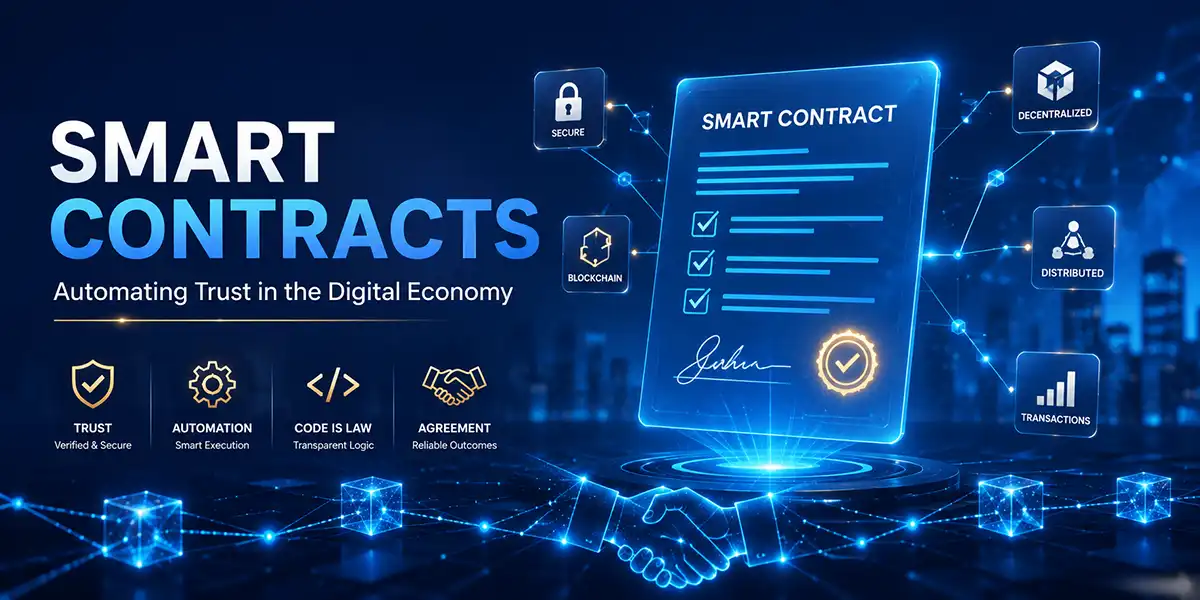
Smart contracts are one of the most important ideas to understand in the future digital economy.
They are often discussed inside crypto and blockchain conversations, but the bigger idea is not only about cryptocurrency. Smart contracts are about digital agreements, automation, ownership, access, payments, verification, and trust.
In simple terms, a smart contract is a piece of code that can help execute an agreement on a blockchain when certain conditions are met.
That sounds technical, but the basic idea is practical: if this happens, then that happens.
If a payment is made, access can be granted. If a digital asset is sold, ownership can transfer. If a royalty condition is triggered, payment can be distributed. If a membership token is held, a user can enter a private digital experience.
This does not mean smart contracts replace lawyers, business judgment, regulation, or human trust. It does not mean every agreement should be automated. But smart contracts introduce a new way to think about how business agreements, digital ownership, and value exchange could work in a more connected digital economy.
This article is not legal, financial, or investment advice. It is a practical introduction to what smart contracts are, how they work, and why they matter.
What Is a Smart Contract?
A smart contract is a digital agreement written as code and deployed on a blockchain.
The purpose of a smart contract is to help enforce or execute certain rules automatically. Instead of relying only on manual processing, a smart contract can follow pre-set instructions when specific conditions are met.
A simple example might look like this:
- If a buyer sends the correct payment, then a digital asset transfers to the buyer.
- If a person owns a membership token, then they gain access to a private community.
- If a song is licensed through a digital system, then royalty payments can be distributed according to agreed percentages.
- If a supply chain record is verified, then the next step in the workflow can be triggered.
The smart contract does not need to “think” like a human. It simply follows the rules it was programmed to follow.
That is why smart contracts are powerful, but also why they need to be designed carefully. Code can automate rules, but the rules need to be clear, secure, and appropriate for the situation.
Why Smart Contracts Matter
Smart contracts matter because they change how people think about agreements in digital environments.
Most traditional agreements depend on a mix of paperwork, platforms, human approval, banks, payment processors, lawyers, administrators, and manual follow-up. That system can work, but it can also be slow, expensive, fragmented, and difficult to verify across different parties.
Smart contracts introduce the possibility of agreements that can be more programmable, transparent, and automated.
This matters in a digital economy where more value is moving through software, digital assets, online communities, creator products, memberships, licenses, data, payments, and blockchain-based systems.
The larger shift is this:
- Contracts are becoming more digital.
- Payments are becoming more programmable.
- Ownership records are becoming more verifiable.
- Access can be controlled through digital tokens or credentials.
- Business workflows can be connected to automated rules.
Smart contracts sit at the intersection of these changes.
Smart Contracts Are Not the Same as Traditional Legal Contracts
One of the biggest misunderstandings is assuming a smart contract is the same thing as a traditional legal contract.
They are related, but they are not always the same.
A traditional legal contract is usually a human-readable agreement that defines responsibilities, rights, obligations, remedies, jurisdiction, and legal consequences.
A smart contract is code that executes certain instructions on a blockchain.
Sometimes a smart contract may support a legal agreement. Sometimes it may automate part of a business process. Sometimes it may simply control access, payments, ownership, or digital asset transfer.
This distinction matters because code does not automatically understand context, fairness, intent, local law, or unusual circumstances. It does what it is programmed to do.
That is why smart contracts should be understood as digital execution tools, not magical replacements for legal thinking. For important business agreements, legal advice and proper documentation still matter.
How Smart Contracts Work in Simple Terms
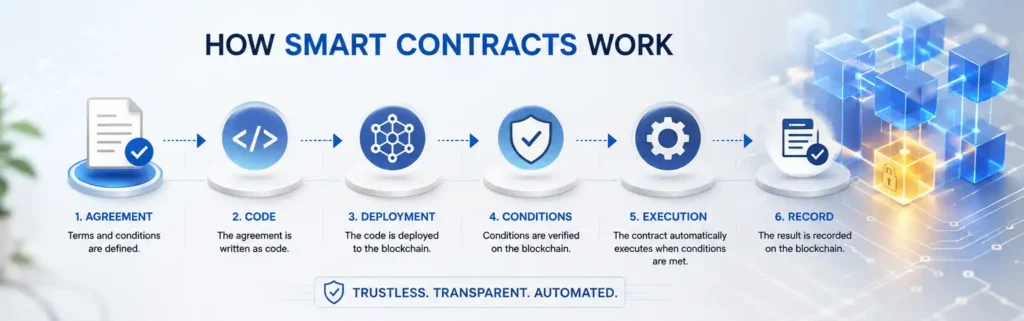
A smart contract usually follows a basic process:
- Rules are written: The agreement logic is turned into code.
- The contract is deployed: The code is placed on a blockchain network.
- Users interact with it: A person, business, wallet, or application triggers the contract.
- Conditions are checked: The contract verifies whether the required conditions are met.
- The action executes: The contract performs the programmed action, such as transferring a token, granting access, or recording a result.
- The result is recorded: The transaction becomes part of the blockchain record.
The simplest way to understand it is this:
A smart contract turns agreed rules into automated digital actions.
That is why smart contracts can be useful for certain types of digital business activity, especially where rules are clear and outcomes can be verified digitally.
Where Smart Contracts Could Be Used
Smart contracts can be used in many areas, but they are most useful where there are clear rules, digital assets, ownership records, access rights, payments, or repeatable processes.
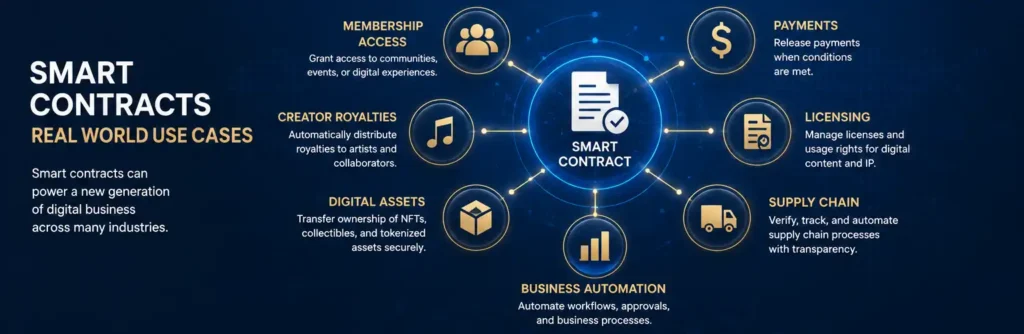
Possible use cases include:
- Digital asset sales: transferring ownership when payment is received.
- Creator royalties: distributing revenue based on programmed percentages.
- Membership access: granting access when someone holds a specific token or credential.
- Licensing: managing rights for digital media, music, art, writing, or software.
- Supply chains: triggering steps when goods, documents, or records are verified.
- Insurance: automating certain claims when verified conditions are met.
- Real estate and tokenized assets: supporting records, ownership, or fractional participation.
- Decentralized finance: powering lending, staking, swaps, and other blockchain-based financial activities.
- Business workflows: connecting payments, approvals, access, and records through programmable rules.
Not every use case will be practical, legal, or ready for mainstream adoption. But the underlying idea is important because it shows how agreements and business processes can become more programmable.
Smart Contracts and Digital Ownership
Smart contracts are closely connected to digital ownership.
In traditional digital systems, ownership is often controlled by platforms. A company may manage the account, the access, the records, the payments, and the rules.
In blockchain-based systems, smart contracts can help define and execute ownership-related actions more directly. They can support token transfers, access rights, digital collectibles, memberships, licenses, royalties, and asset records.
This is why smart contracts matter for creators, businesses, and digital asset owners. They can create new ways to manage value without relying entirely on traditional platform-controlled systems.
For example, a creator could use a smart contract to sell a digital collectible, provide access to a private community, or distribute royalties to collaborators. A business could use a smart contract to manage digital certificates, loyalty rewards, or tokenized access rights.
The important point is not that every creator or business needs to use smart contracts immediately. The important point is that smart contracts introduce a new ownership layer for digital systems.
Smart Contracts and Creator Business
Smart contracts could become important for creator business because creators are increasingly building digital products, communities, memberships, licensing systems, and intellectual property portfolios.
Creators are not only publishing content. They are building digital assets and business systems around their ideas, media, audience, and trust.
Smart contracts could support creator business in several ways:
- Automated royalty splits between collaborators.
- Token-based access to courses, communities, or events.
- Limited digital editions of media or educational products.
- Licensing agreements for digital content or creative assets.
- Membership passes connected to wallets.
- Proof of ownership for digital collectibles or certificates.
- Automated distribution of revenue from digital sales.
This connects directly to the future digital economy because creators are becoming media brands, educators, product owners, and digital asset builders.
Smart contracts may give creators new ways to manage access, ownership, royalties, and value exchange. But creators also need to understand the risks, costs, user experience challenges, and legal questions before using them.
Smart Contracts and Business Automation
Smart contracts also connect to automation.
In normal business operations, many processes require manual steps: approvals, payments, access changes, status updates, recordkeeping, verification, and reporting. Smart contracts can automate some of these actions when the conditions are clear and digitally verifiable.
This does not mean businesses should automate everything. Some decisions require judgment, negotiation, empathy, context, legal review, or human oversight.
But for certain repeatable processes, programmable agreements could reduce friction.
Examples might include:
- Automatic release of digital access after payment.
- Automatic distribution of royalties or partner payments.
- Automatic verification of membership or credential ownership.
- Automatic recording of asset transfers.
- Automatic triggering of workflow steps after a blockchain event.
When smart contracts are combined with AI, automation tools, digital identity, and payment systems, they could become part of a larger business automation layer.
The Risks and Limits of Smart Contracts
Smart contracts are powerful, but they are not risk-free.
Because smart contracts are code, mistakes in the code can create serious problems. Bugs, vulnerabilities, unclear rules, poor design, or malicious contracts can lead to financial loss, security issues, or unintended outcomes.
There are also practical and legal questions:
- What happens if the smart contract code has an error?
- Who is responsible if an automated outcome causes harm?
- How does a smart contract connect to traditional law?
- What if users do not understand what they are signing?
- How are disputes handled?
- How are privacy, compliance, and consumer protection managed?
- How do businesses protect users from scams or malicious contracts?
This is why smart contracts should not be treated casually. They need careful design, testing, auditing, legal review, and user education.
Technology can automate rules, but it cannot replace responsible decision-making.
Why Business Leaders Should Understand Smart Contracts
Business leaders do not need to become blockchain developers, but they should understand the basic idea of smart contracts.
The future digital economy will increasingly involve programmable systems: programmable money, programmable assets, programmable access, programmable identity, and programmable agreements.
Leaders who understand these concepts will be better prepared to evaluate opportunities, avoid hype, ask better questions, and think strategically about how digital value moves.
Important questions include:
- Could smart contracts reduce friction in this process?
- Is this agreement clear enough to automate?
- What still requires human judgment?
- What legal or compliance issues apply?
- How will users understand what they are signing?
- What security review is required?
- How does this connect to digital ownership or customer value?
Smart contracts are not the answer to every problem. But they are a signal of where digital business systems may be heading.
A Simple Framework for Understanding Smart Contracts
A practical way to understand smart contracts is through six ideas:
- Rules: The agreement logic is defined in advance.
- Code: The rules are written into a blockchain-based program.
- Trigger: A user, wallet, application, payment, or event activates the contract.
- Verification: The contract checks whether the required conditions are met.
- Execution: The contract performs the programmed action.
- Record: The result is recorded on the blockchain.
This framework keeps the concept simple. A smart contract is not magic. It is a programmable agreement system that can execute certain actions when clear conditions are met.
Final Thought
Smart contracts are important because they show how agreements can become more digital, programmable, and connected to ownership systems.
They can support payments, access, licensing, royalties, memberships, digital assets, tokenized value, and automated workflows. But they also require careful design, security, legal awareness, and responsible use.
In the future digital economy, smart contracts may become part of the infrastructure that connects digital ownership, creator business, blockchain, automation, and value exchange.
The future of business agreements may not be only written in documents. Some of it may be written into systems that can verify, execute, and record value automatically.
Want to follow this conversation? Read more on the Curtis Randall B-Log, explore resources on My Creative Gear, or connect through the Contact page.