
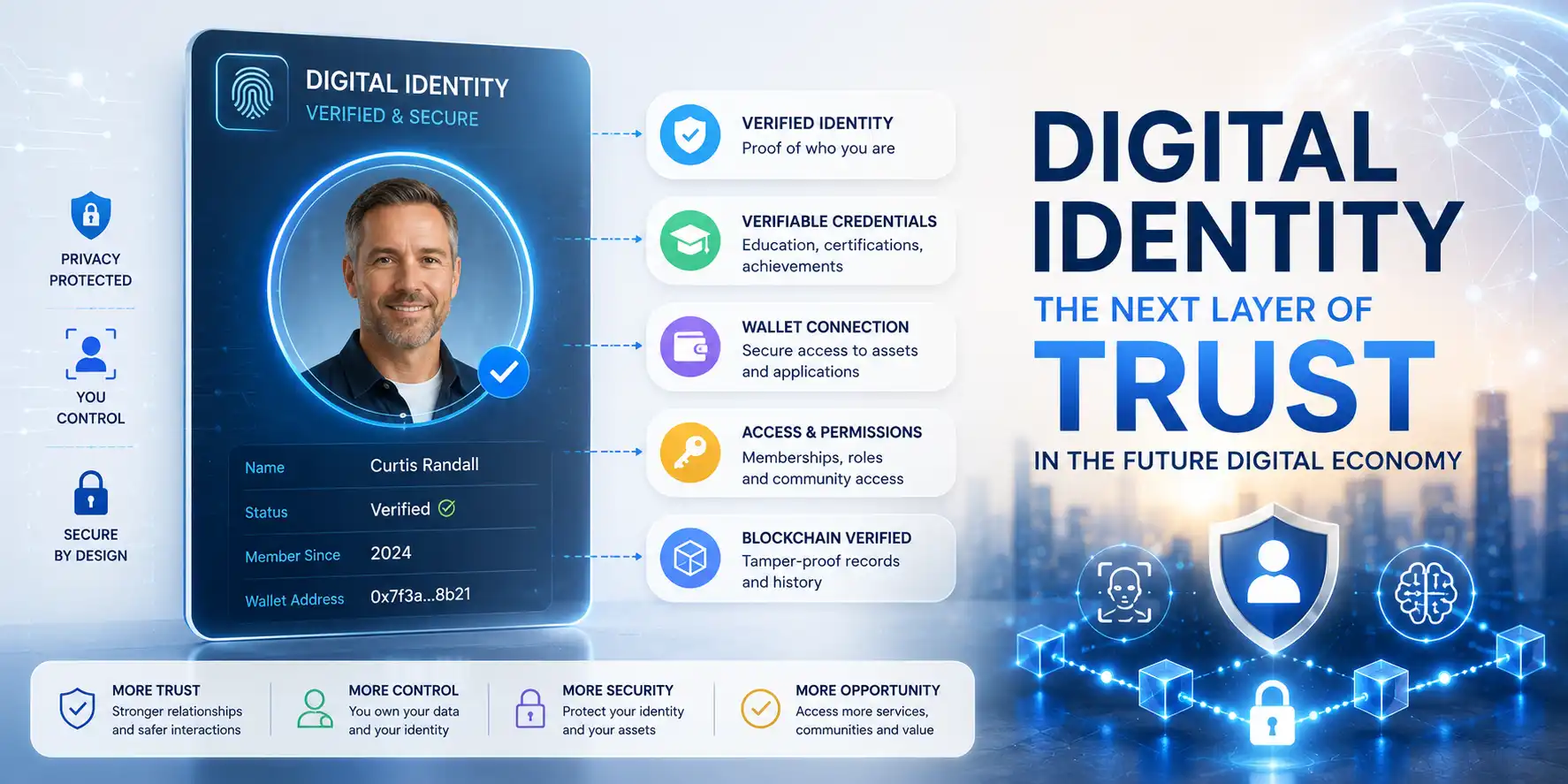
Digital Identity: The Next Layer of Trust in the Future Digital Economy
Digital identity is becoming one of the most important trust layers in the future digital economy.
As more of life, work, business, money, media, education, ownership, and communication moves online, people and organizations need better ways to prove who they are, what they own, what they have access to, and whether something is authentic.
This is becoming even more important as artificial intelligence makes it easier to generate content, images, voices, videos, messages, documents, and digital experiences. In a world where almost anything can be created or copied digitally, trust becomes harder to maintain.
Digital identity is part of the answer.
It is not just about logging into websites. It is about verification, reputation, credentials, ownership, access, privacy, security, and trust in digital systems.
In the future digital economy, digital identity may become as important as digital money, digital ownership, and digital assets because identity is what connects people, organizations, rights, access, and value.
What Is Digital Identity?
Digital identity is the information, credentials, records, signals, and verification systems that represent a person, organization, device, or entity in digital environments.
At a basic level, digital identity can include things like usernames, email addresses, passwords, profile information, phone numbers, account history, government IDs, payment accounts, and platform logins.
But the future of digital identity is much broader.
It may include wallet-based identity, verified credentials, professional reputation, digital certificates, ownership records, access rights, educational proof, membership status, transaction history, creator authenticity, and proof that a person or organization is who they claim to be.
A simple way to think about digital identity is this:
- Who are you?
- What can you prove?
- What do you own?
- What do you have access to?
- What can others trust?
Those questions are becoming more important as the digital economy grows.
Why Digital Identity Matters Now
Digital identity matters now because the online world is becoming more complex, automated, and harder to verify.
AI can create realistic content at scale. Bots can imitate people. Scams can become more sophisticated. Deepfakes can confuse audiences. Fake accounts can manipulate conversations. Digital assets can be copied, screenshotted, or misrepresented. Credentials can be exaggerated. Online trust can be damaged quickly.
At the same time, more business is happening digitally. People are buying digital products, joining online communities, using Web3 wallets, accessing online education, building personal brands, working remotely, using AI tools, and exchanging value across digital platforms.
This creates a trust problem.
If we cannot verify identity, ownership, access, credentials, or authenticity, digital systems become less reliable.
Digital identity helps create a foundation for trust. It gives people and organizations better ways to verify relationships, permissions, assets, credentials, and participation in digital environments.
Digital Identity Is More Than a Login
Most people experience digital identity through logins. They create an account, choose a password, verify an email address, and use that account to access a platform.
That model is familiar, but it is limited.
A platform login usually belongs inside a platform-controlled system. The platform manages the account, the permissions, the data, the recovery process, and the rules. If the platform changes its policies, restricts the account, removes access, or shuts down, the user has limited control.
The future of digital identity may move beyond isolated platform accounts toward identity systems that are more portable, verifiable, and user-controlled.
This does not mean traditional logins disappear. But it does mean new identity layers may sit beside them.
- A wallet may prove ownership of a digital asset.
- A credential may prove a certification or qualification.
- A token may prove membership access.
- A verification system may prove a creator’s content is authentic.
- A digital signature may prove that a person approved an action.
- A reputation record may prove participation or contribution.
Digital identity becomes more powerful when it is not trapped inside one platform.
The Connection Between Digital Identity and Digital Ownership
Digital identity and digital ownership are closely connected.
If digital ownership is about what you control online, digital identity is about how that control can be recognized, verified, and trusted.
For example, if someone owns a digital asset, they need a way to prove ownership. If someone has access to a private community, they need a way to prove access. If someone earns a credential, they need a way to prove the credential is legitimate. If a creator publishes original work, they may need a way to prove authorship or authenticity.
That is why digital identity is a trust layer for digital ownership.
In blockchain and Web3 systems, wallets can play a role in this. A wallet can connect to digital assets, transaction records, access rights, memberships, credentials, and identity tools. It can help show that a person or organization has control over a certain address or asset.
But identity is bigger than wallets alone. It also includes reputation, permissions, privacy, verification, records, and systems that allow others to trust a claim.
Why AI Makes Digital Identity More Important
AI is making digital identity more important because it is making digital creation easier.
Text, images, audio, video, documents, websites, social posts, and marketing assets can now be created quickly. That creates enormous opportunity, but it also creates confusion.
People will increasingly ask:
- Who created this?
- Is this person real?
- Is this content authentic?
- Can this credential be trusted?
- Does this account represent the real organization?
- Was this message approved by the right person?
- Is this asset original, licensed, or copied?
In an AI-powered world, trust cannot depend only on appearance. A message can look professional and still be fake. A video can look convincing and still be synthetic. A profile can look legitimate and still be misleading.
Digital identity systems can help people and organizations prove authenticity, verify sources, and protect trust.
Verifiable Credentials
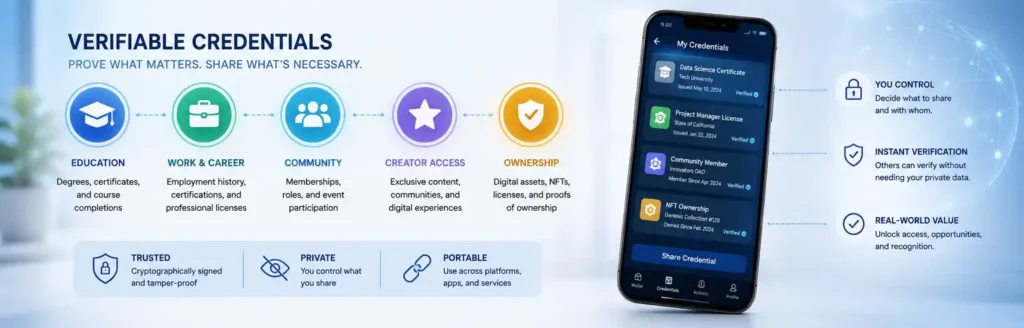
One important part of digital identity is the idea of verifiable credentials.
A verifiable credential is a digital record that can help prove something about a person, organization, or asset. It might prove that someone completed a course, earned a certification, attended an event, has a professional qualification, belongs to a community, or has permission to access something.
In traditional systems, credentials are often trapped in documents, databases, certificates, PDFs, emails, or platform accounts. They can be difficult to verify quickly.
Digital credentials could make verification easier, especially when they are designed to be portable, secure, and privacy-aware.
This could matter for education, hiring, professional development, online communities, events, licensing, memberships, and creator business.
For example:
- An online course could issue a verifiable completion credential.
- A professional association could issue membership credentials.
- A company could issue employee or contractor access credentials.
- A creator could issue community access credentials.
- An event could issue attendance or participation credentials.
- A digital product could include proof of purchase or ownership.
Credentials become more valuable when they can be trusted across systems.
Digital Identity and Privacy
Digital identity must also include privacy.
The goal should not be to expose more personal information everywhere online. A better goal is to prove what needs to be proven without revealing unnecessary information.
For example, someone may need to prove that they are over a certain age without sharing their full birthdate. A person may need to prove they completed a qualification without exposing unrelated personal data. A user may need to prove membership access without sharing every detail of their identity.
Good digital identity systems should balance verification and privacy.
This is important because trust does not come from collecting unlimited data. Trust comes from collecting the right data, protecting it properly, and giving people more control over how identity information is used.
Digital Identity for Creators
Digital identity will matter for creators because creators are becoming media brands, educators, product builders, community leaders, and digital asset owners.
A creator may need to prove that an article, video, podcast, course, digital product, or media asset is authentic. They may need to protect their name, brand, content library, and intellectual property. They may need to verify membership access, product ownership, certificates, or community participation.
As AI-generated content grows, creators will need better ways to show what is truly theirs.
This could include verified profiles, wallet-connected memberships, digital certificates, signed media, content provenance, protected brand assets, and stronger ownership systems.
For creators, digital identity is not only about security. It is about trust, authenticity, audience relationships, and long-term brand value.
Digital Identity for Organizations
Organizations also need to understand digital identity.
Businesses need to verify employees, contractors, partners, customers, transactions, documents, digital assets, access rights, certifications, and approvals. They also need to protect their brand from impersonation, fraud, misinformation, and unauthorized use.
As work becomes more distributed and AI-generated communication becomes more common, identity verification becomes part of operational trust.
Organizations should be asking:
- How do we verify who has access to our systems?
- How do we protect our brand identity online?
- How do customers know they are interacting with the real company?
- How do we verify digital documents, approvals, or credentials?
- How do we manage identity across employees, partners, contractors, and AI systems?
- How do we protect customer privacy while maintaining trust?
Digital identity is becoming part of business infrastructure, not just an IT issue.
Digital Identity and Web3 Wallets
Web3 wallets may become one piece of the digital identity puzzle.
A wallet can help someone prove control over an address, sign a message, connect to a decentralized application, hold a token, prove membership, or access digital assets. This makes wallets useful for certain kinds of identity, ownership, and access.
But wallets are not perfect identity systems by themselves. A wallet address does not automatically tell you who a person is in the real world. Wallets can be lost, compromised, copied into phishing sites, or misunderstood by users.
That is why wallet-based identity needs education, security, usability, and responsible design.
The future may include a mix of traditional accounts, verified credentials, wallet-based identity, decentralized identity tools, biometric verification, organizational trust systems, and privacy-preserving proofs.
The Risks of Digital Identity
Digital identity also carries risks.
If identity systems are poorly designed, they can create surveillance, privacy loss, data breaches, exclusion, discrimination, platform lock-in, or new forms of control. If identity data is centralized in one place, it can become a target for hackers. If users do not understand how identity tools work, they can be misled or exploited.
This is why digital identity should be built around trust, privacy, security, transparency, user control, and practical safeguards.
The goal is not simply to identify everyone everywhere. The goal is to create better ways to prove what needs to be proven, protect what needs to be protected, and give people and organizations more trustworthy digital systems.
A Simple Framework for Digital Identity
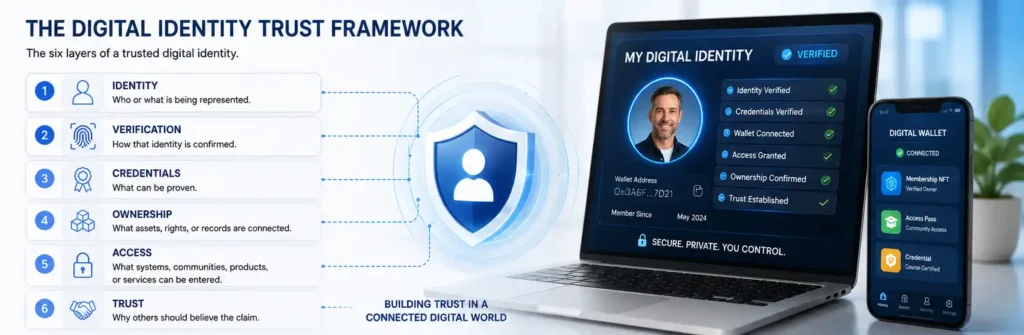
A practical way to understand digital identity is through six layers:
- Identity: Who or what is being represented?
- Verification: How is that identity confirmed?
- Credentials: What can be proven?
- Ownership: What assets, rights, or records are connected?
- Access: What systems, communities, products, or services can be entered?
- Trust: Why should another person, platform, or organization believe the claim?
This framework helps move digital identity out of technical jargon and into practical business understanding.
Final Thought
Digital identity is becoming the next layer of trust in the future digital economy.
As AI makes content easier to create, Web3 expands digital ownership, blockchain supports verification, and more business moves online, people and organizations will need better ways to prove identity, access, ownership, credentials, and authenticity.
The future of digital identity is not only about logging in. It is about trust.
In the future digital economy, the question will not only be what do you own? It will also be: what can you prove, what can you protect, and what can others trust?
Want to follow this conversation? Read more on the Curtis Randall B-Log, explore resources on My Creative Gear, or connect through the Contact page.