
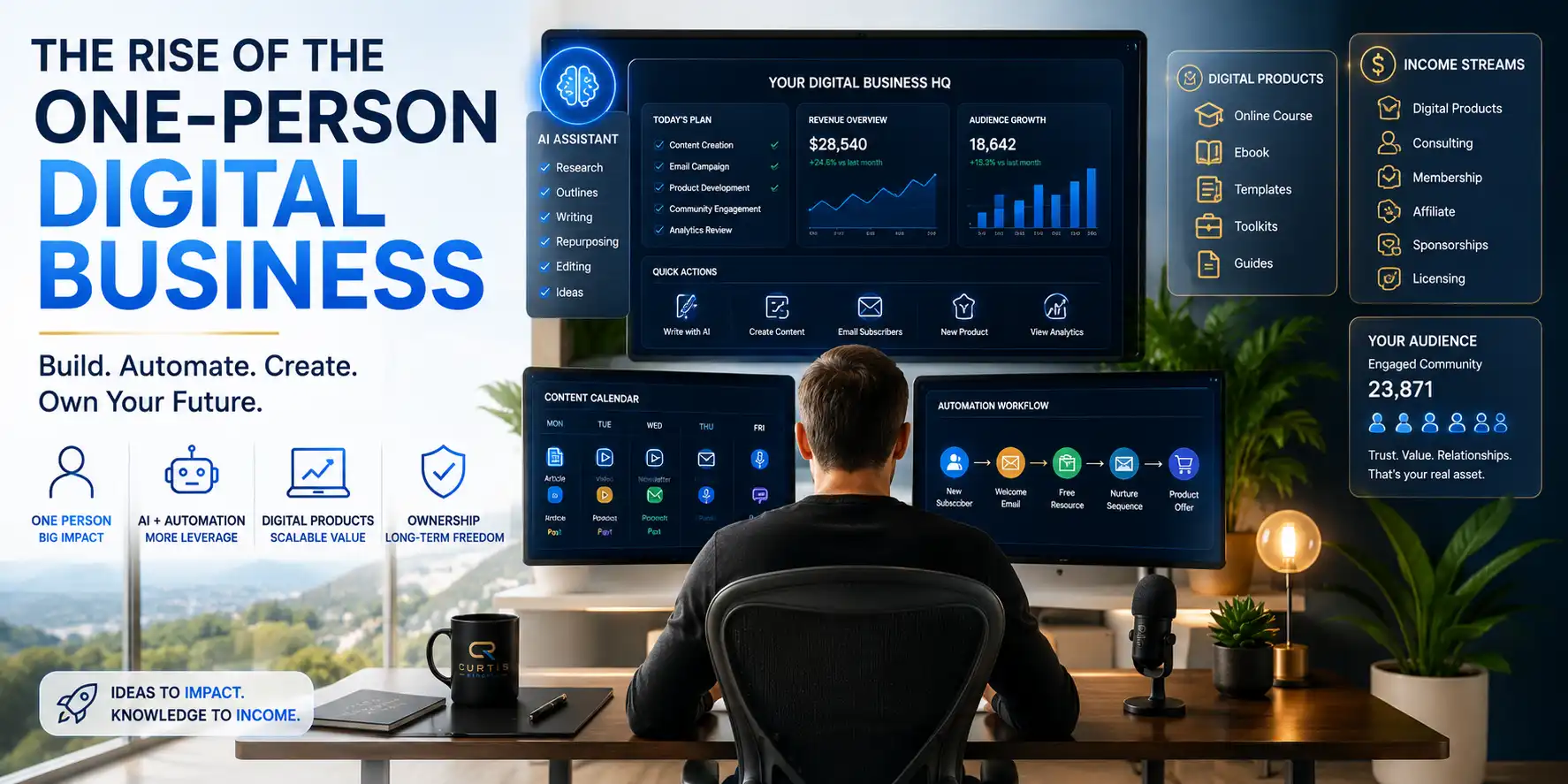
The Rise of the One-Person Digital Business
The one-person digital business is becoming one of the most important models in the future digital economy.
For years, building a business usually meant building a team, renting space, hiring specialists, managing suppliers, buying expensive software, and creating complex operations. That model still exists, but it is no longer the only path.
Today, one person with knowledge, creativity, digital tools, AI support, automation, owned media, and a clear offer can build a serious digital business from almost anywhere.
This does not mean building a business is easy. It does not mean AI removes the need for strategy, effort, judgment, consistency, trust, or value. But it does mean the leverage available to individuals has changed dramatically.
A one-person digital business can now create content, build an audience, sell digital products, offer advisory services, run automated email systems, publish media, manage customer relationships, and use AI to support many tasks that once required a larger team.
This is not just a creator economy trend. It is a deeper shift in how work, ownership, media, and value creation are changing.
What Is a One-Person Digital Business?
A one-person digital business is a business built around the knowledge, skills, experience, ideas, media, products, systems, and relationships of one individual.
It may include services, consulting, digital products, courses, workshops, memberships, newsletters, content, affiliate income, sponsorships, licensing, community access, templates, books, or subscription-based offers.
The key difference is that the business is designed to operate with a lean structure. Instead of relying on a large team from the beginning, the owner uses digital systems to create leverage.
That leverage can come from:
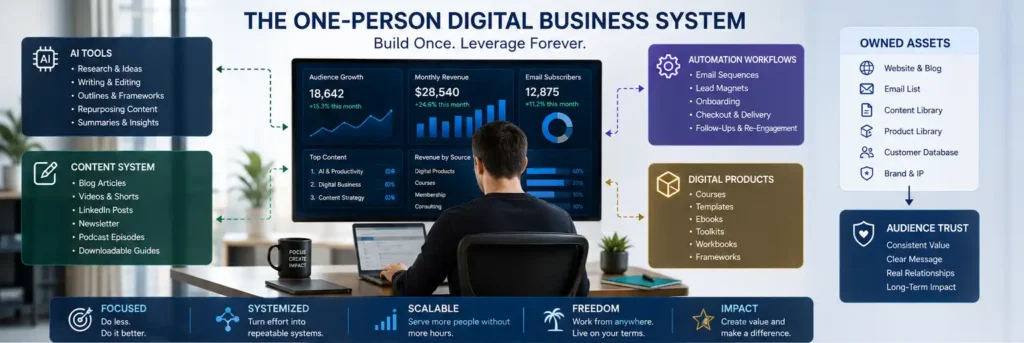
- AI tools that support research, writing, planning, content creation, analysis, and workflow design.
- Automation tools that manage repetitive tasks and customer journeys.
- Owned media such as a website, blog, newsletter, podcast, or YouTube channel.
- Digital products that can be sold repeatedly without starting from zero every time.
- Content systems that turn ideas into visibility, trust, and audience growth.
- Personal authority built around a clear area of expertise.
- Digital ownership of assets, lists, libraries, offers, and intellectual property.
The one-person digital business is not only about being small. It is about being focused, flexible, and systemized.
Why This Model Is Growing Now
The one-person digital business is growing because several major shifts are happening at the same time.
AI is making it easier to create, organize, research, edit, summarize, plan, and repurpose ideas. Automation is making it easier to manage repetitive workflows. Digital platforms are making it easier to reach audiences. Payment systems are making it easier to sell globally. Online education is making it easier to package knowledge. Digital ownership is making it more important to build assets that are not completely dependent on social platforms.
At the same time, the future of work is changing. People are looking for more control, more flexibility, more ownership, and more ways to turn their knowledge into value.
This creates an important opportunity.
A person no longer needs to wait for a company to give them permission to publish, teach, advise, build products, or create a media platform. They can begin building their own system.
That system can start small, but over time it can become a meaningful digital asset.
AI Gives One Person More Leverage
AI is one of the biggest reasons the one-person digital business is becoming more realistic.
In the past, a solo business owner often needed help with writing, design, research, editing, planning, customer communication, marketing, video scripts, product development, website copy, and content repurposing.
Today, AI can support many of those tasks.
AI can help a solo founder:
- Brainstorm product ideas.
- Create outlines and first drafts.
- Summarize research.
- Develop content calendars.
- Repurpose articles into social posts.
- Write email sequences.
- Create video scripts.
- Improve customer support materials.
- Analyze audience questions.
- Organize workflows and systems.
But AI is not the business. AI is the leverage layer.
The value still comes from the human: the experience, judgment, taste, point of view, trust, creativity, and ability to understand what an audience actually needs.
A one-person digital business succeeds when AI supports a clear strategy. It fails when AI is used only to create more noise.
Automation Turns Effort Into Systems
Automation is another major part of the one-person digital business model.
Without automation, a solo business owner can quickly become overwhelmed. There are too many tasks: publishing, email follow-up, customer delivery, scheduling, payments, lead capture, product access, reminders, onboarding, and reporting.
Automation helps turn repeated effort into a system.
Examples include:
- A website form that adds a subscriber to an email list.
- A welcome sequence that delivers a free guide automatically.
- A product checkout that sends access after purchase.
- A calendar system that books appointments without manual back-and-forth.
- A newsletter workflow that organizes weekly publishing.
- A customer onboarding sequence that explains next steps.
- A content repurposing system that turns one article into several media assets.
Automation does not replace relationships. It protects the owner’s time so they can focus on higher-value work.
The goal is not to make the business feel robotic. The goal is to make the business more reliable, consistent, and scalable.
Content Becomes the Discovery Engine
A one-person digital business needs a way for people to discover the value behind it. That is where content becomes important.
Content is not just marketing. It is how a solo business owner teaches, explains, builds trust, shares perspective, demonstrates expertise, and creates a relationship before a sale ever happens.
A strong content system may include:
- Articles that explain important ideas.
- Short videos that introduce key concepts.
- LinkedIn posts that build authority.
- Newsletters that deepen the relationship.
- Podcasts that build trust through voice and conversation.
- Downloadable guides that grow an email list.
- Case studies that show practical value.
The mistake many people make is thinking content is the business. It is not. Content is the discovery engine.
The business needs offers, products, systems, customer journeys, and ownership behind the content.
Content creates visibility. Systems turn visibility into value.
Digital Products Create Scalable Value
Digital products are one of the most powerful parts of a one-person digital business.
A digital product allows someone to package knowledge, experience, frameworks, templates, lessons, or tools into something that can be sold, delivered, updated, and improved over time.
Digital products can include:
- Ebooks.
- Courses.
- Templates.
- Toolkits.
- Workbooks.
- Paid newsletters.
- Research reports.
- Frameworks.
- Workshops.
- Membership resources.
The advantage of digital products is that they turn knowledge into an asset.
Instead of explaining the same thing repeatedly, a solo business owner can create a structured resource once, improve it over time, and sell it to many people.
This does not mean digital products are passive income without work. They require positioning, quality, marketing, delivery, customer support, and ongoing improvement.
But they do create leverage. They allow one person to serve more people without every sale requiring a one-to-one exchange of time.
Digital Ownership Makes the Business Durable
A one-person digital business becomes stronger when it is built on owned systems.
Social platforms are useful for discovery, but they are not enough. Algorithms change. Reach changes. Accounts can be restricted. Platforms can shift direction. Audiences can become harder to reach.
That is why digital ownership matters.
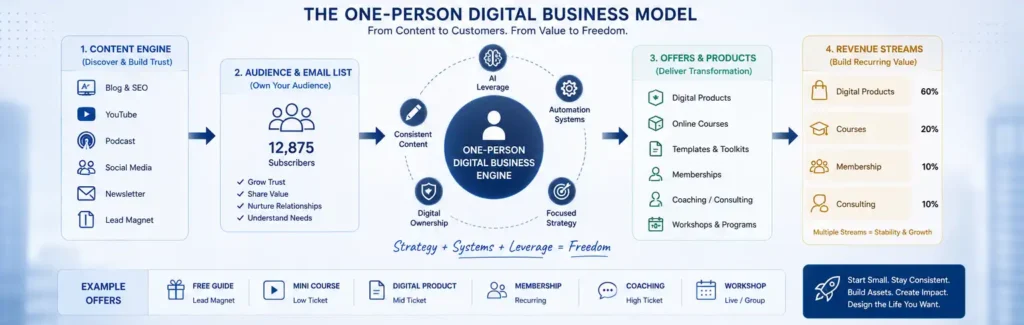
A solo business owner should think about building assets they control:
- A website.
- An email list.
- A content library.
- A product library.
- A customer database.
- A brand identity.
- Digital intellectual property.
- A repeatable offer system.
- A direct relationship with the audience.
Owned systems make the business more durable because they reduce dependency on any single platform.
In the future digital economy, ownership is not just about holding digital assets. It is about controlling the systems where your value lives.
The One-Person Business Still Needs Strategy
AI tools and automation can make one person more capable, but they do not replace strategy.
A one-person digital business still needs clear answers to important questions:
- What problem does this business solve?
- Who is the audience?
- What does the owner want to be known for?
- What is the core offer?
- What content builds trust?
- What product creates value?
- What system turns attention into relationships?
- What assets need to be owned?
- What should be automated?
- What should remain human?
Without strategy, a solo business can become scattered. The owner may chase too many platforms, too many tools, too many products, and too many ideas.
The strongest one-person digital businesses are not built around doing everything. They are built around clarity, focus, trust, and repeatable systems.
Human Trust Becomes the Advantage
As AI creates more content, trust becomes more valuable.
People will not buy from a one-person digital business simply because it posts often. They will buy because they trust the person behind it. They believe the person understands the problem, has useful experience, explains clearly, and can help them move forward.
This is why human qualities become more important, not less.
- Judgment.
- Experience.
- Taste.
- Point of view.
- Consistency.
- Integrity.
- Story.
- Clarity.
- Care.
AI can help produce more. But trust is earned by the person, the brand, and the value delivered over time.
A Simple Framework for a One-Person Digital Business
A practical one-person digital business can be built around seven connected layers:
- Position: What do you want to be known for?
- Audience: Who are you helping?
- Content: How will people discover and trust your ideas?
- Ownership: What platforms, lists, assets, and systems do you control?
- Offer: What product, service, or solution creates value?
- Automation: What repeated tasks can be systemized?
- Trust: How will you build credibility and long-term relationships?
This framework keeps the business simple. It helps one person avoid tool-chasing and focus on building a real value system.
Final Thought
The rise of the one-person digital business is one of the clearest signs of how the future digital economy is changing.
AI gives individuals more leverage. Automation turns repeated effort into systems. Digital products turn knowledge into assets. Content builds trust. Digital ownership makes the business more durable.
But the real foundation is still human value.
The people who succeed will not simply be the ones who use the most tools. They will be the ones who combine tools with strategy, trust, ownership, clarity, and a real understanding of the people they serve.
The one-person digital business is not just a solo work model. It is a new way to turn knowledge, trust, media, systems, and ownership into value.
Want to follow this conversation? Read more on the Curtis Randall B-Log, explore resources on My Creative Gear, or connect through the Contact page.