
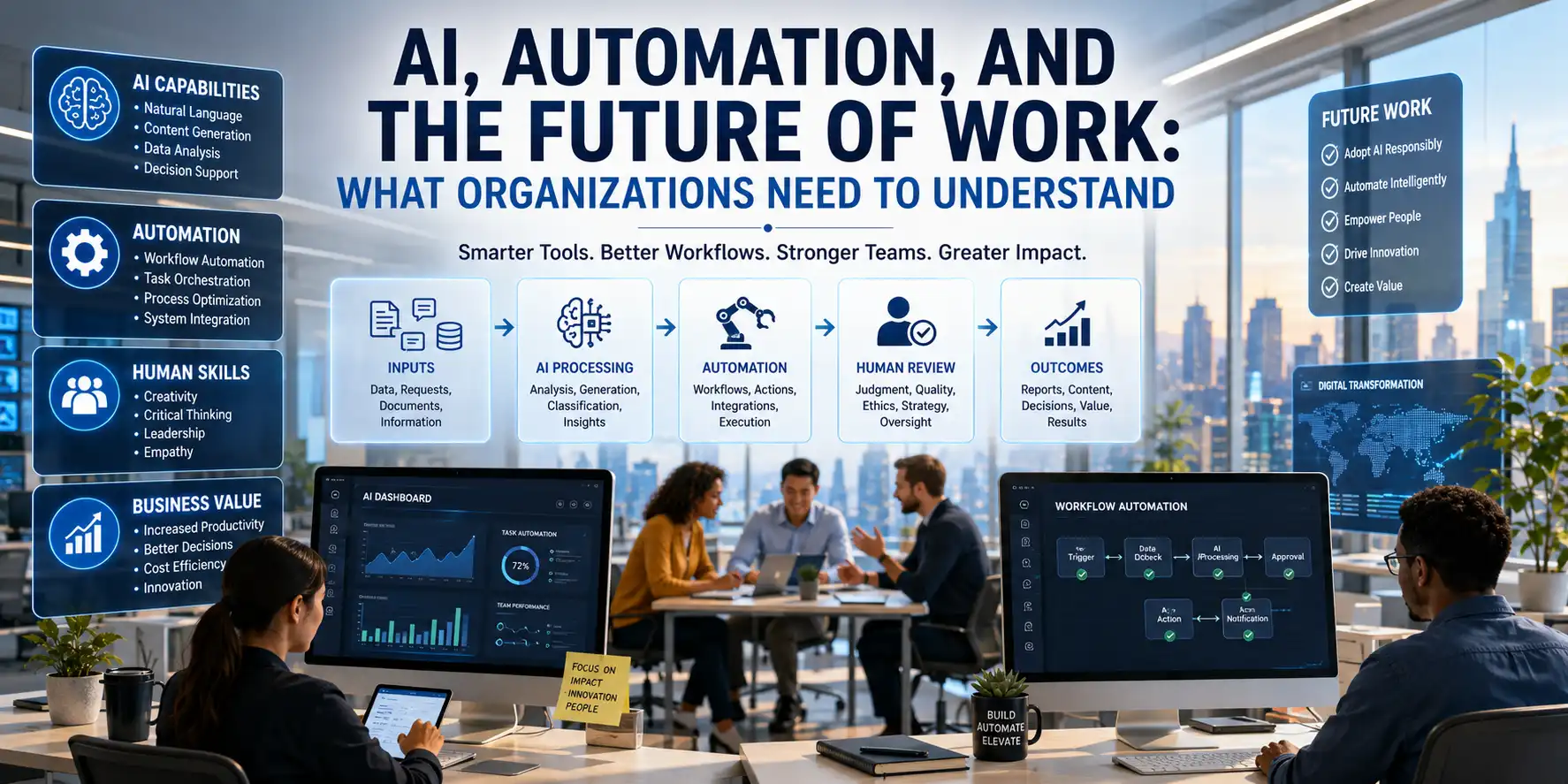
AI, Automation, Future of Work: What Organizations Need to Understand
AI and automation are changing the future of work, but not always in the way people imagine.
The conversation often becomes too simple. Some people see AI as a threat that will replace everyone. Others see it as a magic tool that will solve every business problem. The truth is more practical. AI and automation are changing how work is created, organized, delivered, measured, and improved.
For organizations, the important question is not only, “Which AI tools should we use?” The better question is, “How will AI and automation change the way our organization creates value?”
That question belongs inside the larger conversation about the future digital economy. AI changes how things are created. Automation changes how businesses operate. Digital ownership changes what people and organizations control. Future work changes the skills, roles, and systems people need to create value.
Organizations that understand this shift will be better prepared to adapt, redesign workflows, support teams, protect quality, and build stronger systems for the next era of work.
AI Is Not Just a Tool. It Is a Work System
Many organizations begin with AI by testing individual tools. They try writing tools, image tools, meeting summaries, chatbots, research assistants, customer service bots, or workflow apps. That is a useful starting point, but it is not the full opportunity.
AI becomes more valuable when it is connected to a work system.
A work system includes the people, processes, tools, decisions, approvals, data, outputs, and outcomes that make work happen. When AI is placed inside that system, it can reduce friction, speed up repetitive tasks, improve access to information, support decision-making, and help teams produce more consistent work.
That is why AI strategy should not only focus on software. It should focus on workflow design.
Organizations need to ask:
- Where does work slow down?
- Which tasks are repetitive?
- Where do teams lose time?
- Where does information get trapped?
- Which decisions require human judgment?
- Which processes could be supported by automation?
- How do we protect quality, accuracy, and trust?
AI is powerful, but it becomes much more useful when it is connected to a clear operating system.
Automation Changes How Organizations Operate
Automation is the process of using technology to complete tasks, connect workflows, or trigger actions with less manual effort. It can be simple, such as automatically sending a confirmation email. It can also be more advanced, such as using AI agents to research, summarize, organize, route, or respond to information.
Automation matters because many organizations are full of repeated manual steps. People copy information from one place to another. They answer the same questions. They search for the same documents. They rebuild the same reports. They recreate similar content. They spend time managing processes that could be simplified.
AI and automation can help reduce that friction.
But automation should not be used blindly. A broken process that gets automated can simply become a faster broken process. Before automating, organizations should understand the workflow, remove unnecessary steps, define standards, and decide where human review is still needed.
The best automation does not remove human value. It removes unnecessary friction so people can focus on higher-value work.
The Future of Work Is About Value Creation
The future of work is often discussed as a jobs issue. That matters, but the bigger question is value creation.
Work exists because value needs to be created. Customers need service. Products need development. Ideas need communication. Systems need management. Problems need solving. Relationships need building. Decisions need making.
AI and automation change how that value is created.
Some tasks become faster. Some tasks become automated. Some tasks become less valuable because tools can now perform them easily. Other skills become more valuable because they guide, judge, improve, and connect the work.
This is why organizations should think less about replacing jobs and more about redesigning work.
Important questions include:
- What value does this role create?
- Which parts of the role can be supported by AI?
- Which parts require human trust, judgment, empathy, creativity, or leadership?
- How can teams use AI to improve outcomes?
- What new skills are needed?
- What new workflows should be built?
The future of work is not simply about fewer people or more tools. It is about better systems for creating value.
Human Skills Become More Important, Not Less
As AI becomes more capable, human skills do not disappear. They shift.
If AI can generate drafts, images, summaries, ideas, and options, then the human role becomes more focused on direction, judgment, taste, quality, trust, ethics, context, relationships, and decision-making.
In many organizations, the most valuable people will not be the ones who simply use AI the most. They will be the ones who know how to use AI well inside a business context.
Human skills that become more important include:
- Judgment: knowing what is accurate, useful, appropriate, and valuable.
- Strategy: connecting tools to business goals.
- Creativity: seeing new possibilities and original directions.
- Communication: explaining ideas clearly across teams and audiences.
- Systems thinking: understanding how tools, people, workflows, and value connect.
- Trust-building: protecting credibility, quality, and relationships.
- Adaptability: learning quickly as tools and business models change.
- Leadership: helping people navigate uncertainty and change.
AI can increase output. Human intelligence gives that output direction and meaning.
Organizations Need AI Literacy at Every Level
AI literacy does not mean everyone needs to become a technical expert. It means people need a practical understanding of what AI can do, where it helps, where it fails, and how to use it responsibly.
Without AI literacy, organizations risk two problems. They may avoid useful technology because they do not understand it. Or they may use it carelessly because they overestimate what it can do.
AI literacy should include:
- Understanding basic AI capabilities and limitations.
- Knowing how to write clear prompts and provide useful context.
- Knowing when human review is required.
- Recognizing privacy, security, copyright, and accuracy risks.
- Understanding how AI can support workflows.
- Learning how to evaluate AI-generated output.
- Knowing how to use AI without weakening trust or quality.
Organizations that build AI literacy will be better prepared to use AI as a responsible business advantage.
The Role of Teams Will Change
AI and automation will change how teams work together.
Some team members may use AI to speed up research. Others may use it to create first drafts. Others may use it to automate reporting, summarize meetings, analyze customer feedback, generate creative options, or manage project workflows.
This changes team dynamics because work can move faster, but it also creates new coordination challenges.
Teams need shared standards. They need to know which tools are approved, what data can be used, how outputs should be reviewed, and where human judgment is required. They also need clarity around ownership, privacy, accuracy, and brand voice.
Without shared standards, AI adoption can become messy. Different people use different tools in different ways, with different levels of quality and risk.
The solution is not to block experimentation. The solution is to create a responsible system for experimentation.
AI Agents Will Push Automation Further
One of the most important shifts in the future of work is the rise of AI agents.
An AI agent is a system designed to complete tasks with a level of autonomy. Instead of only responding to one prompt, an agent may be able to follow instructions, use tools, gather information, take steps, and complete a workflow.
This matters because AI agents can move automation from simple task support into more complex workflow support.
For example, AI agents may help with:
- Research and report preparation.
- Customer service triage.
- Lead qualification.
- Meeting summaries and follow-up tasks.
- Content repurposing.
- Data analysis and alerts.
- Project management support.
- Internal knowledge search.
- Workflow routing and task completion.
This does not mean organizations should hand everything to agents without oversight. It means organizations need to understand where agentic systems may create efficiency, where they may introduce risk, and how to design human review into important workflows.
The Risk Is Not Only Job Loss. It Is Poor Adaptation.
Many discussions about AI focus on job loss. That is a real concern and should not be ignored. But there is another risk organizations need to consider: poor adaptation.
Poor adaptation happens when businesses either move too slowly, move too carelessly, or misunderstand what AI and automation are really changing.
Some organizations may ignore AI until competitors become faster and more efficient. Others may rush into automation without protecting quality, people, privacy, or trust. Some may buy tools without redesigning workflows. Others may train teams on prompts but fail to connect AI to business value.
The goal should not be panic or hype. The goal should be thoughtful adaptation.
Organizations need to move with curiosity, structure, and responsibility.
A Practical Framework for Organizations
Organizations can begin by using a simple framework for AI and automation readiness:
- Understand: Build practical AI literacy across leadership and teams.
- Map: Identify workflows, repetitive tasks, bottlenecks, risks, and opportunities.
- Prioritize: Choose the areas where AI or automation can create clear value.
- Experiment: Test tools and workflows in controlled, low-risk environments.
- Govern: Create standards for privacy, accuracy, security, intellectual property, and review.
- Train: Help teams develop the skills to use AI responsibly and effectively.
- Measure: Track time saved, quality improved, revenue supported, or friction reduced.
- Improve: Treat AI adoption as an ongoing system, not a one-time project.
This framework keeps the focus where it belongs: not on tool chasing, but on business value, human capability, and better systems.
Future Work Requires Future Leadership
The future of work will require a different kind of leadership.
Leaders will need to understand technology without becoming trapped in technical details. They will need to support innovation without losing human trust. They will need to encourage experimentation while protecting standards. They will need to redesign workflows while helping people adapt.
This is where systems thinking becomes important.
AI and automation are not isolated tools. They affect people, processes, culture, customer experience, brand trust, intellectual property, operations, and business models. Leaders need to see those connections.
The organizations that succeed will not simply be the ones that buy the most AI tools. They will be the ones that understand how to combine people, technology, workflows, and strategy into better systems for creating value.
Final Thought
AI and automation are reshaping the future of work. But the real opportunity is not just doing the same work faster. The real opportunity is redesigning work around better systems.
Organizations need to understand where AI helps, where automation creates leverage, where human judgment matters, and how teams need to adapt.
The future of work belongs to organizations that can combine technology with human intelligence, strategy, trust, and systems thinking.
AI changes how work gets created. Automation changes how work gets done. Human judgment decides what work is worth doing.
Want to follow this conversation? Read more on the Curtis Randall B-Log, or connect through the Contact page.