
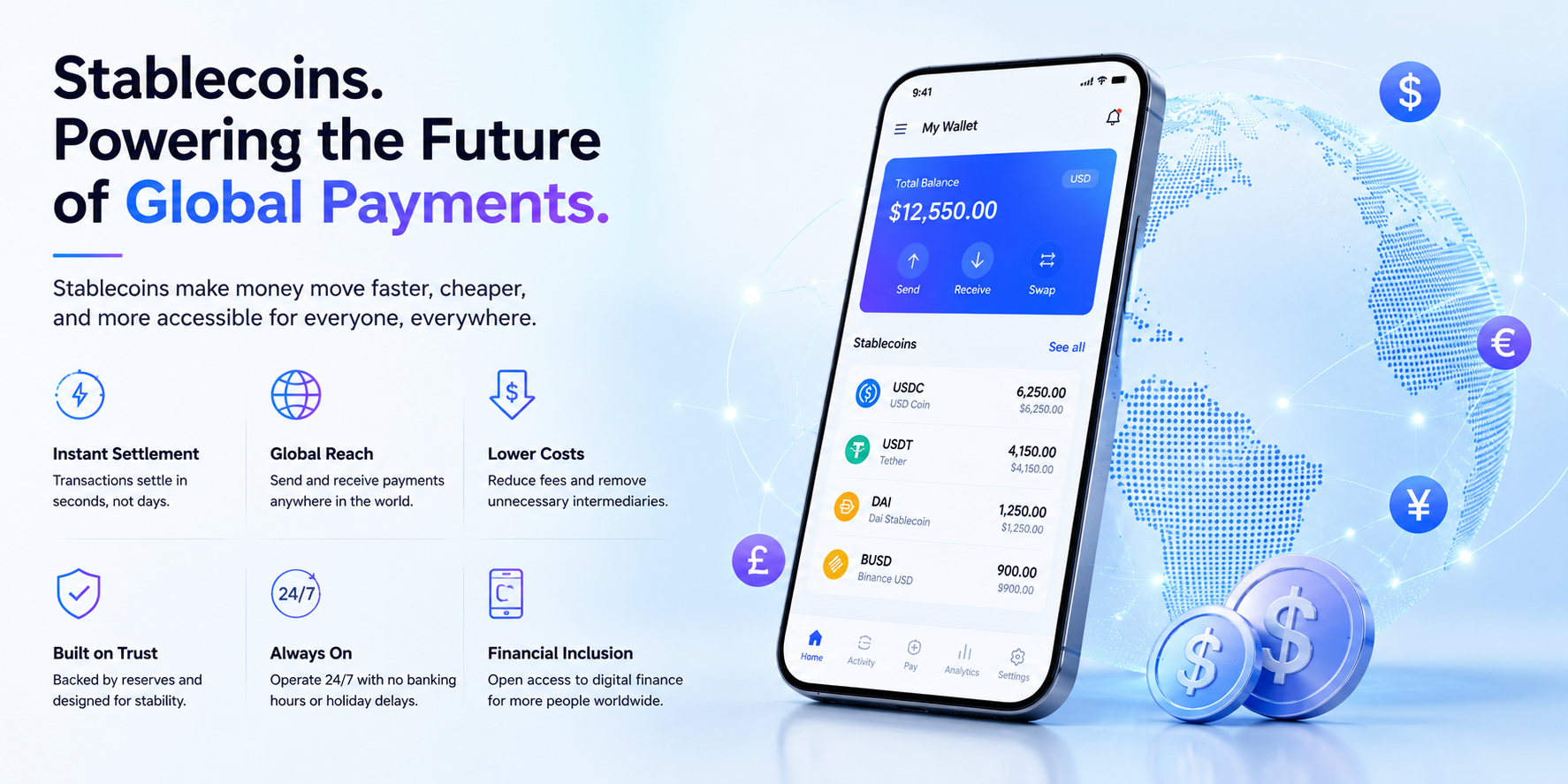
Stablecoins and the Future of Global Payments
The way money moves around the world is changing. For decades, international payments have relied on traditional banking networks that can be slow, expensive, and complicated. Today, a new financial technology is emerging that could dramatically improve how businesses and individuals transfer value across borders: stablecoins.
While many people associate cryptocurrency with volatile digital assets, stablecoins are different. They are designed to maintain a stable value, making them far more practical for payments, commerce, and financial infrastructure.
As adoption grows among businesses, financial institutions, and governments, stablecoins are becoming one of the most important developments shaping the future digital economy.
What Are Stablecoins?
Stablecoins are digital currencies that are typically pegged to a stable asset such as the U.S. dollar. Unlike cryptocurrencies that can experience significant price fluctuations, stablecoins aim to maintain a predictable value.
For example, a dollar-backed stablecoin is generally designed so that one token equals one U.S. dollar.
This stability makes them attractive for payments, remittances, trading, savings, and business transactions.
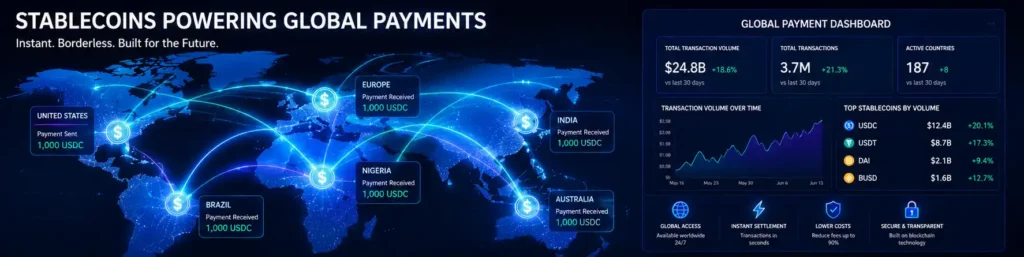
Why Traditional Cross-Border Payments Need Improvement
Sending money internationally can be surprisingly inefficient.
- Transfers can take several days.
- Fees can be expensive.
- Multiple intermediaries may be involved.
- Exchange rates often add hidden costs.
- Many regions remain underserved by traditional banking systems.
For businesses operating globally, these inefficiencies create unnecessary friction and expense. For individuals sending money to family members abroad, they can significantly reduce the value of every transfer.
How Stablecoins Improve Global Payments
Stablecoins offer several advantages over traditional payment networks.
Faster Settlement
Transactions can often be completed within minutes rather than days, regardless of geographic location.
Lower Costs
By reducing the number of intermediaries involved in a transaction, stablecoins can significantly lower transfer fees.
Global Accessibility
Anyone with internet access and a compatible digital wallet can potentially participate in the global financial system.
24/7 Availability
Unlike traditional banking systems that operate within business hours, blockchain networks run continuously.
Stablecoins and the Future Digital Economy
The growing adoption of stablecoins reflects a broader transformation occurring throughout the digital economy.
Money is becoming increasingly digital, programmable, and globally accessible. Stablecoins provide an important bridge between traditional finance and blockchain-based financial infrastructure.
Financial institutions are exploring how stablecoins can improve payment efficiency, while businesses are evaluating new ways to manage global transactions and treasury operations.
In many regions, stablecoins are already being used as a practical alternative for preserving value and conducting international commerce.
[INSERT IN-ARTICLE IMAGE 2 HERE]

Challenges Facing Stablecoins
Despite their potential, stablecoins still face several challenges.
- Regulatory uncertainty in some jurisdictions.
- Reserve transparency requirements.
- Security and custody concerns.
- Competition from central bank digital currencies (CBDCs).
- Integration with existing financial systems.
As regulations evolve and infrastructure matures, many of these challenges are expected to become more manageable.
What Businesses Should Watch
Organizations should monitor several key trends:
- Stablecoin payment adoption by major financial institutions.
- Cross-border payment innovation.
- Tokenized financial infrastructure.
- Regulatory developments.
- Integration between traditional banking and blockchain networks.
Businesses that understand these developments early may gain significant advantages as digital finance continues to evolve.
Conclusion
Stablecoins are rapidly evolving from a niche cryptocurrency product into a core component of modern financial infrastructure. Their ability to facilitate faster, cheaper, and more accessible global payments positions them as one of the most promising innovations in the future of finance.
As adoption continues to grow, stablecoins could become one of the foundational technologies powering the future digital economy, connecting businesses, consumers, and financial systems across the world.

About the Author
Curtis Randall is an award-winning creative executive and future systems thinker helping people and businesses understand the future of work, technology, digital ownership, and creativity. Through CurtisRandall.com, and Sights.com, Curtis explores the systems shaping how people work, create, own, and build value in a rapidly changing world.
Connect with Curtis: LinkedIn · YouTube · Instagram · X · TikTok · Facebook · Threads