

Why Creative Thinking Is Becoming More Valuable in the AI Business Era
AI is changing how businesses create, communicate, market, sell, design, plan, and operate. Tasks that once required hours, teams, budgets, and technical skill can now be accelerated with AI tools. Content can be drafted faster. Images can be explored faster. Research can be summarized faster. Campaign ideas can be generated faster. Workflows can be automated faster.
But speed is not the same as value.
As AI makes production easier, creative thinking becomes more important, not less. The businesses that win will not simply be the ones that use AI to make more content. They will be the ones that use creative thinking to make better decisions, stronger strategies, clearer messages, more useful products, and more meaningful customer experiences.
That is the real shift happening in the AI business era.
AI can generate. Creative thinking directs.
AI can produce options. Creative thinking chooses what matters.
AI can speed up work. Creative thinking gives that work purpose.
Creative Thinking Is Not Just About Making Things Look Good
One of the biggest mistakes businesses make is thinking creativity is only about design, branding, advertising, or content. Those are important expressions of creativity, but creative thinking is much bigger than that.
Creative thinking is the ability to see possibilities, connect ideas, solve problems, communicate clearly, adapt to change, and imagine better ways of doing things.
In business, creative thinking shows up everywhere:
- How a company explains its value.
- How a product is positioned.
- How a customer journey is designed.
- How a team uses technology.
- How a brand builds trust.
- How a business turns knowledge into assets.
- How a company adapts when the market changes.
That means creative thinking is not decoration. It is strategy.
In the AI era, this becomes even more important because the tools can create almost anything. The question is no longer only, “Can we make it?” The better question is, “Should we make it, why does it matter, and how does it create value?”
AI Is Increasing Output, But Output Is Not the Goal
AI has made it easier to produce more. More copy. More designs. More videos. More social posts. More ideas. More variations. More versions of everything.
That can be useful, especially for businesses trying to keep up with constant demand for content, personalization, and digital communication. Adobe has described how creative professionals are using generative AI to keep pace with rising content demands while still focusing on workflow and quality.
But more output can quickly become more noise.
If every business uses AI to create more content, the market becomes crowded with faster content, not necessarily better content. The advantage shifts from production volume to creative judgment.
Creative judgment asks:
- Is this useful?
- Is this true to the brand?
- Does this solve a real problem?
- Does this help the customer understand something?
- Does this create trust?
- Does this feel human?
- Does this support the business strategy?
AI can help produce the material, but creative thinking decides whether the material deserves to exist.
The Creative Advantage Is Moving Upstream
Before AI, much of the creative workload was tied to execution. Writing drafts. Creating layouts. Editing images. Producing variations. Building presentations. Cutting videos. Designing campaigns. Preparing content.
Those tasks still matter, but AI is changing how they are done. As execution becomes faster, the higher-value creative work moves upstream.
The advantage is now in:
- Understanding the problem.
- Defining the strategy.
- Shaping the message.
- Designing the system.
- Knowing the audience.
- Building the offer.
- Creating trust.
- Connecting the work to business value.
This is where experienced creative thinkers become more valuable. Not because they can make things manually faster than AI, but because they know what good looks like. They understand taste, timing, emotion, positioning, story, clarity, and context.
AI can generate directions. Creative thinking gives direction.
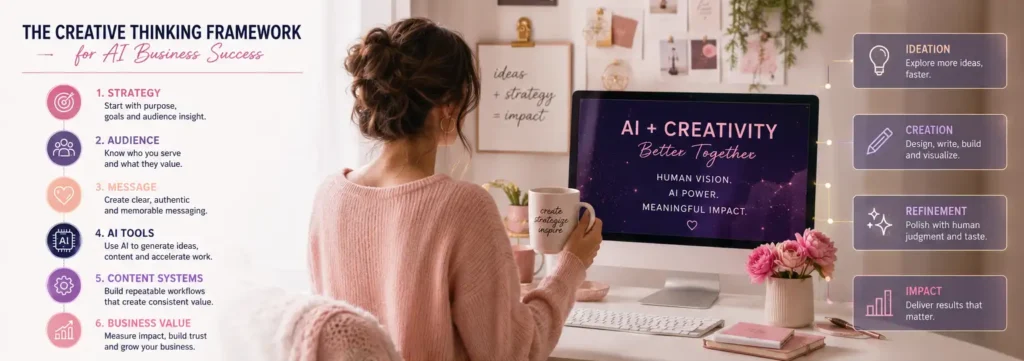
AI Business Needs Better Creative Strategy
AI business is not only about automation. It is about using intelligent tools to create better systems for value creation.
That includes marketing systems, content systems, product systems, customer service systems, sales systems, media systems, and internal workflow systems.
McKinsey’s 2025 State of AI research points to an important idea: organizations get value from AI when they rewire how work gets done, not simply when they add tools on top of old processes.
This matters because creative strategy is also a system. It connects audience insight, messaging, brand position, content, distribution, technology, workflow, and business goals.
Without creative strategy, AI can become scattered. One team uses it for copy. Another uses it for images. Another uses it for social posts. Another uses it for presentations. Everyone creates faster, but the business does not become clearer, stronger, or more valuable.
Creative strategy turns AI from a production tool into a business advantage.
The Human Role Is Moving Toward Taste, Judgment, and Direction
As AI becomes more capable, the human role does not disappear. It changes.
The human role becomes more about taste, judgment, direction, ethics, context, originality, empathy, and meaning.
This is especially important in creative business work because audiences can feel when something is generic. They may not always know why, but they can sense when a message lacks originality, emotion, or point of view.
A business cannot build trust with generic content forever. It needs perspective. It needs voice. It needs clarity. It needs a reason to exist beyond producing more posts.
Research on generative AI and creativity suggests that AI can support creative tasks, but human-AI collaboration still needs human direction. AI can help generate ideas, but people must guide, select, refine, and protect originality.
The new creative advantage is not being anti-AI. It is knowing how to collaborate with AI without losing the human intelligence that makes the work matter.
Businesses Need Creative Systems, Not Random AI Experiments
Many businesses are still using AI in random ways. Someone tries a prompt. Someone creates a few images. Someone rewrites a post. Someone tests a chatbot. Someone uses AI to summarize a meeting.
That is a normal starting point, but it is not a strategy.
The next step is building creative systems.
A creative AI business system might include:
- A brand voice guide for AI-assisted writing.
- A prompt library for recurring content needs.
- A campaign planning workflow.
- A visual direction system for images and videos.
- A content repurposing process.
- A review system for accuracy and quality.
- A human approval process for sensitive content.
- A measurement system tied to business goals.
This is where creative thinking becomes operational. It is not only about big ideas. It is about building repeatable systems that help teams create better work with more consistency.
AI can help businesses move faster. Creative systems help them move in the right direction.
Creativity Is How Businesses Become Understandable
One of the most underrated business advantages is clarity.
Many companies have good products, strong services, useful knowledge, or real expertise, but they struggle to explain why they matter. Their websites are unclear. Their content is scattered. Their offers are confusing. Their social media does not build trust. Their message sounds like everyone else.
AI can help generate language, but creative thinking helps clarify meaning.
Creative thinking asks:
- What do we actually help people do?
- Why should anyone care?
- What problem are we solving?
- What is our point of view?
- What is the simplest way to explain this?
- What should people remember?
Businesses that answer these questions well will stand out in the AI era because they will be easier to understand.
That is a creative advantage.
AI Will Make Average Creative Work Easier to Produce
This is an uncomfortable truth: AI will make average creative work easier to produce.
Average copy, average images, average videos, average presentations, average social posts, and average campaigns will become cheaper and faster. That does not mean all creative work loses value. It means average execution becomes less defensible.
The value moves to the things that are harder to automate:
- Original point of view.
- Deep audience understanding.
- Strategic positioning.
- Emotional intelligence.
- Creative taste.
- Business judgment.
- Storytelling.
- Trust.
- Leadership.
This is why creative professionals and business leaders should not only ask, “How do I use AI?” They should ask, “What creative value do I bring that AI cannot replace?”
That question is important for individuals, teams, and companies.
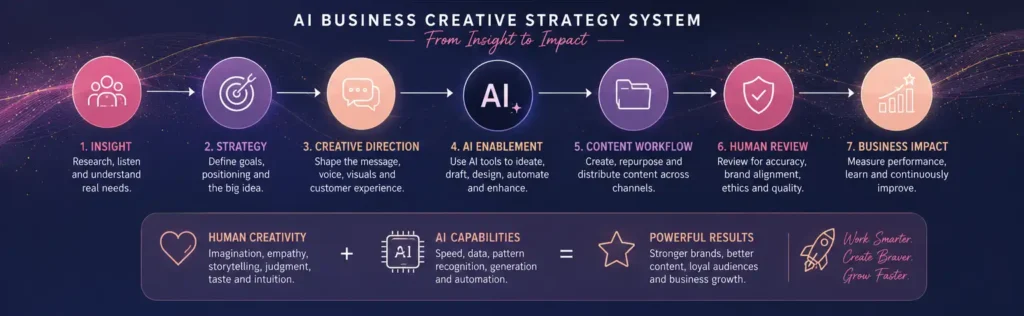
The Future Creative Leader Is a Systems Builder
The creative leader of the future will not only manage ideas. They will build systems.
They will understand AI tools, but they will also understand brand, business, audience, workflow, content, data, media, and trust. They will know how to connect strategy to production, production to distribution, and distribution to business value.
This is a powerful role because many businesses will need help translating AI potential into practical systems.
They will need people who can ask better questions, create better workflows, guide teams, protect quality, and turn scattered experiments into usable business processes.
That is where creative leadership becomes business leadership.
How Businesses Can Build a Creative AI Advantage
Businesses do not need to overhaul everything overnight. They can start with a practical approach.
- Define the business goal. Do not use AI just to use AI. Start with the outcome.
- Clarify the brand voice. AI needs direction or it will sound generic.
- Map the creative workflow. Identify where AI can help with research, ideation, drafting, production, repurposing, or analysis.
- Create human review points. Accuracy, tone, originality, and ethics need human judgment.
- Build reusable prompts and templates. Turn experiments into repeatable systems.
- Measure the result. Faster is useful, but better outcomes matter more.
This is how AI becomes part of a creative business system instead of just another tool.
Final Thought
The AI business era will create a lot of content. It will create more automation, more speed, more tools, more templates, and more competition for attention.
But the businesses that stand out will still need creative thinking.
They will need strategy. They will need judgment. They will need clarity. They will need story. They will need systems. They will need people who can connect technology to value.
Creative thinking is becoming more valuable because AI is making production easier. When production gets easier, direction becomes more important.
The future belongs to people who can combine human creativity with intelligent systems — and turn ideas into business value.
Want to follow this conversation? Read more on the Curtis Randall B-Log, explore resources on My Creative Gear, or connect through the Contact page.