
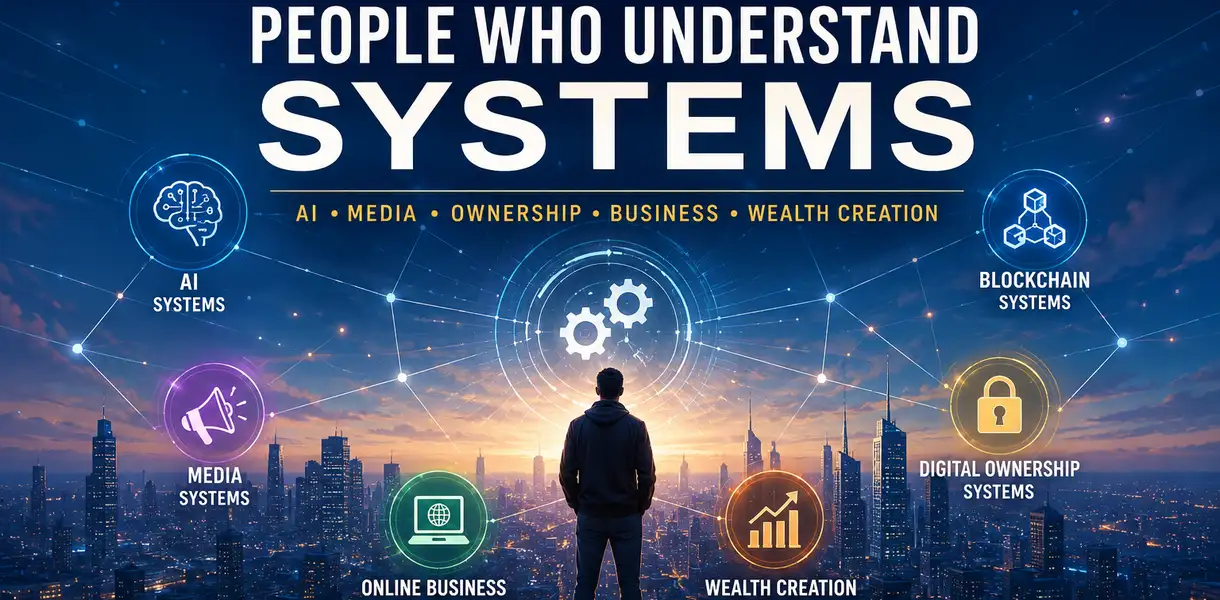
The Future Belongs to People Who Understand Systems
The future is not going to reward people simply for working harder, creating more content, using more tools, or reacting faster to every new trend. Those things may help for a short time, but they are not enough on their own.
The future will reward people who understand systems.
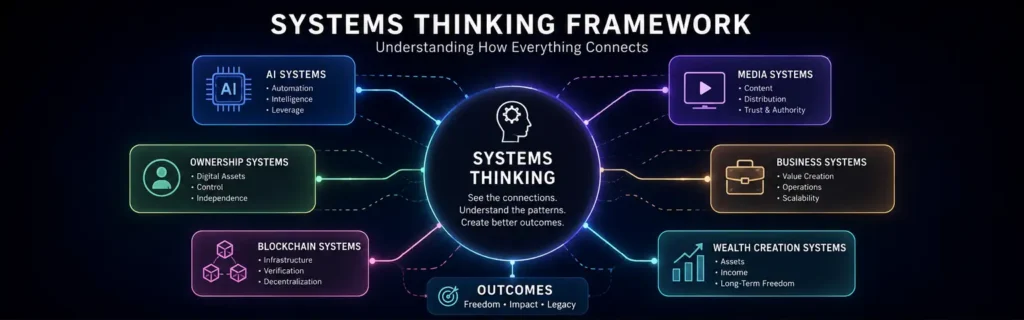
Work systems. Technology systems. Ownership systems. Media systems. Business systems. Wealth creation systems.
This is becoming one of the most important shifts of our time. AI is changing how work gets done. Digital platforms are changing how people build visibility. Blockchain is changing how we think about ownership. Online business is changing how people create income. Media is changing how trust is built. And wealth creation is becoming more connected to knowledge, digital assets, systems, and leverage.
The people who only look at individual tools may feel overwhelmed. The people who understand the systems behind those tools will be better prepared.
That is why systems thinking is becoming a future skill.
What Systems Thinking Really Means
Systems thinking is the ability to see how different parts connect, influence each other, and create outcomes over time.
Most people look at the surface. They see a new AI tool, a new social platform, a new crypto headline, a new business trend, or a new piece of technology. Systems thinkers look deeper. They ask better questions.
- What problem does this solve?
- What behavior does it change?
- What does it make easier?
- What does it make less valuable?
- Who gains more control?
- Who loses control?
- Where does the value move?
- What can be owned?
- What can be repeated?
- What can grow over time?
Those questions matter because the world is becoming more connected. Work, technology, media, ownership, and wealth creation are no longer separate conversations. They are becoming part of one larger system.
To understand the future, you need to understand how the pieces fit together.
AI Is Not Just a Tool. It Is a System of Leverage
AI is often discussed as a collection of tools. Writing tools. Image tools. Video tools. Coding tools. Research tools. Automation tools. But the bigger shift is not the tool itself. The bigger shift is leverage.
AI allows people and businesses to do certain types of work faster, test ideas more quickly, automate repeatable tasks, summarize information, generate drafts, analyze patterns, and build workflows that once required larger teams or bigger budgets.
The World Economic Forum’s Future of Jobs Report 2025 points to a changing skills landscape shaped by technology, AI, automation, and new forms of work. The OECD’s work on AI and work also highlights both the productivity opportunities and the risks connected to AI adoption.
This is why AI should not be viewed only as a shortcut. It should be viewed as part of a larger system.
AI can help people create faster, but speed alone does not create value. Value comes from direction, judgment, trust, strategy, distribution, ownership, and execution.
Anyone can use AI to produce more. Fewer people know how to use AI to build something that lasts.
The System Is More Important Than the Tool
Tools change quickly. Systems last longer.
One AI platform may be popular today and replaced tomorrow. One social media tactic may work for a few months and then fade. One content format may rise and then become crowded. One crypto trend may explode and then disappear.
If your strategy depends only on a tool, you are always chasing. If your strategy is built on a system, you can adapt.
A strong system can survive tool changes because the purpose is clear. The system knows what it is trying to do.
- A content system builds trust.
- A media system creates visibility.
- An email system builds direct relationships.
- A product system turns knowledge into value.
- An AI system creates leverage.
- An ownership system builds control.
- A wealth system turns value into long-term opportunity.
That is the difference between activity and strategy.
Digital Ownership Is an Ownership System
Digital ownership is one of the most important systems to understand because so much of modern opportunity now happens online.
Many people are building visibility, income, and influence on platforms they do not control. They post on social media, upload to video platforms, sell through marketplaces, and build attention inside algorithms that can change at any time.
Those platforms can be valuable, but they are not the same as ownership.
A systems thinker understands the difference between renting attention and building assets. Your website, email list, content library, digital products, brand, intellectual property, community, and knowledge assets can all become part of a digital ownership system.
This does not mean you should ignore platforms. It means you should use platforms to feed something you own.
That is a major shift. Instead of only asking, “How do I get more views?” the better question becomes, “How do I turn attention into ownership?”
Media Is a Trust System
Media is no longer only something large companies create. Individuals, creators, consultants, founders, educators, and business leaders can all build media platforms now.
A blog, podcast, YouTube channel, newsletter, LinkedIn presence, or short-form video strategy can all become part of a media system.
But the goal is not simply to post more. The goal is to build trust.
Trust comes from clear thinking, consistent ideas, useful insight, and the ability to explain what matters. In a world full of noise, people are looking for guides. They want someone who can help them understand change, not just react to it.
This is why media and authority are connected. If you can explain where things are going, why they matter, and how people can adapt, your media becomes more than content. It becomes a trust system.
Wealth Creation Is a Value System
Wealth creation is often misunderstood. It is not only about money, investing, crypto, real estate, or business ownership. Those can be part of the conversation, but the deeper idea is value.
Wealth creation begins when value can be created, owned, repeated, scaled, or transferred over time.
In the digital economy, that value can come from many places. Knowledge. Content. Digital products. Software. Communities. Courses. Consulting frameworks. Brand authority. Intellectual property. Online business systems. AI-enabled workflows. Digital assets. Blockchain-based ownership models.
The important point is that wealth creation is not random. It is not just luck. It is not simply working more hours. It is understanding how value moves through a system.
When people understand value systems, they start making better decisions. They think beyond short-term income and start asking what can become an asset.
That question changes everything.
Blockchain Is an Ownership Infrastructure Conversation
Blockchain and crypto are often discussed through hype, price movement, speculation, and fear. But the deeper conversation is about ownership infrastructure.
Blockchain introduced a new way to record, verify, transfer, and program digital value. That does not mean every crypto project is useful. It does not mean every token is valuable. It does not remove risk. But it does introduce important ideas around ownership, verification, custody, identity, digital assets, and programmable value.
For anyone thinking about the future of work, digital ownership, and wealth creation, blockchain should be understood as part of the larger systems conversation.
The mature approach is education first. Understand the technology. Understand the risks. Understand the difference between speculation and infrastructure. Understand why custody, security, regulation, volatility, and scams matter.
Blockchain is not the whole future. But ownership will be part of the future, and blockchain has changed the way people think about ownership online.
The Future of Work Requires Better Systems
The future of work is not only about jobs disappearing or new jobs appearing. It is also about how people create value, build skills, use technology, manage change, and create options.
McKinsey’s future-of-work research continues to focus on how organizations and workers need to adapt as technology changes roles, skills, productivity, and business models.
But this is not only a corporate issue. It affects individuals too.
People need systems for learning. Systems for content. Systems for building visibility. Systems for managing AI. Systems for protecting digital assets. Systems for developing income streams. Systems for understanding risk. Systems for building authority.
Without systems, people react. With systems, people adapt.
Systems Thinking Creates Confidence
One of the biggest reasons systems thinking matters is that it reduces confusion.
When people only see isolated trends, the future can feel chaotic. AI feels threatening. Blockchain feels confusing. Social media feels exhausting. Online business feels overwhelming. Wealth creation feels out of reach.
But when people start seeing systems, the picture becomes clearer.
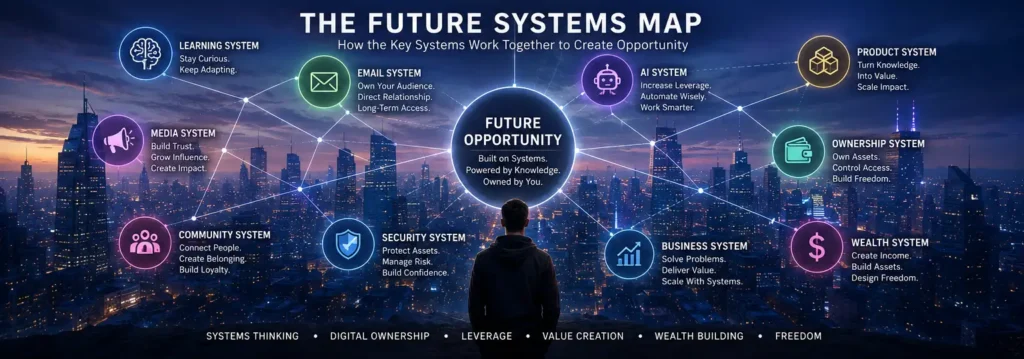
AI becomes a leverage system. Media becomes a trust system. Digital ownership becomes a control system. Business becomes a value system. Wealth creation becomes an asset system. Learning becomes an adaptation system.
That shift matters because confidence does not come from knowing everything. Confidence comes from understanding enough to make better decisions.
What People Should Build Now
The practical question is simple: what should people start building?
The answer will be different for every person and business, but the foundation is similar.
- Build a learning system so you can keep adapting.
- Build a media system so people understand what you stand for.
- Build an ownership system so you are not dependent only on platforms.
- Build an AI system so you can create leverage instead of noise.
- Build a product or service system so your knowledge can create value.
- Build a wealth creation system so income can become assets and options.
These systems do not need to be complicated at the beginning. A simple website, a clear message, a useful content plan, an email list, a digital product idea, and a weekly learning routine can be a strong start.
The key is to stop thinking only in terms of tasks and start thinking in terms of systems.
Final Thought
The future will keep changing. Tools will change. Platforms will change. Business models will change. Skills will change. Markets will change.
But systems thinking will remain valuable because it helps people understand change instead of simply reacting to it.
The future belongs to people who understand systems — because systems reveal how value is created, how ownership is built, how technology creates leverage, and how people can adapt with more confidence.
The next advantage is not just using better tools. The next advantage is understanding the systems behind them.
Want to follow this conversation? Read more on the Curtis Randall B-Log, explore resources on My Creative Gear, or connect through the Contact page.