
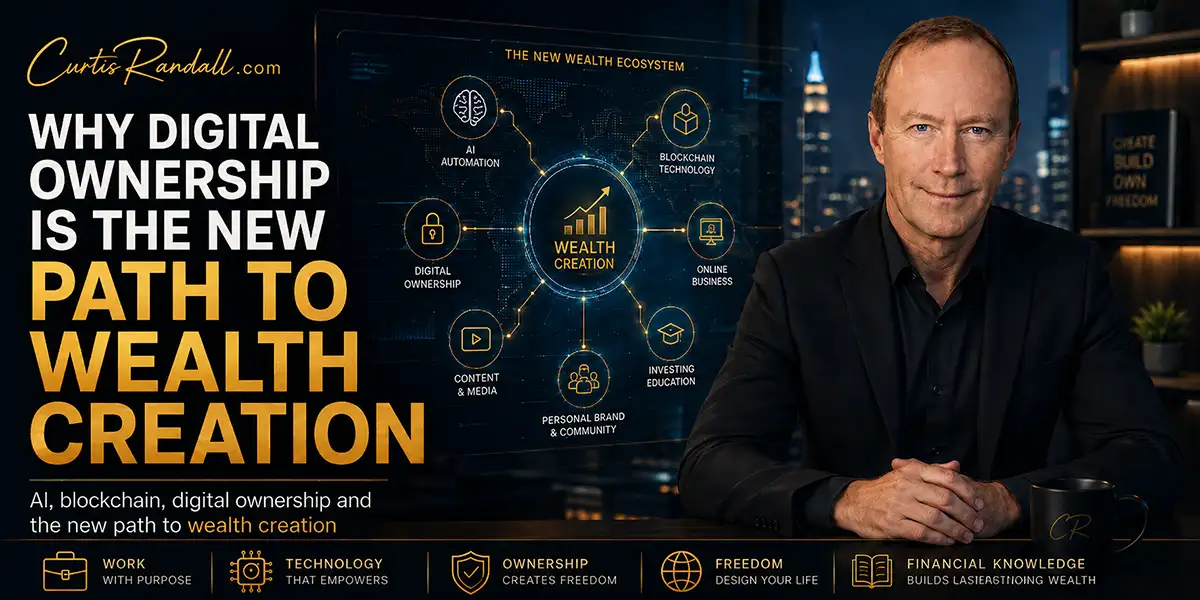
Why Digital Ownership Is the New Path to Wealth Creation
The world is moving into a new era of wealth creation. Work is changing. Technology is changing. AI is changing how tasks are completed. Blockchain is changing how people think about ownership. Digital platforms are changing how people build audiences, income, products, communities, and opportunity.
For decades, most people were taught to think about wealth through traditional paths: get a stable job, save money, buy a home, invest slowly, and build a career over time. That path still matters, but it is no longer the whole picture.
The next generation of opportunity will not only belong to people who work hard. It will belong to people who understand how value is created, how digital assets are built, how ownership works online, and how technology can be used to create leverage.
That is why digital ownership is becoming one of the most important ideas in the future of wealth creation.
This is not about hype. It is not about chasing every new coin, trend, platform, or tool. It is about understanding a much bigger shift: the people who own digital assets, digital systems, digital audiences, digital products, and digital knowledge will have more control over their future than those who only rent space on other people’s platforms.
The future belongs to people who understand ownership.
What Digital Ownership Really Means
Digital ownership is the ability to control, build, transfer, monetize, or benefit from assets that exist in the digital world.
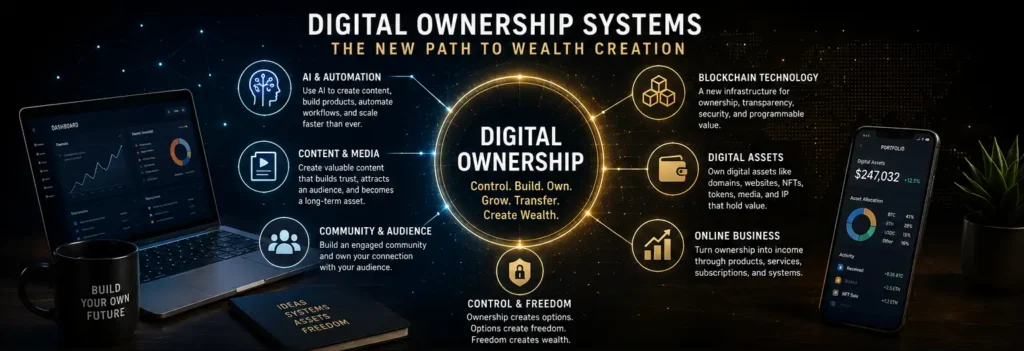
That can include a website, email list, digital product, online course, content library, software tool, personal brand, online community, paid newsletter, intellectual property, digital media archive, blockchain wallet, tokenized asset, domain name, or even the systems behind how your knowledge is packaged and sold.
Some digital ownership is simple. If you own your website, your email list, and your products, you have more control than someone who only posts on social media. Other forms of digital ownership are more advanced, such as crypto assets, tokenized value, smart contracts, and blockchain-based systems.
The point is not that every digital asset is valuable. Many are not. The point is that the future economy is becoming more digital, and the people who understand how digital value is created will have more options.
Ownership creates options. Options create freedom. Freedom is one of the deeper goals of wealth creation.
Why Renting Attention Is Not Enough
Most people are building their digital lives on rented land.
They post on social media platforms they do not control. They build audiences inside algorithms they do not own. They depend on marketplaces that can change rules overnight. They publish content inside systems where visibility can disappear without warning.
These platforms can be useful. YouTube, LinkedIn, Instagram, TikTok, X, Facebook, and other platforms are powerful tools for visibility. They can help people reach an audience, share ideas, and build trust. But visibility is not the same as ownership.
If your entire business depends on a platform you do not control, your income is fragile. If your audience only exists inside someone else’s algorithm, your influence is fragile. If your work creates value for a platform but does not build an asset for you, your future is fragile.
Digital ownership changes the equation.
Your website, your email list, your intellectual property, your paid resources, your content archive, your digital products, and your brand are all assets that can support long-term value. They give you a stronger foundation than attention alone.
Attention can help you grow. Ownership helps you build.
AI Makes Digital Ownership More Important
AI is changing how work gets done. Research, writing, planning, design exploration, coding, content production, customer support, workflow automation, and business analysis can now be accelerated with AI tools.
That creates a major shift. If AI can help people create faster, then simply creating more content will not be enough. The advantage moves from output to ownership, judgment, positioning, systems, and trust.
The World Economic Forum’s Future of Jobs Report 2025 points to major changes in skills, work, and technology adoption. The OECD’s research on the future of work also highlights how AI can increase productivity while forcing people and organizations to adapt.
The message is clear: AI is not just another tool. It is a force changing how value is produced.
When production becomes easier, ownership becomes more important.
Anyone can use AI to generate content. Fewer people will know how to turn that content into an owned system. Fewer people will know how to build an audience they can reach directly. Fewer people will know how to create products, services, frameworks, tools, and assets that produce value over time.
That is where wealth creation begins to separate from activity.
Digital Assets Are the Building Blocks of Modern Wealth
A digital asset is anything online that can create value, support income, increase influence, or become part of a larger system.
A blog post can be a digital asset. A YouTube video can be a digital asset. A course can be a digital asset. A downloadable template, guide, prompt pack, email list, private community, podcast, brand, or software tool can all become digital assets.
The mistake many people make is treating content as disposable. They publish something, get a few views, and move on. But strong content can become part of a digital asset system.
One article can become a video. One video can become multiple short clips. One short clip can lead people to a website. One website visit can lead to an email subscriber. One email subscriber can become a customer. One customer problem can become a product. One product can become a business system.
That is the path from content to ownership.
The future of online business will not only reward people who create. It will reward people who turn creation into systems and systems into assets.
Blockchain Introduced a New Ownership Conversation
Blockchain matters because it introduced a new way to think about digital ownership.
Before blockchain, digital files were easy to copy and difficult to verify as unique. Blockchain created a way to record ownership, transfer value, verify transactions, and build systems that do not rely entirely on traditional intermediaries.
This does not mean every blockchain project is useful. It does not mean every token is valuable. It does not mean crypto is without risk. In fact, crypto assets can be highly volatile, and regulators such as the U.S. Securities and Exchange Commission have repeatedly warned investors about risks including price volatility, fraud, hacking, platform risk, and operational failures.
But the bigger idea behind blockchain is still important: digital ownership can be recorded, transferred, and programmed in new ways.
That idea will continue to influence finance, identity, digital assets, payments, contracts, loyalty systems, communities, tokenization, and creator ownership models.
The smart approach is not hype. The smart approach is education.
People need to understand wallets, custody, private keys, exchanges, stablecoins, tokenization, scams, security, volatility, and risk management. They need to understand the difference between blockchain as a technology and crypto as an investment category.
Digital ownership is not only about crypto. But crypto and blockchain are part of the larger digital ownership conversation.
Crypto Should Be Treated as Education Before Investment
Crypto has created opportunity, but it has also created confusion. Some people see it as the future of money. Others see it only as speculation. The truth is more complex.
There are real technologies, real adoption patterns, real use cases, and real risks. Chainalysis’ 2025 Global Crypto Adoption Index shows continued global participation in crypto markets, with adoption varying by country and use case. At the same time, crypto remains a high-risk area that requires caution and education.
That is why the conversation should begin with understanding, not promotion.
People should understand why Bitcoin matters, how blockchains work, why custody is important, why scams happen, why volatility is real, how regulation is evolving, and how digital assets may fit into a broader future of ownership and value.
This is not financial advice. It is future literacy.
In the years ahead, more people will need to understand the language of digital assets, even if they never become active crypto investors. Just as people had to learn the internet, online banking, social platforms, and digital media, they will need to understand the basic principles of blockchain and digital ownership.
Wealth Creation Is About Value, Not Hype
Wealth creation is often misunderstood. It is not only about getting rich. It is not only about investing. It is not only about money.
At its core, wealth creation is about building value that can grow, support freedom, and create options over time.
That value can come from skills, knowledge, relationships, products, intellectual property, systems, digital assets, investments, ownership, or business models. The key is that wealth creation requires a shift from short-term activity to long-term asset thinking.
Many people are busy. Fewer people are building assets.
Digital ownership forces a better question: what are you building that can continue to create value?
- Are you building an audience you can reach directly?
- Are you building a website that becomes an authority hub?
- Are you building products that can be sold more than once?
- Are you building content that compounds over time?
- Are you building knowledge that others will pay to access?
- Are you building systems that make your work more valuable?
- Are you building ownership instead of only activity?
These are the questions that matter in the new economy.
The Creator Economy Was the First Signal
The creator economy showed that individuals could build influence, income, media platforms, communities, and businesses without waiting for traditional gatekeepers.
That was a major shift. But the creator economy was only the beginning.
The next stage is not just about being a creator. It is about becoming an owner.
Creators who only post content are vulnerable to platform changes. Creators who build websites, email lists, products, communities, intellectual property, and trusted authority are building something more durable.
This same idea applies to professionals, consultants, business owners, educators, coaches, speakers, and companies. The future will reward those who can turn knowledge into owned systems.
Audience is useful. Ownership is powerful.
Digital Ownership and the Future of Work
The future of work will not be defined only by jobs. It will also be defined by skills, platforms, networks, systems, assets, and ownership.
Some people will work traditional jobs. Some will build businesses. Some will freelance. Some will consult. Some will invest. Some will create digital products. Some will build communities. Some will combine several of these paths.
The important point is that people will need more than one way to create value.
AI will make certain tasks easier to automate. Digital platforms will continue to shift attention. Blockchain will keep pushing conversations around ownership and value. Online business models will keep evolving. Financial systems will continue to change.
In that environment, digital ownership becomes a form of resilience.
It gives people more than a job title. It gives them assets, skills, leverage, visibility, and optionality.
What People Should Start Owning
Digital ownership can sound complicated, but it can start with simple practical steps.
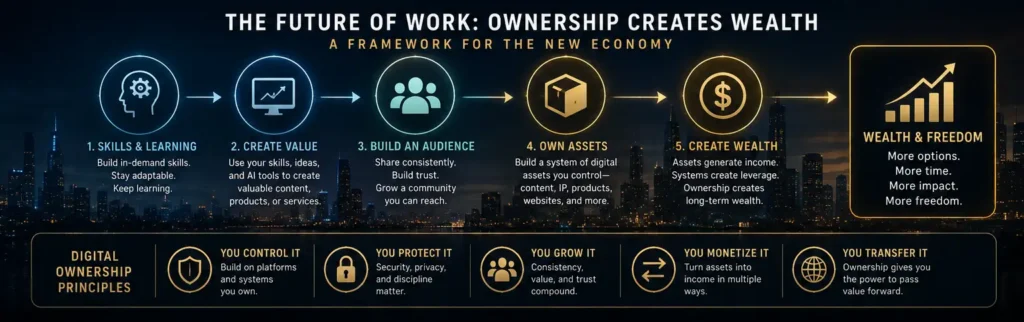
People should start by owning their digital foundation. That means having a website, a clear personal or business brand, a basic content library, an email list, and a way to package knowledge into useful resources.
From there, ownership can expand into digital products, paid guides, templates, courses, workshops, private communities, software tools, consulting frameworks, media properties, and intellectual property.
For some people, digital ownership may eventually include crypto assets, blockchain wallets, tokenized assets, or digital collectibles. For others, it may simply mean building a stronger online business foundation.
Not everyone needs the same path. But everyone should understand the concept.
Because the future will increasingly reward people who own something valuable in the digital world.
Digital Ownership Requires Responsibility
Ownership also requires responsibility.
If you own a website, you need to maintain it. If you build an audience, you need to serve it. If you create a product, you need to make it useful. If you invest in digital assets, you need to understand risk. If you use AI, you need judgment. If you use blockchain, you need security awareness.
Digital ownership is not passive. It is active. It requires learning, discipline, and better decision-making.
That is why the path to wealth creation is not just about having access to tools. It is about having the literacy to use those tools wisely.
The future will create new opportunities, but it will also create new risks. The people who take time to understand both will be in a stronger position.
The New Wealth Skill Is Understanding Systems
The future belongs to people who understand systems.
Work systems. Technology systems. Ownership systems. Wealth systems.
AI is a system of leverage. Blockchain is a system of ownership. Content is a system of trust. Digital products are systems of scalable value. Personal brands are systems of reputation. Online businesses are systems of distribution and monetization.
Once you start seeing the world this way, wealth creation becomes less mysterious.
It is not about luck. It is not about chasing every trend. It is not about trying to predict every market. It is about understanding how value moves, how trust is built, how assets are created, and how ownership compounds over time.
Digital ownership is the bridge between technology and wealth creation.
Final Thought
Digital ownership is not a buzzword. It is a shift in how people create value, build opportunity, and protect their future.
The future of work will continue to change. AI will keep accelerating production. Blockchain will keep challenging old ideas about ownership. Digital platforms will keep reshaping visibility and income. The people who understand these forces will have more options than those who ignore them.
That is why digital ownership matters.
It is the new path to wealth creation because it helps people move from renting attention to owning assets, from activity to systems, and from dependence to more control over their future.
The future belongs to people who understand ownership — and know how to turn digital value into lasting opportunity.
Want to follow this conversation? Read more on the Curtis Randall B-Log, explore practical tools on My Creative Gear, or connect through the Contact page.