
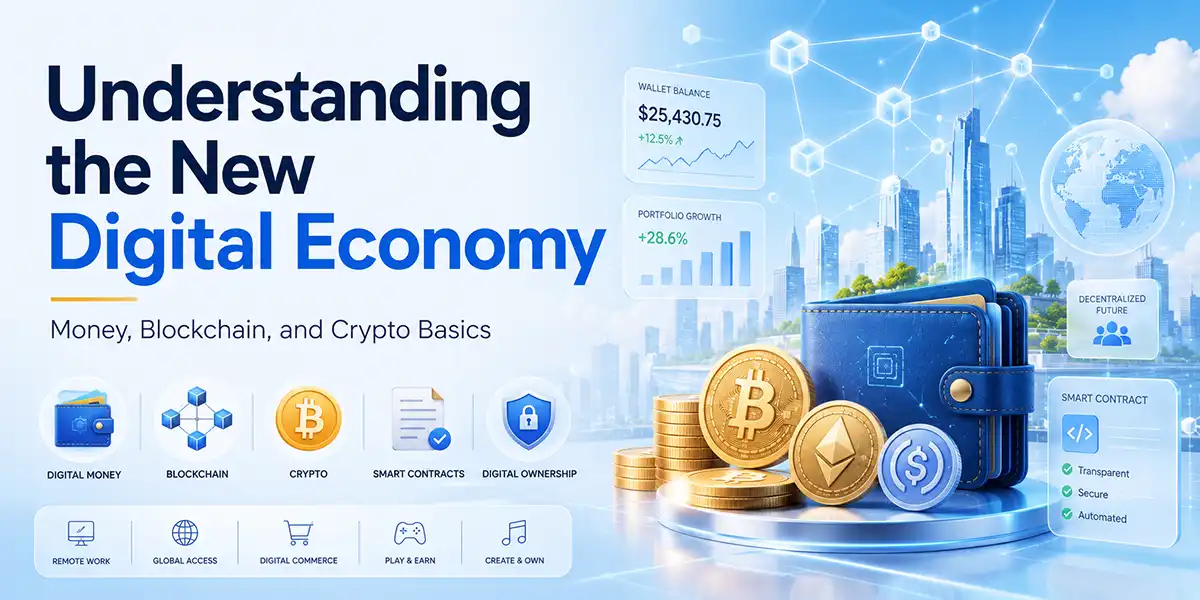
Understanding the New Digital Economy: Money, Blockchain, and Crypto Basics
The new digital economy is not only about artificial intelligence, automation, media, and online business. It is also about money, ownership, value, trust, and the systems that move wealth through the internet.
That is why blockchain and crypto basics are becoming important for more people and organizations to understand. Not because everyone needs to become a trader. Not because every new coin matters. Not because hype should replace common sense. But because the digital economy is changing how people think about money, assets, ownership, identity, transactions, and financial opportunity.
Before people can understand digital ownership, future work, automation, creator business, or digital wealth creation, they need to understand a few basic ideas: what money is, why trust matters, what blockchain does, what crypto assets are, and why these systems are part of a much bigger shift.
This article is not financial advice. It is a simple foundation for understanding the systems behind the future digital economy.
Why Money Is the Starting Point
Most people use money every day without thinking deeply about what money actually is. We earn it, spend it, save it, borrow it, invest it, and measure value with it. But money is more than paper, coins, bank balances, credit cards, or numbers on a screen.
Money is a system of trust.
At its simplest, money helps people exchange value. It allows people to trade work, products, services, time, or assets without needing to barter directly. Instead of trading one thing for another, money becomes the bridge between value and exchange.
Money is often explained through three core functions: it acts as a medium of exchange, a store of value, and a unit of account.
- A medium of exchange: something people can use to buy and sell.
- A store of value: something people can hold for future use.
- A unit of account: something people can use to measure prices, income, debt, and value.
Once you understand those three ideas, it becomes easier to understand why digital money, blockchain, and crypto matter. They are not only about technology. They are about how value is recorded, transferred, stored, verified, and trusted in a digital world.
Money Has Already Become Digital
Many people think digital money is something new. But most people already use digital money every day.
When you use a debit card, receive a bank transfer, pay a bill online, send money through an app, buy something from an online store, or get paid by direct deposit, you are already using digital money systems.
The important question is not whether money is digital. It already is.
The bigger question is: who controls the system, who verifies the transaction, who owns the record, who has access, and how much trust is required between the people involved?
Traditional digital money usually depends on banks, payment companies, governments, and financial institutions. Those systems are familiar and useful, but they are usually centralized. That means trusted organizations sit in the middle of the transaction.
Blockchain introduced a different idea: what if a network could record and verify transactions without one central company controlling the entire ledger?
What Is Blockchain?
A blockchain is a digital record system. It is often described as a shared ledger because many participants can hold and verify the same record of transactions.
The word “blockchain” comes from the way information is organized. Transactions are grouped into blocks, and those blocks are linked together in a chain. Each new block connects to the previous one, creating a history that is difficult to change without the network noticing.
That is the key idea: blockchain is a system for creating trust in a digital environment.
Instead of one company holding the only record, a blockchain can allow many computers across a network to help maintain and verify the record. Depending on the blockchain, this can create transparency, security, and resistance to tampering.
This does not mean every blockchain is useful. It does not mean every project is valuable. It does not mean every crypto asset is safe. But the underlying idea is important because it changes how people think about ownership, verification, and trust online.
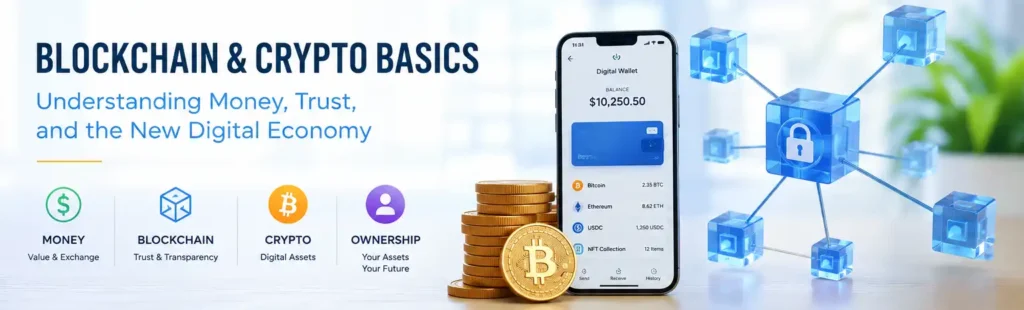
Why Bitcoin Was Such a Big Idea
Bitcoin brought blockchain into public awareness because it introduced a new kind of digital money system.
The original Bitcoin idea was built around peer-to-peer electronic cash. Peer-to-peer means people can transact directly with each other through a network rather than relying on one central authority to approve every transaction.
That was a major shift because digital money had always faced a difficult problem: how do you stop the same digital money from being copied and spent twice?
Bitcoin’s answer was to use a public transaction history, cryptographic proof, network agreement, and economic incentives. In simple terms, the network keeps a shared record of transactions so participants can agree on what happened.
Whether someone loves Bitcoin, dislikes Bitcoin, or has no interest in owning it, the concept changed the conversation. It showed that digital value could exist in a networked form outside the traditional idea of one company or institution controlling the entire ledger.
What Is Crypto?
Crypto is a broad term for digital assets that use cryptography and blockchain-based systems. Bitcoin is the most well-known example, but crypto has expanded far beyond Bitcoin.
Some crypto assets are designed to act like digital money. Others are used to power blockchain networks. Some are connected to applications, communities, games, digital collectibles, decentralized finance, or ownership rights inside a platform.
This is where people can easily get confused, because not every crypto asset does the same thing.
A simple way to think about it is this:
- Bitcoin is often discussed as digital money or digital store-of-value technology.
- Ethereum is often discussed as a programmable blockchain network for applications and smart contracts.
- Stablecoins are digital tokens designed to track the value of another asset, often a fiat currency such as the U.S. dollar.
- Utility tokens may provide access or function inside a specific network or application.
- NFTs are tokens that can represent unique digital items, membership, media, collectibles, identity, or ownership records.
The important point is that crypto is not one thing. It is a category of technologies, assets, experiments, networks, and business models. Some may become important. Some may fail. Some may be risky. Some may be scams. This is why education matters.
What Are Smart Contracts?
One of the biggest ideas in blockchain is the smart contract.
A smart contract is code that can run on a blockchain. Instead of only recording that a transaction happened, a programmable blockchain can also run rules. This allows developers to build applications that can move assets, manage agreements, create digital tokens, support decentralized finance, or power other digital systems.
Ethereum describes smart contracts as programs that run on the Ethereum blockchain. This idea helped expand blockchain from a record system into a programmable system.
That is why blockchain is not only about money. It can also be about ownership, access, contracts, communities, identity, media, royalties, digital products, and automated business processes.
This is where blockchain connects to the future of work and digital ownership. If more of the economy becomes digital, then the systems that define who owns what, who can access what, and how value moves become more important.
Digital Ownership Is Bigger Than Crypto Prices
Many people only hear about crypto when prices go up or down. That is understandable because markets get attention. But the more important long-term conversation may be digital ownership.
Digital ownership asks a bigger question: in a digital world, what do you actually own?
Do you own your audience, or are you renting attention from a platform? Do you own your content library, or is it locked inside a social network? Do you own your digital products, your customer relationships, your data, your assets, your identity, or your community?
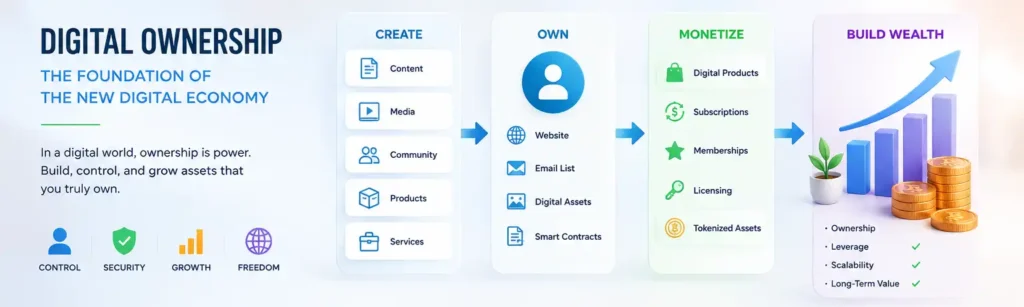
This matters because more work, commerce, education, entertainment, and communication are moving through digital systems. The people and organizations that understand ownership will have a better chance of building long-term value.
Blockchain is one possible technology layer in that ownership conversation. It may not be the answer to everything, but it introduces important ideas: portable assets, verifiable records, digital scarcity, decentralized networks, and programmable value.
Crypto Is Also Risky
It is important to be honest: crypto is risky.
Prices can move quickly. Projects can fail. Scams exist. Platforms can collapse. Regulations can change. Technology can be misunderstood. People can lose money by chasing hype, trusting the wrong people, or investing in things they do not understand.
That is why the first step should not be speculation. The first step should be education.
Before getting involved with any crypto asset, people should understand the basics, consider the risks, avoid promises of guaranteed returns, protect their personal information, and never invest money they cannot afford to lose.
This is also why the conversation should be broader than “which coin will go up?” The better conversation is, what systems are changing, what new forms of ownership are emerging, what risks should people understand, and how does digital value fit into the future economy?
Why This Matters for Future Work
The future of work is not only about jobs. It is about value creation.
AI is changing how work gets produced. Automation is changing how businesses operate. Media platforms are changing how attention is built. Creator business is changing how individuals package knowledge and influence. Blockchain and crypto are changing how people think about ownership and value transfer.
These systems are connected.
A creator, consultant, entrepreneur, or organization may need to understand AI for productivity, media for visibility, websites and email lists for ownership, digital products for scalable income, and blockchain for the future of digital assets and value systems.
This does not mean everyone needs to become a technical expert. But it does mean more people need a basic understanding of the systems shaping the digital economy.
The people who understand the basics will be better prepared to ask smarter questions, avoid obvious traps, and recognize real opportunities when they appear.
A Simple Framework for Understanding the New Digital Economy
Here is a simple way to think about the new digital economy:
- Money is how we exchange, store, and measure value.
- Blockchain is a way to record and verify digital transactions through a shared ledger.
- Crypto is a broad category of digital assets built around cryptographic and blockchain systems.
- Smart contracts are programmable rules that can run on blockchain networks.
- Digital ownership is about controlling more of your assets, identity, audience, content, and value in digital spaces.
- Wealth creation is about understanding how value is created, owned, transferred, protected, and grown.
That framework is not complicated, but it is powerful. It helps move the conversation away from hype and toward understanding.
Final Thought
The new digital economy is being shaped by systems: money systems, AI systems, automation systems, media systems, ownership systems, blockchain systems, and wealth creation systems.
Blockchain and crypto are part of that bigger picture. They are not the whole future, and they are not without risk, but they are important enough to understand.
The goal is not to chase hype. The goal is to build literacy.
When people understand how money, blockchain, crypto, and digital ownership connect, they are better prepared for future work, emerging technologies, creator business, and wealth creation.
The future digital economy will reward people who understand how digital systems create, move, protect, and grow value.
Want to follow this conversation? Read more on the Curtis Randall B-Log, or connect through the Contact page.