
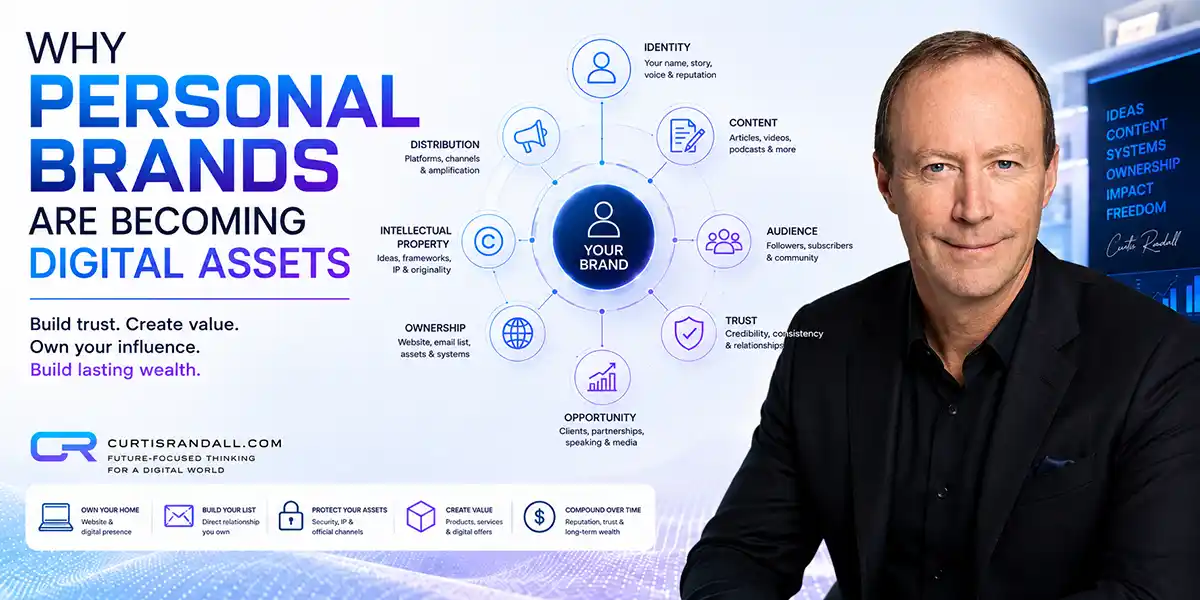
Why Personal Brands Are Becoming Digital Assets
Personal brands are no longer just about visibility.
They are becoming digital assets.
For years, personal branding was often discussed through a narrow lens: how you present yourself online, how you look on social media, how often you post, how polished your profile appears, or how recognizable your name becomes.
Those things still matter, but they are only the surface.
In the future digital economy, a personal brand can become something much more valuable. It can become a trust engine, a content library, a distribution system, an intellectual property platform, a business development tool, a media asset, a digital ownership layer, and a pathway to wealth creation.
That is a very different way to think about personal branding.
A personal brand is no longer just what people see. It is what people trust, remember, search for, share, learn from, and choose to do business with.
What Makes a Personal Brand a Digital Asset?
A digital asset is something that can create value in a digital environment. It may help generate attention, trust, leads, sales, opportunities, authority, partnerships, products, or long-term visibility.
A personal brand becomes a digital asset when it does more than represent you. It begins to work for you.
That can happen when your name is connected to useful ideas, your website explains your authority, your content builds trust, your audience understands your point of view, your frameworks become recognizable, your expertise becomes searchable, and your reputation creates opportunity even when you are not actively pitching.
This is where personal branding moves from image to infrastructure.
It becomes part of your digital ownership system.
The Future Digital Economy Runs on Trust
The future digital economy is filled with tools, platforms, automation, AI-generated content, digital products, online courses, newsletters, communities, creator businesses, virtual services, and new forms of digital ownership.
That creates enormous opportunity, but it also creates noise.
When everyone can publish, generate, automate, and distribute, trust becomes more valuable. People will need clearer signals of credibility. They will need to know who is behind the ideas, who has real experience, who can be relied on, and who is simply repeating what everyone else is saying.
The OECD’s Digital Economy Outlook examines the opportunities and challenges of the digital economy, including digital innovation, data, connectivity, and trust. Trust is not a soft issue in the digital economy. It is infrastructure.
A strong personal brand can become one of the clearest trust signals a person has.
AI Makes Personal Brands More Important, Not Less
Some people assume AI will reduce the value of personal brands because content will become easier to create. I think the opposite is true.
AI will make average content easier to produce. It will make generic posts, generic articles, generic images, generic advice, and generic summaries more common. That means people will be surrounded by more content, not necessarily more meaning.
In that environment, personal brands become more important because people will look for trusted voices. They will look for people with judgment, experience, context, taste, and a clear point of view.
AI can help produce content, but it cannot automatically create trust. It can help accelerate output, but it cannot replace lived experience, reputation, relationships, accountability, or human direction.
This is why a personal brand should not be built only on posting frequency. It should be built on clarity, credibility, consistency, and owned assets.
Your Name, Face, Voice, and Ideas Are Becoming More Valuable
In the age of AI, identity itself is becoming more valuable and more vulnerable.
Your name, face, voice, likeness, writing style, frameworks, ideas, and reputation can all become part of your digital value. They can help you build trust and opportunity. They can also be copied, imitated, misused, or misrepresented.
This is one reason intellectual property needs to be part of the personal brand conversation. The World Intellectual Property Organization has published resources on artificial intelligence and intellectual property, including the impact of generative AI on creators, copyright, innovation, and IP systems.
People who build personal brands need to think beyond visibility. They need to think about documentation, ownership, usage rights, brand assets, content libraries, licensing, attribution, and official channels.
The more your reputation matters, the more ownership matters.
A Personal Brand Should Have an Owned Home
Social platforms are useful for reach, but they should not be the only home of a personal brand.
A LinkedIn profile can build credibility. YouTube can build authority. Instagram can build familiarity. X can help with ideas and commentary. TikTok can help with reach. Facebook can help with community. But all of these platforms are still platforms you do not control.
Your personal brand needs an owned home.
That usually starts with a website.
A website gives your personal brand structure. It can organize your story, articles, services, products, media, awards, speaking topics, contact path, authority content, and broader ecosystem. It gives search engines, AI systems, potential clients, partners, journalists, and followers a clear place to understand who you are and what you stand for.
This is one of the reasons I continue building CurtisRandall.com as my personal authority hub, while using Sights.com as a broader education platform for the future digital economy.
Reach belongs on platforms. Authority should live somewhere you own.
Content Turns a Personal Brand Into a Searchable Asset
A personal brand becomes more valuable when it is supported by a content library.
Without content, people may know your name but not understand your thinking. With content, people can see how you explain ideas, solve problems, connect trends, make decisions, and guide others.
Articles, videos, podcasts, newsletters, guides, frameworks, posts, talks, and interviews all help transform reputation into a searchable body of work.
This matters because people increasingly discover authority through search, social platforms, AI summaries, video clips, recommendations, and content ecosystems. If your ideas are not documented, they are harder to find, trust, share, and build upon.
Content is not just marketing. It is evidence.
It shows what you know. It shows how you think. It shows why your perspective matters.
Personal Brands Can Become Product Platforms
One of the biggest shifts in the creator economy is that personal brands can become product platforms.
A person can turn knowledge into books, courses, templates, guides, workshops, digital products, paid newsletters, memberships, consulting frameworks, software tools, speaking topics, or communities.
This is where personal branding connects to wealth creation.
A personal brand that only creates attention may be fragile. A personal brand that creates trust, captures knowledge, builds owned relationships, and offers useful products or services becomes more durable.
McKinsey has written about how companies are using AI and generative AI to scale personalization and improve digital customer interactions through its research on the next frontier of personalized marketing. The same broader idea applies to personal brands: the future belongs to people who can build more relevant, useful, and trusted relationships at scale.
Products are not separate from the brand. They are expressions of the brand’s value.
The Personal Brand Stack
A strong personal brand is not built from one thing. It is built as a stack.
The personal brand stack includes:
- Identity: Your name, positioning, story, face, voice, and public presence.
- Authority: Your experience, point of view, credibility, and proof.
- Content: Your articles, videos, podcasts, talks, guides, and posts.
- Audience: The people who follow, trust, subscribe, share, or buy from you.
- Ownership: Your website, domain, email list, IP, products, and systems.
- Opportunity: Clients, speaking, partnerships, products, media, and business development.
When these layers work together, the personal brand becomes more than visibility. It becomes an asset system.
Personal Brands Are Not Just for Influencers
One of the biggest misunderstandings about personal branding is that it is only for influencers.
That is not true anymore.
Personal brands matter for executives, consultants, creators, founders, advisors, educators, professionals, authors, speakers, freelancers, investors, and anyone whose reputation creates opportunity.
In a digital economy, people want to know who is behind the work. They want to understand the thinking, credibility, values, and experience behind the message. A company brand can build trust, but a human brand often makes that trust more relatable.
This is especially important as AI-generated content grows. Human credibility becomes a differentiator.
What Makes a Personal Brand Valuable?
A personal brand becomes valuable when it creates trust that can lead to opportunity.
That value can show up in many ways:
- People search for your name.
- People understand what you stand for.
- People trust your judgment.
- People share your ideas.
- People invite you into conversations.
- People ask for your guidance.
- People buy your products or services.
- People recommend you when you are not in the room.
- People connect your name to a specific subject or point of view.
That is not vanity. That is market signal.
When reputation creates opportunity, the personal brand has become an asset.
Digital Ownership Protects the Brand Asset
If a personal brand is becoming a digital asset, it needs protection.
That means owning your domain, securing your accounts, organizing your content, protecting your images and brand assets, documenting your frameworks, keeping your website updated, building an email list, and making your official channels clear.
It also means being careful about what you publish, what tools you use, how your likeness appears, and how your ideas are represented.
In the age of AI, trust can be created quickly, but it can also be damaged quickly. People need to take more responsibility for their digital presence.
Digital ownership is how a personal brand becomes more resilient.
How to Start Building Your Personal Brand as a Digital Asset
The process does not need to be complicated, but it does need to be intentional.
Start with clarity. What do you want to be known for? What subject do you understand deeply? What problems can you help people think through? What experience gives your perspective weight? What ideas are worth documenting?
Then build the foundation:
- Own your name or brand domain if possible.
- Create or improve your personal website.
- Write authority articles that explain your thinking.
- Turn your knowledge into repeatable frameworks.
- Use social platforms for reach, not dependency.
- Build an email list or direct audience path.
- Protect your images, identity, and official channels.
- Create products, guides, or services that turn your expertise into value.
Most people will not do this. They will keep posting without building. That creates an opening for the people who think more strategically.
Do not just build attention. Build an asset.
Final Thought
Personal brands are becoming digital assets because trust, identity, content, ownership, and opportunity are becoming more connected.
AI will make content easier to create. Platforms will continue changing. Digital ownership will become more important. Intellectual property will become more complicated. People will need clearer signals of trust and authority.
In that environment, a strong personal brand can become one of the most valuable assets a person builds.
Your personal brand is not just how people see you. It is how your ideas, reputation, content, trust, and ownership create value over time.
That is why personal brands are becoming digital assets.
Explore More
Read more future-focused articles on the Curtis Randall B-Log, explore the broader future digital economy on Sights.com, or reach out through the Contact page.

About the Author
Curtis Randall is an award-winning creative executive and future systems thinker helping people and businesses understand the future of work, technology, digital ownership, and creativity. Through CurtisRandall.com, and Sights.com, Curtis explores the systems shaping how people work, create, own, and build value in a rapidly changing world.
Connect with Curtis: LinkedIn · YouTube · Instagram · X · TikTok · Facebook · Threads