
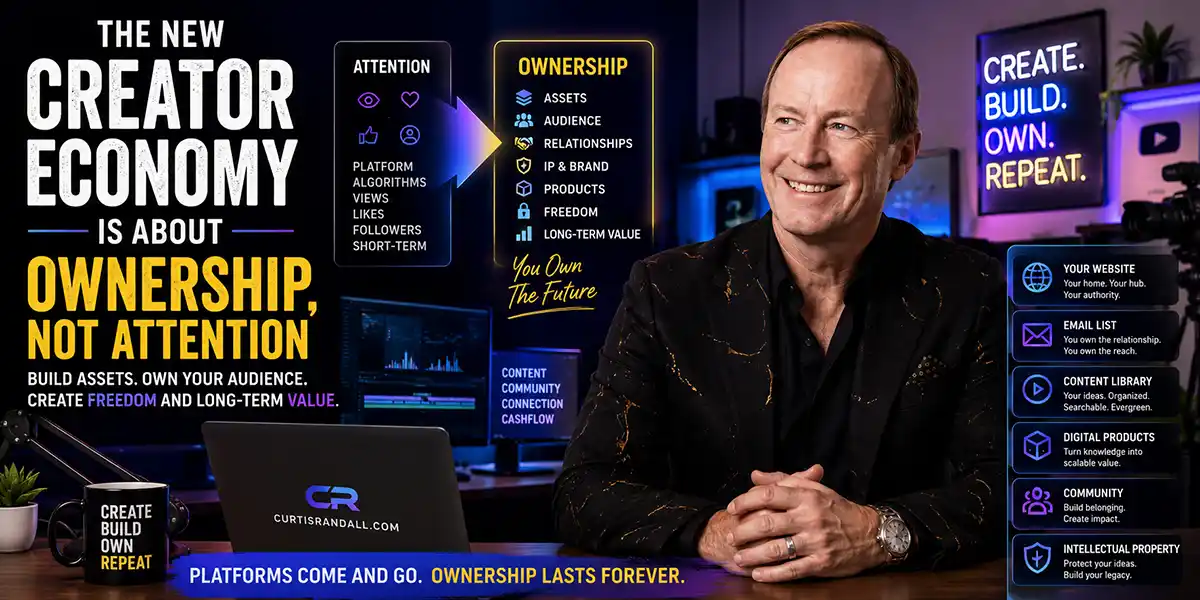
The New Creator Economy Is About Ownership, Not Attention
The creator economy is entering a new stage.
The first stage was about attention. Build a following. Post consistently. Grow your audience. Get views. Get likes. Get subscribers. Work with brands. Monetize platforms. Become visible.
That stage changed the world. It gave individuals more power to publish, teach, entertain, influence, educate, and build businesses without waiting for traditional gatekeepers.
But attention alone is no longer enough.
The new creator economy is about ownership. It is about owning your audience relationships, your content library, your intellectual property, your products, your distribution systems, your brand, and your long-term value.
The creators who understand this shift will have a stronger chance of building something durable. The creators who only chase attention may find themselves working harder while owning less.
The Attention Era Built the Creator Economy
The attention era was important because it opened the door for millions of creators.
Platforms like YouTube, Instagram, TikTok, Facebook, LinkedIn, podcasts, newsletters, and streaming tools gave individuals the ability to reach audiences directly. A creator did not need a television network, publishing deal, agency, studio, or large media budget to be seen.
This created a powerful shift. Individuals could become media companies. Experts could become educators. Entertainers could build communities. Professionals could share knowledge. Small businesses could reach customers in ways that used to be impossible.
Deloitte’s research on the creator economy describes a global phenomenon where creators and social platforms have become deeply connected, with an estimated 50 million creators serving billions of social media users worldwide. The same research also notes that the relationship between creators and platforms may be approaching a critical juncture as the ecosystem matures. Deloitte
That is the key point: the creator economy is maturing.
And as it matures, the winners will not only be the people who attract attention. They will be the people who convert attention into ownership.
Attention Is Useful, But It Is Fragile
Attention matters. Without attention, people may never discover your ideas, products, services, or point of view.
But attention is fragile when it is built only on platforms you do not control.
Algorithms change. Reach can drop. Accounts can be restricted. Monetization rules can shift. Platform priorities can move overnight. A format that works one year can disappear the next. A creator can have a large following and still struggle to reach their own audience.
This is the weakness of attention without ownership.
If a creator’s entire business depends on one platform, one algorithm, one brand deal, or one style of content, the business is exposed. That does not mean platforms are bad. It means platforms should be used strategically.
Use platforms for reach. Build ownership for resilience.
Ownership Is the Next Creator Advantage
Ownership gives creators more control over the value they create.
That can include a website, email list, customer list, content library, digital products, online courses, paid community, intellectual property, frameworks, brand assets, podcast archive, video library, newsletter, membership, or software tool.
Ownership is not about rejecting platforms. It is about making sure your platform activity builds something that lasts beyond the feed.
A viral post can create attention for a day. A strong article can become part of a searchable content library. A short video can bring someone into your email list. A free guide can introduce someone to a paid product. A podcast can build authority. A community can build trust. A framework can become intellectual property.
That is the ownership mindset.
The new creator economy is not only about creating more content. It is about creating assets.
The Creator Economy Is Becoming a Business System
The creator economy is often discussed as if it is mainly about posting content. That is too narrow.
A serious creator business is a system. It may include content strategy, audience development, brand positioning, product design, email marketing, partnerships, digital sales, community building, analytics, intellectual property, and owned media.
This is why the best creators often behave more like founders than entertainers. They are not only making posts. They are building systems around trust.
That shift matters for professionals, experts, educators, consultants, media personalities, creators, and entrepreneurs. In the future digital economy, the ability to turn knowledge, attention, and trust into owned assets will become increasingly important.
This is also why I see creator economy ownership as part of a much larger conversation around future work, digital ownership, and wealth creation.
Audience Ownership Matters More Than Follower Counts
Follower counts can be useful, but they can also be misleading.
A creator may have a large following and still have weak business results. Another creator may have a smaller audience but stronger trust, better products, direct relationships, and more reliable income.
The difference often comes down to audience ownership.
Audience ownership means building direct relationships with people who want to hear from you outside of algorithm-controlled feeds. That may include an email list, newsletter, membership, community, customer database, private group, or direct subscription model.
When you own more of the relationship, you are less dependent on platform reach. You can communicate more directly. You can learn what people need. You can offer products, services, or resources with more control. You can build trust over time.
This is one of the most important shifts creators need to make.
Do not only ask, “How many followers do I have?” Ask, “How many relationships am I building that I can continue to serve?”
Content Libraries Are More Valuable Than Content Feeds
A feed moves quickly. A library compounds.
This is one of the simplest ways to understand the difference between attention and ownership.
A social post may be seen for a short period. A searchable article, podcast episode, YouTube video, guide, course, or resource can continue to create value long after it is published.
That does not mean feeds are useless. Feeds help with discovery. But creators should also build libraries that organize their ideas, frameworks, lessons, and point of view.
A content library can support search visibility, AI discoverability, product development, authority building, audience education, speaking, consulting, partnerships, and long-term credibility.
This is one reason a personal website still matters. On CurtisRandall.com, the B-Log gives my ideas a home. On Sights.com, future digital economy education can be organized into a broader learning platform.
Feeds create motion. Libraries create memory.
AI Will Make Ownership Even More Important
AI is going to change the creator economy in a major way.
It will make it easier to write, edit, design, produce, summarize, translate, repurpose, and distribute content. That will help creators move faster, but it will also flood the internet with more generic output.
When content becomes easier to make, trust becomes more valuable. Originality becomes more important. Point of view becomes more important. Identity, voice, experience, and intellectual property become more important.
The World Intellectual Property Organization has highlighted how generative AI is accelerating the need for stronger copyright infrastructure to protect creators while still allowing innovation to continue. WIPO
This matters because creators will need to think more carefully about what they own, what they license, what tools they use, how their work is protected, and how their identity is represented.
In the AI era, creator ownership is not optional. It is protection.
Intellectual Property Is a Creator Asset
One of the most underused assets in the creator economy is intellectual property.
Creators often produce ideas, frameworks, phrases, methods, formats, visuals, lessons, and systems without organizing them into anything ownable or recognizable.
That is a missed opportunity.
Intellectual property can include original frameworks, course material, books, brand names, scripts, visual systems, training methods, templates, guides, and repeatable concepts. These assets can support products, licensing, education, consulting, speaking, and long-term brand value.
The creator economy should not only be about more content. It should be about creating ideas worth owning.
That is how creators move from posting to building.
Digital Products Turn Attention Into Ownership
Digital products are one of the clearest ways creators can move from attention to ownership.
A digital product might be a guide, template, workbook, online course, paid report, resource library, membership, toolkit, or software-based solution. It turns knowledge into something useful, repeatable, and scalable.
This is important because a creator who only earns from views, sponsorships, or platform payouts may remain dependent on systems they do not control. A creator with their own products has more control over pricing, positioning, customer relationships, and long-term value.
Digital products do not have to replace brand deals or platform monetization. They can complement them. But they change the business model because they shift the creator from attention seller to asset owner.
That is a major difference.
Community Is More Valuable Than Passive Reach
Another important shift is from passive reach to active community.
A large audience is not always a strong community. An audience watches. A community participates. An audience may follow. A community may belong.
Community can create stronger relationships, better feedback, deeper trust, product ideas, recurring revenue, collaboration, and long-term loyalty. It can also make a creator less dependent on constantly chasing new attention.
This is especially valuable in an environment where social feeds are crowded and attention is expensive.
The new creator economy will reward people who can build relationships, not just impressions.
Brands Will Also Need to Think Differently
This shift affects brands as well as creators.
For years, many brands treated creators mainly as rented attention. Pay for a post. Borrow an audience. Use a face. Run a campaign. Move on.
That model still exists, but it is not the most mature version of the creator economy.
Deloitte’s work on social commerce notes that younger consumers often look to creators for purchase guidance, with its 2023 Creator Economy in 3D research finding that 35% of Gen Z consumers look to content creators to guide purchase decisions. Deloitte
If creators influence trust and purchase decisions, brands should think beyond one-off attention buys. They should think about deeper partnerships, authentic education, product alignment, shared value, and long-term audience trust.
The creator economy is becoming more strategic. Brands that understand that will build better relationships with creators and audiences.
The Creator Ownership Stack
A mature creator business needs a creator ownership stack.
That stack may include:
- Identity: Your name, positioning, values, and point of view.
- Audience: The people who follow, trust, subscribe, buy, and participate.
- Owned media: Your website, blog, podcast, newsletter, video library, and resource hub.
- Relationships: Email lists, communities, customers, partners, and direct channels.
- Intellectual property: Frameworks, courses, guides, methods, brands, and original content.
- Products: Digital products, memberships, workshops, books, tools, and services.
- Systems: AI workflows, publishing systems, sales systems, analytics, and customer experience.
This stack is what turns a creator from someone who posts into someone who builds.
What Creators Should Start Building Now
The shift from attention to ownership does not need to happen overnight. But creators should start moving in that direction now.
Start with the basics:
- Own a domain and build a proper website.
- Create an email list or direct audience channel.
- Organize your best content into a searchable library.
- Document your frameworks, methods, and ideas.
- Create a small digital product that solves a specific problem.
- Build one owned community or direct relationship path.
- Use AI to improve workflows, not replace your point of view.
- Think about intellectual property before your ideas are copied or diluted.
This is not about abandoning attention. It is about making attention lead somewhere.
Attention should lead to trust. Trust should lead to relationship. Relationship should lead to ownership. Ownership should lead to long-term value.
Why This Matters for the Future Digital Economy
The creator economy is not separate from the future digital economy. It is one of its clearest examples.
Creators use digital platforms, AI tools, content systems, digital products, communities, intellectual property, personal brands, and direct audience relationships to create value. That is the future digital economy in action.
The next stage will not be defined only by who gets the most attention. It will be defined by who builds the strongest systems of trust, ownership, and value.
This matters for creators. It also matters for businesses, professionals, educators, consultants, and anyone who wants to build authority in a digital world.
The future is not just about being seen. It is about owning more of what your visibility creates.
Final Thought
The creator economy began with attention, but it cannot end there.
Attention helped creators become visible. Ownership will help them become resilient.
The new creator economy is about building digital assets, direct audience relationships, intellectual property, products, communities, and systems that create long-term value.
The creators who win the next stage will not only be the ones who get attention. They will be the ones who turn attention into ownership.
That is the shift every creator needs to understand.
Explore More
Read more on the Curtis Randall B-Log, explore future-focused education on Sights.com, or connect through the Contact page.
About the Author
Curtis Randall is an award-winning creative executive and future systems thinker helping people and businesses understand and adapt to the future of work, creativity, technology, digital ownership, and wealth creation. Through CurtisRandall.com and Sights.com, Curtis explores the systems shaping how people work, create, own, and build value in a rapidly changing world.
Connect with Curtis: LinkedIn · YouTube · Instagram · X · TikTok · Facebook · Threads