
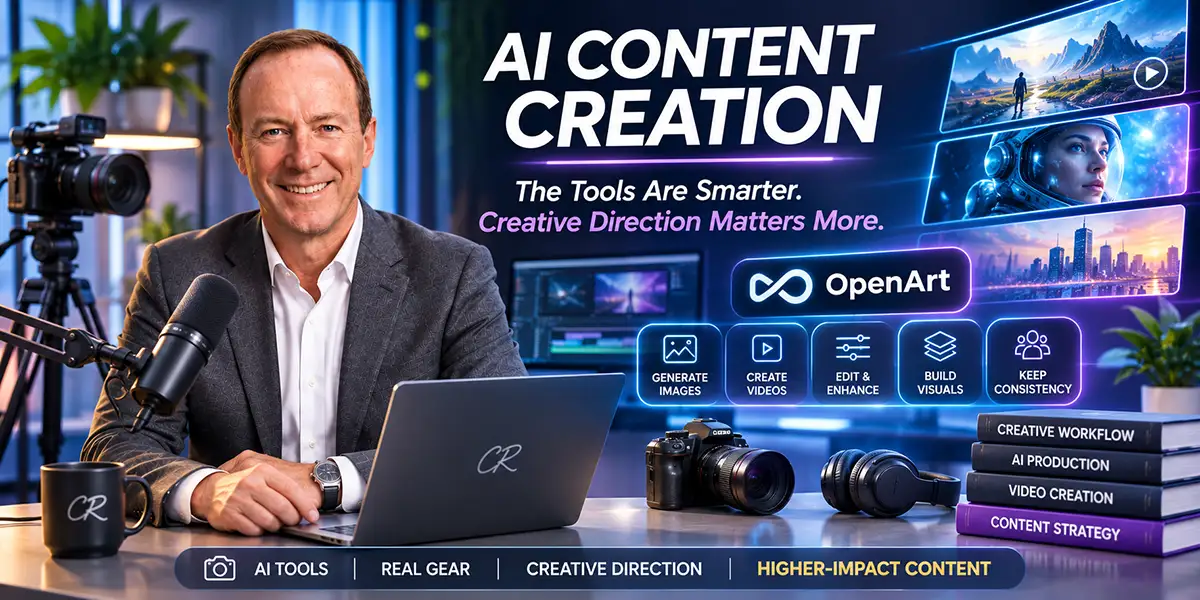
AI Content Creation: The Tools Are Getting Smarter. Your Creative Direction Matters More.
The content creation industry has a supply problem.
For years, we told everyone to create more. Publish more articles. Produce more videos. Post more frequently. Build more social content. Feed the algorithms. Stay visible.
Then artificial intelligence arrived and made content production dramatically more accessible.
Today, an individual can generate images, develop scripts, experiment with video concepts, create voiceovers, design promotional materials, and build entire content workflows with tools that were unimaginable for most independent creators just a few years ago.
That is an extraordinary shift. But it also creates a problem.
When almost anyone can produce content, simply producing content stops being much of an advantage.
What matters now is what you create, why you create it, how well you direct it, and whether anyone finds it worth their attention.
AI can make content production easier. It cannot automatically make your content meaningful.
AI Content Creation Is Changing the Economics of Production
I have spent more than 35 years working across creative production, media, marketing, television, and digital content. One of the biggest realities of traditional production was the cost of turning an idea into something audiences could actually see.
You needed cameras, lighting, sound, editing systems, production teams, locations, talent, time, and often a significant budget.
Those requirements have not disappeared. High-quality physical production still matters. But AI is changing which parts of the process need to be expensive, slow, or technically difficult.
A visual concept can be developed before booking a studio. An image can become the starting point for a motion sequence. A campaign idea can be explored through multiple visual treatments before production begins. A creator can experiment with different presentation formats without building an entirely new production setup.
For independent creators and small businesses, this can reduce the cost of experimentation. For experienced creatives, it creates new ways to explore ideas and direct production.
But lower production costs do not guarantee an audience, strong results, or revenue. Those still depend on relevance, differentiation, distribution, and trust.
The Creative Director Is Becoming More Important
There is a tendency to assume that as AI improves, the human creative role becomes less important. I see a more interesting possibility.
As execution becomes easier, direction becomes more valuable.
AI can produce ten image variations. Someone still needs to decide which one communicates the right message. AI can suggest several video concepts. Someone needs to recognize which concept has a compelling story. AI can draft a promotional article. Someone needs to decide whether the claims are accurate, the advice is useful, and the voice reflects the brand.
Creative direction involves judgment, audience understanding, storytelling, visual taste, consistency, and knowing when to reject an idea.
It is not just about making something look good. It is about making something communicate.
This connects directly to my broader view of AI and human direction: the more powerful the tools become, the more important it is to understand what we are asking them to accomplish.
OpenArt: A Practical AI Visual Creation Platform
One platform worth exploring for AI-powered visual production is OpenArt.

OpenArt brings together tools for generating and editing images, developing AI video, working with reference imagery, creating reusable characters, and exploring visual concepts across different AI models.
For creators, the practical value is the ability to move from an idea to visual exploration without rebuilding the production process from scratch for every concept.
Consider a creator developing a short educational video. They could use a visual creation platform to explore the environment, test a character or presenter look, establish a lighting style, create reference frames, and develop supporting footage before moving into the final edit.
The same approach can apply to social campaigns, product presentations, YouTube thumbnails, branded visuals, explainers, or cinematic storytelling.
Explore OpenArt: Try OpenArt AI for images, video, and creative visual development. This is an affiliate link; I may receive a commission if you purchase.
Before choosing a subscription, compare the available models, credit costs, generation limits, commercial-use terms, and the level of creative control you actually need.
Where AI Image Generation Makes Sense
AI image generation is especially useful when the objective is visual exploration.
Imagine developing a campaign for a new product. Instead of committing immediately to a single photographic direction, you could explore several environments, lighting treatments, compositions, and visual styles.
You might compare a clean editorial look against a cinematic one. You might test how the product appears in different contexts. You might create visual references for a real photo shoot or develop supporting illustrations for a finished article.
The important distinction is between generating an image and creating a usable visual asset.
A usable asset must be consistent with the brand, appropriate for the audience, technically suitable for its destination, and free of obvious inaccuracies or unwanted visual artifacts.
That means checking typography, hands, product details, logos, identity consistency, and anything that could misrepresent a real person or product.
AI Video Creation Opens Another Production Layer
AI video production extends those possibilities from still images into motion.
Creators can use text or reference images to explore scenes, camera movement, atmosphere, transitions, and visual storytelling. OpenArt currently offers image-to-video, text-to-video, editing, character, and video-direction workflows, although the features and models available depend on the selected tool and plan.
This opens practical opportunities for supporting footage, concept demonstrations, promotional sequences, animated explanations, and short-form social content.
But good video still requires structure.
A beautiful moving image is not automatically a story. You still need a beginning, a point, a progression, and an outcome.
For longer videos, that often means combining AI-generated footage with traditionally recorded material, narration, music, sound design, graphics, and careful editing.
The best workflow is not necessarily fully automated. It is the one that produces the strongest final experience.
Why Real Cameras, Audio, and Lighting Still Matter
One of the most important points in this discussion is that AI does not make real production equipment irrelevant.
Sometimes the strongest content is a real person speaking clearly to a camera. Sometimes it is a product being demonstrated honestly. Sometimes it is a real location, an interview, a documentary sequence, or an unscripted human moment.
Those situations still benefit from reliable cameras, microphones, lighting, and stabilization.
Good audio matters particularly because viewers may tolerate an imperfect image longer than they will tolerate speech they cannot understand.
My own approach has always been to use equipment that serves the production, rather than buying equipment simply because it is new.
For a compact creator setup, useful categories include a portable camera, a dependable wireless microphone, a stable tripod, and lighting appropriate for the location. For travel and documentary production, a lightweight action or 360-degree camera may offer creative possibilities that a fixed studio camera does not.
I maintain a dedicated resource covering cameras, audio equipment, travel gear, tripods, and other equipment I use or recommend.
Explore my equipment recommendations: My Creative Gear — Cameras, Microphones, and Production Tools. Some product links on that page earn me an affiliate commission.
A Better AI Content Creation Workflow
The most effective way to introduce AI into content creation is not to automate everything at once. It is to build a repeatable workflow that keeps human direction at the center.
1. Begin With the Audience and the Idea
Before choosing a model, an image style, or a camera, decide who the content is for and what they should understand, feel, or do after experiencing it.
2. Develop the Story and Structure
Create an outline or script. Identify the opening hook, key points, visual opportunities, evidence, and conclusion. AI can help explore possibilities, but the argument and point of view need human review.
3. Establish a Visual Direction
Choose the style, tone, color palette, framing, and visual references. If AI-generated visuals are appropriate, use a platform such as OpenArt to develop concepts and compare treatments. This is an affiliate link; I may earn a commission.
4. Capture Real Material Where It Adds Value
Record original commentary, demonstrations, interviews, product footage, or location material when authenticity and factual accuracy matter. Use appropriate microphones, cameras, and lighting to make that material strong.
5. Produce and Edit
Combine the useful elements. AI imagery, recorded footage, narration, graphics, and music should work together rather than compete for attention. Remove anything that does not support the message.
6. Verify and Review
Check factual claims, visual accuracy, intellectual property, likeness permissions, music rights, product claims, and any AI-generated material that could mislead an audience.
7. Publish, Measure, and Learn
Look beyond production volume. Measure whether people click, stay, understand, engage, subscribe, inquire, or purchase. Use those signals to improve future content.
The point of the workflow is not simply to create faster. It is to learn what creates value and then make that process more effective.
An Example: One Idea, Multiple Useful Assets
Imagine producing a short educational piece about digital ownership.
You begin with one central idea: why creators should own more than their social media audience.
That idea becomes a researched article. The article becomes the foundation for a short video script. A visual creation tool helps develop illustrations explaining the difference between platform reach and owned assets. A camera records the presenter explaining the concept. An editor combines the original footage with visual examples.
From that production, you may develop a long-form video, several short clips, social posts, a newsletter introduction, and links back to the full article.
One idea becomes a coordinated content system.
That is a much better use of AI than producing a dozen disconnected posts just because the tools make it possible.
AI Content Still Needs Original Thinking
There is another important consideration: search visibility and authority.
Google’s Search Central guidance emphasizes helpful, reliable, people-first content and warns against using generative AI to produce large volumes of pages without adding meaningful value. It also recommends checking automatically generated material for accuracy and providing clear information about authorship and the production process when useful.
Readers do not benefit simply because a publisher has found a faster way to produce articles. They benefit when those articles explain something clearly, provide useful evidence, and bring original experience or analysis to the discussion.
That is why I believe AI should support authority content rather than replace the thinking behind it.
Read Google’s guidance on generative AI content and its people-first content principles for further context.
The Business Opportunity Is Bigger Than Content
AI content creation also connects to the broader future digital economy.
A creator who learns to combine original ideas, AI assistance, production skills, and owned distribution can build more than a publishing habit.
They can build a searchable content library, a recognizable point of view, a trusted audience, an educational product, a useful digital resource, or a media business.
But there is an important distinction between producing content and creating wealth.
Content only becomes economically valuable when it serves a real audience and supports something people value. That could be a product, a service, licensing, a subscription, a partnership, or an opportunity built through trust.
This is why I see AI content production as part of a larger ownership strategy. It connects directly to the idea of personal brands as digital assets and the shift toward creator ownership rather than attention alone.
The question is no longer simply how much content you can produce. It is what value that content builds over time.
The Future Is Hybrid: AI Capability and Human Creativity
I do not believe the most useful conversation is AI versus human creators.
I believe the more productive conversation is how human expertise and intelligent tools can work together.
Use AI to explore ideas, experiment with visuals, reduce repetitive work, and extend creative possibilities. Use human experience to understand the audience, develop the message, choose the strongest direction, verify the result, and establish trust.
Sometimes the finished work will be heavily AI-assisted. Sometimes it will be primarily recorded with a real camera and microphone. Often, the most effective production will combine both approaches.
The objective should never be to use the most AI. The objective should be to make the strongest content.
My Recommended Starting Points
If you are beginning to explore AI content production, I would focus on two areas rather than collecting dozens of tools.
First, develop your AI visual workflow. Explore image generation, reference images, visual consistency, and short video concepts with OpenArt AI. This link may earn me a commission. Learn the creative process before committing to an expensive production workflow.
Second, build a reliable physical production foundation. Explore the cameras, audio equipment, tripods, and creator accessories on my My Creative Gear page. Some equipment links on that page may earn me a commission.
Start with the tools that solve actual production problems. Build experience. Improve the workflow. Expand only when there is a clear reason.
Final Thought
AI is making content creation more accessible, more flexible, and in some cases much more affordable.
That is exciting. But it is only the beginning of the story.
As the amount of content increases, audiences will have even more reasons to ignore content that offers nothing new.
Creators will need stronger ideas, better storytelling, clearer direction, trustworthy information, and meaningful relationships with the people they serve.
The future of content creation is not about who can generate the most. It is about who can use the new tools to create something worth paying attention to.
AI can accelerate production. Human direction creates purpose. And when the two work together effectively, the possibilities for creative people and businesses become much more interesting.
Explore More
Explore the creative equipment and production tools I recommend, discover more about the future digital economy on Sights.com, or read more on the Curtis Randall B-Log.

About the Author
Curtis Randall is an award-winning creative executive and future systems thinker helping people and businesses understand and adapt to the future of work, creativity, technology, digital ownership, and wealth creation. Through CurtisRandall.com and Sights.com, Curtis explores the systems shaping how people work, create, own, and build value in a rapidly changing world.
Connect with Curtis: LinkedIn · YouTube · Instagram · X · TikTok · Facebook · Threads