
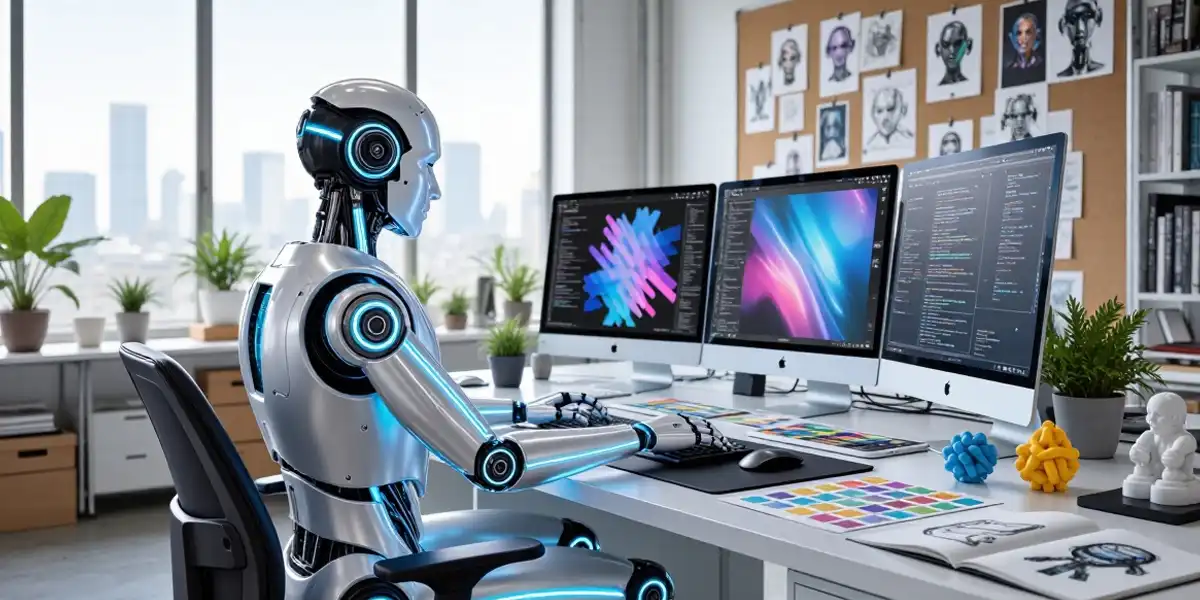
What AI Can Do for Creatives
The landscape of Generative AI is undergoing a remarkable transformation as artificial intelligence (AI) steps into the limelight, empowering creators across various fields in the realm of video marketing. AI is not merely a tool, it has become a catalyst for innovation, enabling professionals and enthusiasts alike to produce captivating content. This article explores how AI is empowering creatives and revolutionizing video marketing. AI is empowering creatives by enhancing the creative processes and democratizing access to high quality content creation. AI is empowering creatives in unique ways that drive efficiency and personalization.
SEEDANCE 2.0 is Here!
Want to become a professional AI Creative? Check out Open Art AI platform. With access to all the AI genereators and tools you will ever need.
AI Creativity
Creative industries and digital transformation
Creative industries range from visual art, design, music, film/television and publishing to advertising, marketing and gaming. According to the UK Parliament’s horizon-scanning briefing (2024), the digital and creative sectors contributed £124.6 billion and £158.3 billion respectively to the UK economy in 2022, and the government believes that the country’s strength in these sectors gives it an opportunity to grow creative industries by £50 billion and create one million new jobs by 2030. Digital technologies including generative AI, virtual/augmented reality and haptics are collectively referred to as “CreaTech,” and are used to transform cultural experiences, creative processes and artistic outputs. Generative AI tools use machine‑learning models trained on vast datasets to produce new text, images, audio or video in response to prompts. These tools are rapidly being adopted across the creative economy, industry surveys suggest 83% of creative professionals have incorporated generative AI tools into their workflows and that daily use is now common for 70% of professionals. Market research forecasts that generative AI in the creative industries could grow from $1.7 billion in 2022 to $21.6 billion by 2032.
Key applications and tools for creative people
Ideation and co‑creation
- Brainstorming and overcoming creative block: Interviewed writers use generative AI models to generate ideas or text fragments that provide starting points, transforming writer’s block into a manageable challenge. AI prompts help them maintain creative momentum and finish projects. The model output often serves as a “safety net,” allowing writers to reshape the material into their own voice.
- Visual exploration: Generative image tools (e.g., DALL‑E, Midjourney, Stable Diffusion) allow artists to explore new visual styles. They can generate draft visuals from simple text or reference images, which artists then refine. Tools such as Runway Gen‑3/Gen‑4 and OpenAI’s Sora extend this concept to video, enabling creators to generate short cinematic scenes from prompts, remix existing footage, loop sequences or blend different styles.
- Music composition: AI composition programs like Sumo, Aiva, Amper Music and others can create full songs or assist with arrangements based on desired mood or genre. The IABAC guide notes that musicians can input a few instructions and obtain compositions that they can then refine, making experimentation with new genres easier. AI can also synthesize sound‑alike vocals. For example, restorative AI isolated John Lennon’s voice from a noisy demo, allowing the Beatles’ 2023 single “Now And Then” to combine his vocals with newly recorded tracks.
- Writing and script development: Large language models (LLMs) such as ChatGPT, Claude, Gemini or Jasper can draft dialogue, story outlines, marketing copy or entire articles. Research on creative writers shows that they use AI for ideation, outlining and editing but set clear boundaries. AI helps them increase productivity and experiment with new styles while they heavily revise outputs to maintain authenticity and authorial voice.
Automation of repetitive tasks
- Video and image editing: AI‑powered tools can auto‑crop images, suggest layouts and perform background removal, object replacement or frame interpolation. Runway’s suite lets users generate videos from text or images, adjust camera motion, extend or edit clips, and perform sophisticated effects like lip‑synched voiceovers. It also offers audio generation for custom voice models and synchronization.
- Graphic design: AI design engines (e.g., Adobe Sensei and Canva’s Magic Resize) automate tasks like resizing assets, cleaning up designs and suggesting colour palettes. They enable quick production of marketing materials while freeing designers to focus on creative direction. Automated logo generators (Looka, Wix) use AI to produce branding kits in minutes.
- Video post‑production: Tools such as Sora and Runway can re‑cut footage, loop sequences and apply style presets, streamlining editing workflows. AI‑powered platforms can also enhance resolution or add special effects without manual rotoscoping.
- Marketing and personalization: AI systems analyse audience data to generate personalized advertising content, social media images or targeted promotional banners octet.design. Automation reduces the workload on marketing teams and allows rapid experimentation.
Accessibility and inclusivity
- Assisting creators with disabilities: Writers with physical ailments (e.g., carpal tunnel syndrome) use AI to dictate text or generate drafts, enabling them to remain competitive. Visual artists with limited mobility can use voice‑controlled AI tools to create digital art.
- Democratizing creativity: User‑friendly AI tools lower entry barriers, individuals without formal training can produce high‑quality art, music or written content. AI design platforms make it possible for small businesses or content creators to produce professional‑looking visuals without hiring specialists.
Applications for companies and creative teams
Content volume and scale
- Rapid content generation: Market analysts report that over 34 million AI‑generated images are produced daily and that 71% of social‑media images now contain some AI‑generated elements. The scale enables brands to test multiple creative variations and tailor content to different segments.
- Reduced production time and costs: Organizations using AI video creation tools report a 62% decrease in training‑video production time and a 44% reduction in production costs. Employees save an average of 45 hours per month when AI tools automate content creation tasks.
- Positive ROI: Surveys show that 74% of enterprises achieve positive return on investment within the first year of implementing generative AI solutions. Benefits include strategic time recovery (40%), reduced workplace stress (35%) and improved content accuracy (18%).
Strategic creativity and innovation
- Prototyping and design exploration: Generative AI design algorithms can propose multiple design options based on functional requirements, enabling architects and product designers to explore forms that might be overlooked by humans. For example, generative AI is used in fashion to forecast trends and create immersive virtual showrooms and in architecture to produce collaborative 3‑D visualizations.
- Story‑telling in entertainment: In film and gaming, generative AI can co‑create storyboards, design characters and environments, and even generate script drafts. The UK Parliament briefing notes that YouTube is partnering with musicians to let users generate tracks using artists’ vocals and that artists compare generative AI adoption to earlier technological shifts like photography.
- Virtual performers and concerts: Immersive shows like ABBA Voyage use AI-driven avatars of performers, mixing live performance with digital representations to create new revenue streams. AI also enables artists to perform posthumously. The Beatles’ “Now And Then” leveraged restorative AI to isolate a deceased band member’s voice and create a new track.
Customer engagement and personalization
- Dynamic content: AI can generate personalized videos or songs for individual customers, increasing engagement. AI models can analyze consumer preferences and produce bespoke marketing materials or design assets that resonate with specific audiences.
- Enhanced user experiences: Chatbots and voice assistants provide interactive storytelling experiences. AI‑generated music adjusts to user activities (e.g., gaming or fitness apps). Customer satisfaction increases when content feels tailored.
Benefits reported by creative professionals
Adobe’s 2024 AI and Creative Frontier study surveyed over 2,000 U.S. creative professionals and found broad support for generative AI tools. Ninety percent of creators said AI helps them save time and money by relieving menial tasks and aiding brainstorming, and the same proportion believed AI could help generate new ideas. A majority 56% recognized that AI can harm creators if models are trained on their work without consent, and 44% had already encountered work online that seemed AI‑generated and resembled their own. Creators strongly support tools that provide transparency and control 91% would use a tool that attaches verifiable attribution to their work 83% want to signal that their work should not be used to train AI models and most support labelling AI‑generated content and government regulation.
Ethical, legal and workforce considerations
Intellectual property and copyright
- Training data and consent: Large generative models are trained on datasets scraped from the internet, including works by living artists. The UK Parliament briefing asks how training on copyrighted works interacts with IP rights, noting that some generative AI developers are being challenged in court and that collective licensing solutions and “fairly trained” certification schemes emerged in 2024. The government acknowledges the need for clear answers to safeguard the copyright regime.
- Attribution and labeling: Creators demand transparency about when AI is used. Most respondents in Adobe’s survey believe AI‑generated content should be labelled and support tools that attach verifiable attribution to their work. Companies like Adobe train their Firefly models only on content they have permission to use and pay contributors whose work helps train the models.
- Legal uncertainty: The legal framework for generative AI is still being tested, and questions about the copyright status of AI‑generated works and fair use exceptions remain unresolved. The UK’s Intellectual Property Office attempted to broker a voluntary code of practice but reported limited progress.
Labour impacts and fair compensation
- Job displacement concerns: Voice actors, musicians and visual artists worry that AI-generated replicas may replace their roles. The Writers Guild of America and SAG‑AFTRA strikes in 2023 centered on the use of AI to replicate performers’ likenesses and on consent and remuneration. Artists like Roxane Lapa argue that generative AI is already displacing concept artists and that AI systems mimic human style using data scraped without consent.
- New opportunities and skills: Generative AI also creates new roles (e.g., prompt engineer, AI art director). Writers integrate AI while maintaining authenticity by revising outputs and using AI for tasks they dislike. Musicians and students are learning AI tools to remain competitive.
Privacy, bias and misinformation
- Misinformation and quality control: AI can generate convincing yet fabricated images, videos or texts, raising concerns about deepfakes and misinformation. The Montreal AI Ethics Institute warns that generative AI programs mimic human creativity by drawing from billions of images scraped without consent and can replicate artists’ styles, potentially eroding the value of human-created art.
- Bias in data: AI outputs can reflect and amplify biases present in training data. Designers and writers should be aware of these biases and critically edit AI outputs.
- Environmental impact: Training large generative models consumes significant energy. Some researchers highlight carbon emissions associated with AI art and call for sustainable practices.
Future directions and considerations
- Human‑AI collaboration: Studies suggest that AI should be viewed as a creative partner rather than a replacement. Tools like DeepArt or Runway’s painting style transfer let artists explore new directions while still controlling the final product. Writers in the UW study treat AI as a co‑author that helps with ideation and editing but maintain control to preserve authenticity.
- Policy and regulation: Governments are beginning to address AI in creative sectors. The UK Culture Secretary hosted roundtables with music, film and publishing leaders to discuss AI’s risks and opportunities, aiming to balance innovation with protection of artists’ rights. Legislators worldwide are considering labelling requirements, opt‑out mechanisms for training data and clearer copyright rules.
- Education and training: Universities and creative programs are incorporating AI courses so that future creatives understand how to leverage AI responsibly. Certification organizations like IABAC offer programs on generative AI for creative industries.
- Audiences and acceptance: Surveys indicate that over half of consumers report positive attitudes toward generative AI‑generated art, with about 34% believing AI‑generated content can be superior to human‑created work in certain contexts. Millennials and Gen Z show particularly strong acceptance, suggesting a growing market for AI‑assisted creativity.
Future of AI | How it Will Impact Our Lives in 2025?
AI has moved from the realms of science fiction into a cornerstone of modern technology, transforming various facets of our daily lives. The Future of AI is now.
SEEDANCE 2.0 is Here!
Want to become a professional AI Creative? Check out Open Art AI platform. With access to all the AI genereators and tools you will ever need.