
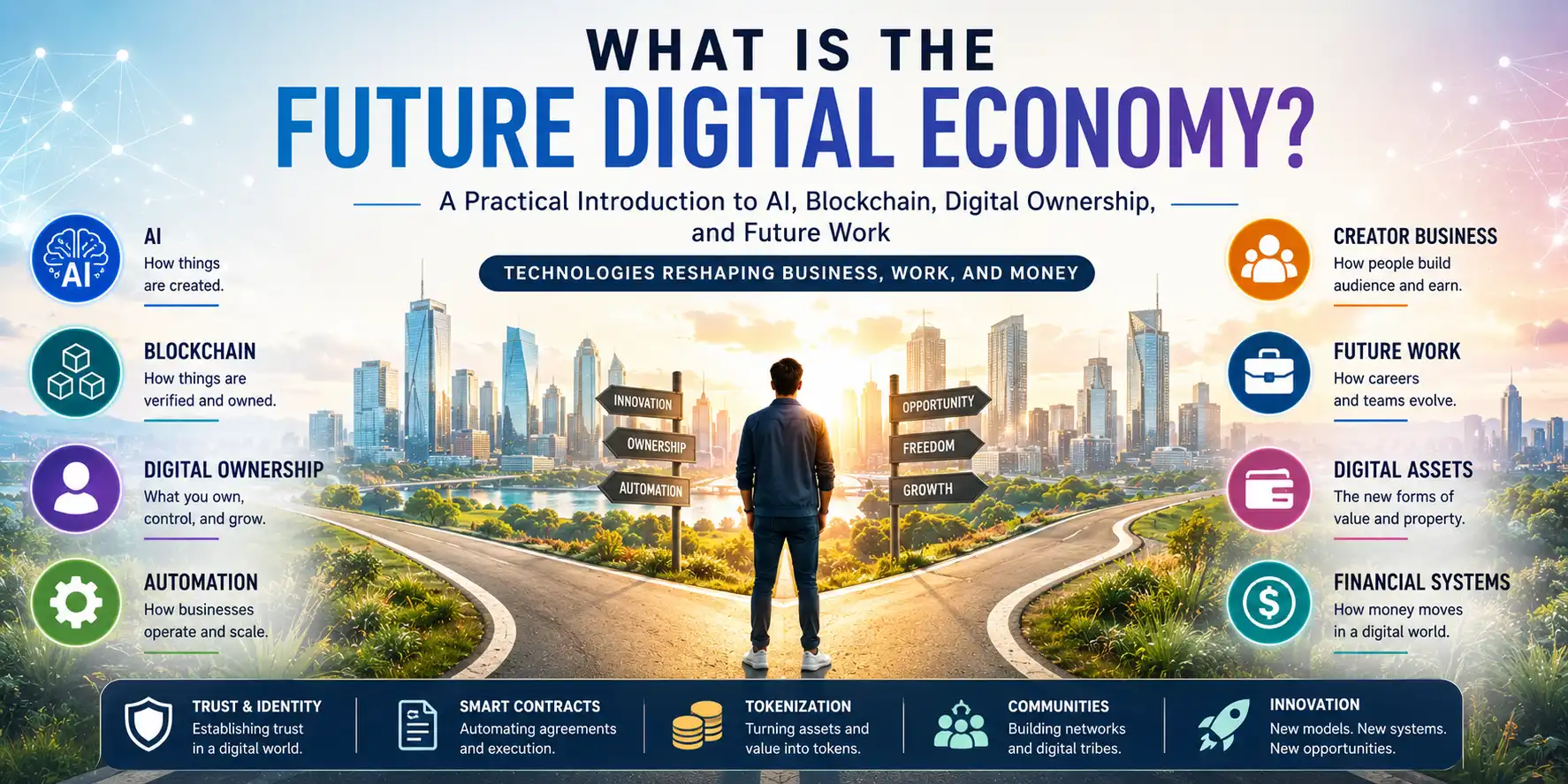
What Is the Future Digital Economy? A Practical Introduction to AI, Blockchain, Digital Ownership, and Future Work
The future digital economy is not one technology. It is not only artificial intelligence. It is not only blockchain. It is not only crypto, automation, digital products, or remote work.
The future digital economy is the larger shift happening when technology changes how value is created, owned, exchanged, protected, automated, and monetized.
This matters because the digital world is no longer just a place where people communicate. It is becoming a place where people work, build businesses, own assets, create media, automate systems, earn income, form communities, verify identity, and exchange value.
To understand the future digital economy, we need to look at the systems underneath it: AI, blockchain, digital ownership, automation, creator business, future work, digital identity, tokenization, smart contracts, and emerging technologies.
Each of these topics matters on its own. But the real opportunity comes from understanding how they connect.
The Future Digital Economy Is a System, Not a Trend
Many people talk about new technology as if each tool exists in isolation.
AI is discussed as a productivity tool. Blockchain is discussed as a financial technology. Digital ownership is discussed as a creator topic. Automation is discussed as an efficiency tool. Future work is discussed as a workplace issue.
But these ideas are connected.
AI changes how things are created. Blockchain changes how things can be verified and owned. Automation changes how businesses operate. Creator business changes how individuals build income from knowledge, media, and audience. Digital ownership changes how people think about control, assets, and long-term value.
That is why the future digital economy should be understood as a system, not a trend.
The people and organizations that understand the system will be better prepared than those who only chase the newest tool.
AI: How Things Are Created
Artificial intelligence is changing how work gets produced.
AI can help write, design, summarize, analyze, automate, generate, edit, plan, research, and support decision-making. It can speed up content creation, business operations, marketing, customer support, education, software development, media production, and knowledge work.
But the real value of AI is not just speed.
The real value is leverage.
AI allows individuals and organizations to do more with ideas, information, media, and workflows. It can help small teams perform like larger teams. It can help experts package their knowledge faster. It can help businesses improve systems, reduce friction, and create new ways of working.
At the same time, AI raises important questions:
- Who owns AI-generated content?
- How should organizations protect intellectual property?
- What human skills become more valuable?
- How will teams change when workflows become automated?
- How do businesses use AI without losing trust, quality, or originality?
In the future digital economy, AI is not just a tool for creating more. It is a system that changes how value is produced.

Blockchain: How Things Are Verified and Owned
Blockchain is often discussed through cryptocurrency, but the larger idea is about trust, ownership, and verification.
A blockchain is a digital record system that can allow information, transactions, and ownership records to be verified across a network. Instead of relying only on one central authority, blockchain systems can create shared records that are difficult to alter without agreement from the network.
This matters because the digital world has a trust problem.
Digital files can be copied. Online identities can be faked. Content can be duplicated. Transactions need verification. Ownership needs proof. Agreements need enforcement. Value needs a reliable record.
Blockchain introduces a different way to think about these issues. It can support ideas such as digital assets, smart contracts, tokenization, decentralized networks, and verifiable ownership.
This does not mean every blockchain project is valuable. It does not mean every crypto asset is safe. It does not mean hype should replace careful thinking. But the underlying concept is important because it changes how people think about ownership in digital spaces.
Digital Ownership: What People Actually Control
Digital ownership may become one of the most important ideas in the future digital economy.
For years, many people built their digital lives on platforms they did not own. They built audiences on social networks, published content inside closed platforms, stored value in accounts controlled by third parties, and depended on algorithms they could not control.
Those platforms are useful, but they also create dependency.
Digital ownership asks a simple question: what do you actually control?
- Do you own your website?
- Do you own your email list?
- Do you own your content library?
- Do you own your customer relationships?
- Do you own your digital products?
- Do you own your audience data?
- Do you own your intellectual property?
- Do you own digital assets that can grow in value?
For creators, entrepreneurs, and organizations, digital ownership is not only a technology issue. It is a business strategy issue.
In the future digital economy, attention is useful, but ownership creates long-term value.
Automation: How Businesses Operate
Automation is changing how work gets done inside organizations.
Tasks that once required manual effort can now be supported by software, AI agents, workflow tools, connected apps, and automated systems. This can affect customer service, marketing, reporting, project management, sales, finance, operations, content creation, and internal communication.
The opportunity is not only to save time. The opportunity is to redesign how work flows through the organization.
That is a very different conversation from simply asking which tools to use.
Better questions include:
- Which tasks should be automated?
- Which decisions still need human judgment?
- Where can AI reduce friction?
- How do we protect quality and trust?
- What workflows need to be rebuilt?
- How will automation affect teams and roles?
In the future digital economy, automation becomes a business design issue. Organizations need to understand how to combine technology, people, processes, and judgment into better systems.
Creator Business: How People Earn
The creator business is becoming a serious part of the digital economy.
A creator is no longer just someone posting content online. A creator can be an educator, consultant, expert, publisher, media brand, community builder, product creator, speaker, or entrepreneur.
The creator business model is built around turning knowledge, trust, content, audience, and intellectual property into value.
This can include:
- Articles and newsletters.
- Video channels and podcasts.
- Digital products and courses.
- Memberships and communities.
- Consulting and advisory services.
- Licensing and intellectual property.
- Events, workshops, and speaking.
- Affiliate income and partnerships.
AI makes creator business more scalable because it can help with research, writing, design, editing, repurposing, and workflow automation. Digital ownership makes creator business more durable because it gives creators more control over assets, audiences, and income systems.
That is why creator business belongs inside the future digital economy conversation. It is one of the ways individuals can create and capture value in a technology-driven world.

Future Work: How Careers and Organizations Evolve
The future of work is not only about remote work or new job titles. It is about how people create value when technology changes the nature of work itself.
AI and automation will continue to change tasks, roles, teams, and workflows. Some work will become faster. Some work will become automated. Some work will become more strategic. Some roles will disappear, while new ones emerge.
This does not mean people become irrelevant. It means human value shifts.
Skills such as judgment, creativity, strategy, communication, adaptability, systems thinking, trust-building, storytelling, leadership, and ethical decision-making become more important when tools become more powerful.
Organizations will need people who can connect technology to business value. Individuals will need to understand how to use tools, build assets, protect ownership, and keep learning as systems evolve.
The future of work is really a future of value creation.
Emerging Technologies Are Converging
The most important thing to understand is that these technologies are beginning to converge.
AI can create content, software, images, video, workflows, agents, and business processes. Blockchain can support ownership, verification, contracts, and digital assets. Automation can connect tasks into systems. Creator business can turn expertise into media, products, services, and communities. Digital ownership can help people control more of the value they create.
When these systems connect, new business models become possible.
- One-person companies supported by AI and automation.
- Creator brands with owned media and digital products.
- Smart contracts for licensing, royalties, and access.
- Digital identity systems for trust and verification.
- Tokenized assets and new financial models.
- Automated commerce and personalized digital services.
- AI-powered education, coaching, and advisory platforms.
This is why the future digital economy is bigger than one technology trend. It is a new way of understanding how work, money, ownership, media, and business are changing together.
Why Organizations Need to Understand This Now
Organizations do not need to chase every new technology. But they do need to understand what is changing.
The businesses that wait too long may find themselves reacting instead of preparing. The organizations that understand the future digital economy can ask better questions earlier.
- How will AI affect our business model?
- What parts of our workflow can be automated?
- How do we protect intellectual property?
- What digital assets should we be building?
- How do we create more owned channels?
- What does digital trust mean for our industry?
- How will blockchain or smart contracts affect commerce?
- What skills will our people need next?
Those are higher-value questions than simply asking which app to install.
The future digital economy requires leaders, creators, entrepreneurs, and organizations to think in systems.
A Simple Framework for the Future Digital Economy
A practical way to understand the future digital economy is through six connected layers:
- Creation: AI changes how ideas, content, products, and workflows are created.
- Ownership: Digital ownership changes what people and organizations control.
- Trust: Blockchain, identity, and verification change how digital trust is established.
- Automation: AI agents and workflow systems change how businesses operate.
- Monetization: Creator business, digital products, and new financial systems change how people earn.
- Work: Future work changes the skills, roles, and systems people need to create value.
This framework makes the topic easier to understand. It shows that the future digital economy is not random. It is a connected shift in how value moves through digital systems.
Final Thought
The future digital economy is not something far away. It is already forming around us through AI, blockchain, automation, digital ownership, creator business, and changing work systems.
The goal is not to become overwhelmed by every new technology. The goal is to understand the larger pattern.
AI changes how things are created. Blockchain changes how things can be verified and owned. Automation changes how businesses operate. Creator business changes how people earn. Digital ownership changes how value is controlled. Future work changes how people and organizations adapt.
When you understand those connections, the future becomes less confusing and more practical.
The future digital economy will reward people and organizations that understand how digital systems create, move, protect, and grow value.

About the Author
Curtis Randall is an award-winning creative executive and future systems thinker helping people and businesses understand the future of work, technology, digital ownership, and creativity. Through CurtisRandall.com, and Sights.com, Curtis explores the systems shaping how people work, create, own, and build value in a rapidly changing world.
Connect with Curtis: LinkedIn · YouTube · Instagram · X · TikTok · Facebook · Threads