
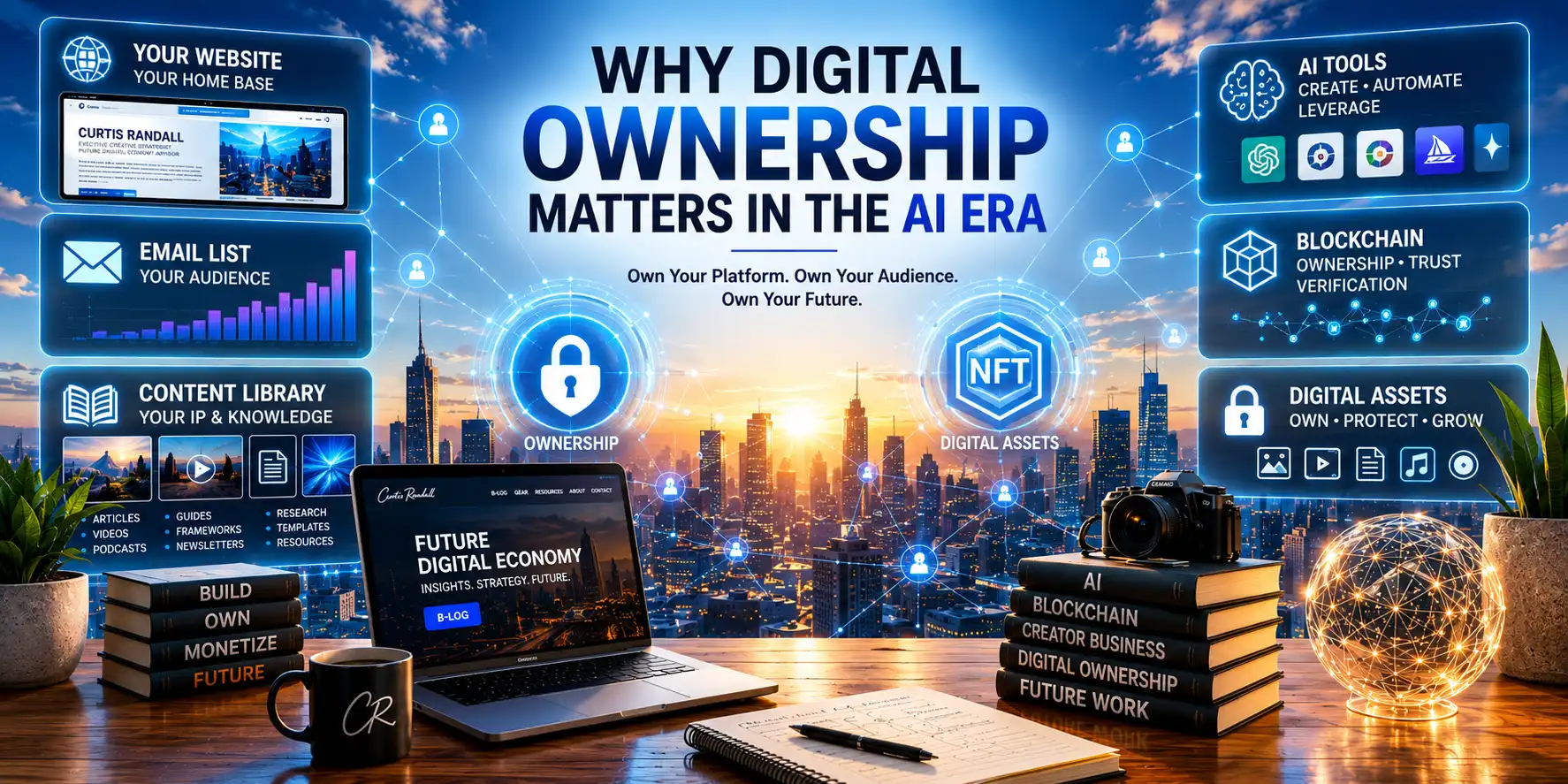
Why Digital Ownership Matters in the AI Era
The AI era is changing how people create, publish, work, communicate, and build value online. Content can be created faster. Images can be generated in seconds. Workflows can be automated. Ideas can become articles, videos, products, and campaigns with less friction than ever before.
But there is a bigger question underneath all of this progress.
What do you actually own?
That question is becoming one of the most important questions in the future digital economy. As AI, automation, blockchain, creator business, and emerging technologies reshape how value is created, digital ownership becomes more important, not less.
Digital ownership is about controlling the assets, systems, relationships, content, data, identity, and value you build online. It is about moving beyond rented attention and building something that can last.
In the AI era, the people and organizations that understand digital ownership will have a stronger foundation for visibility, trust, income, intellectual property, and long-term value creation.
The AI Era Makes Creation Easier
AI has made digital creation easier than ever. A person can now use AI to help write articles, generate social posts, create images, outline videos, summarize research, build presentations, develop product ideas, and automate parts of a business workflow.
This creates enormous opportunity. Individuals can move faster. Small teams can operate with more leverage. Creators can produce more consistently. Businesses can improve communication, marketing, customer support, and internal systems.
But easier creation also creates a new challenge.
If everyone can create more content, then content alone is not the advantage. The advantage moves toward strategy, trust, authority, distribution, ownership, and systems.
In other words, AI makes creation easier, but ownership determines whether that creation becomes an asset.
Attention Is Useful, But Ownership Is Powerful
For years, many people and businesses have focused heavily on attention. They want more views, more likes, more followers, more impressions, and more reach.
Attention matters. It helps people discover your work. It helps ideas spread. It helps brands become visible. But attention on its own is not the same as ownership.
If your audience only exists on a platform you do not control, then you are depending on someone else’s system. Algorithms can change. Accounts can be restricted. Reach can disappear. Platform rules can shift. A channel that worked yesterday may not work tomorrow.
This does not mean social platforms are bad. They are useful tools. But they should not be the whole foundation.
A stronger digital strategy uses platforms to build owned assets.
- Your website.
- Your email list.
- Your content library.
- Your digital products.
- Your customer relationships.
- Your brand platform.
- Your intellectual property.
- Your media archive.
- Your community.
- Your digital asset system.
Attention can create opportunity. Ownership turns opportunity into long-term value.
Your Website Is Still a Core Digital Asset
In the AI era, some people may assume websites are less important because so much activity happens on social platforms, video platforms, search engines, and AI tools.
But your website is still one of the most important digital ownership assets you can build.
A website gives you a home base. It gives your ideas, services, products, articles, resources, and authority a place to live. It allows people to understand who you are, what you believe, what you offer, and how to connect with you.
Unlike a social post, a website can become a long-term library. Unlike a platform profile, a website can be structured around your business model. Unlike rented attention, a website can support your own search visibility, lead generation, products, resources, and credibility.
For individuals, creators, consultants, entrepreneurs, and organizations, a website should not be treated as a digital brochure. It should be treated as an owned media platform.
An Email List Is a Relationship Asset
An email list is one of the clearest examples of digital ownership because it gives you a more direct relationship with your audience.
Social media can help people discover you, but email helps you stay connected. It allows you to communicate without depending entirely on a platform algorithm. It gives you a way to share ideas, products, updates, offers, resources, and deeper thinking with people who have chosen to hear from you.
In the future digital economy, relationships are assets. Trust is an asset. Permission is an asset.
This is why creators and businesses should think beyond followers. Followers are valuable, but subscribers are often more powerful because the relationship is more direct.
A strong digital ownership system should use public platforms to build private relationships.
Content Libraries Become Intellectual Property
Content should not only be viewed as something you post once and forget.
In a digital ownership model, content becomes part of an intellectual property library. Articles, videos, podcasts, frameworks, diagrams, newsletters, guides, presentations, lessons, and resources can all become assets that support authority, education, products, consulting, speaking, and long-term business value.
This is especially important in the AI era because ideas can now be expanded, repurposed, organized, and distributed more efficiently.
One strong article can become:
- A short video script.
- A LinkedIn post.
- A newsletter issue.
- A podcast topic.
- A presentation slide.
- A chapter in a digital product.
- A consulting framework.
- A workshop outline.
- A lead magnet.
- A future course module.
When content is organized properly, it becomes more than marketing. It becomes a business asset.
Digital Products Are Ownership Systems
Digital products are one of the most practical forms of digital ownership.
A digital product can be an ebook, guide, course, template, framework, checklist, membership, paid newsletter, workshop, software tool, media library, resource kit, or advisory system.
Digital products matter because they allow knowledge to become packaged value. They help creators, experts, consultants, and businesses turn ideas into assets that can be sold, licensed, distributed, updated, and scaled.
AI makes digital product creation more accessible, but strategy still matters. The product must solve a real problem, be clearly positioned, deliver useful value, and connect to a larger business system.
The opportunity is not simply to create more products. The opportunity is to build a digital asset library around your expertise.
Blockchain Expands the Ownership Conversation
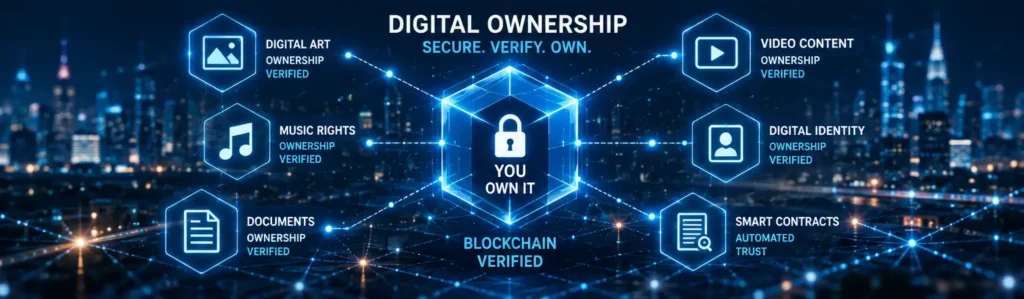
Blockchain is often associated with crypto prices, but the bigger conversation is ownership, verification, trust, and digital value.
A blockchain can act as a shared digital record system. It can help verify transactions, assets, identities, access rights, ownership records, and programmable agreements through smart contracts.
This is important because the digital world has always had a copying problem. Digital information can be duplicated easily. Ownership can be unclear. Provenance can be difficult to prove. Agreements can be hard to track across platforms.
Blockchain does not solve every problem, and not every blockchain project is useful. But it introduces important ideas that belong in the future digital economy conversation:
- Verifiable ownership.
- Digital scarcity.
- Smart contracts.
- Tokenized assets.
- Portable digital identity.
- Automated royalties.
- Decentralized access systems.
- New ways to exchange value online.
For creators, entrepreneurs, and organizations, blockchain should not be viewed only as speculation. It should be understood as one possible ownership infrastructure for digital assets and digital value.
AI Raises New Questions About Intellectual Property
AI also raises new questions around intellectual property, originality, rights, licensing, and ownership.
If AI helps create an image, article, video, design, product idea, or software workflow, who owns the result? What inputs were used? Is the output original enough? Can it be protected? Can it be licensed? Can it be used commercially? What rules apply in different industries or countries?
These questions are still evolving, and organizations should not treat them casually.
The practical lesson is simple: businesses need better systems for managing AI-assisted work.
- Keep records of important creative decisions.
- Use clear approval workflows.
- Protect original brand assets.
- Review AI-generated work before publishing.
- Understand platform terms and licensing rules.
- Use human judgment for sensitive or commercial work.
- Seek legal advice for high-value intellectual property decisions.
Digital ownership in the AI era is not only about what you create. It is also about how you manage, protect, document, and control what you create.
Creator Business Depends on Ownership
The creator business is becoming a serious digital economy model, but it depends heavily on ownership.
A creator who only posts on rented platforms may build attention, but a creator who builds owned systems can build a business.
Owned systems can include a website, newsletter, product library, private community, course platform, consulting offer, paid membership, content archive, media brand, and intellectual property portfolio.
This matters because the creator business model is not only about content. It is about turning knowledge, trust, media, and audience into long-term value.
AI can help creators produce faster. Digital ownership helps creators build something more durable.
Organizations Need a Digital Ownership Strategy
Digital ownership is not only for creators. Organizations need it too.
Businesses should be asking practical questions:
- What digital assets do we own?
- Where does our audience live?
- How much do we depend on third-party platforms?
- What intellectual property are we creating with AI?
- How do we protect our brand assets?
- What content can become long-term business value?
- What customer relationships are we building directly?
- What role could blockchain, smart contracts, or digital identity play in our future?
These are not only marketing questions. They are future business questions.
Organizations that understand digital ownership will be better prepared to build durable digital systems, protect value, and adapt as technology changes.
A Simple Digital Ownership Framework
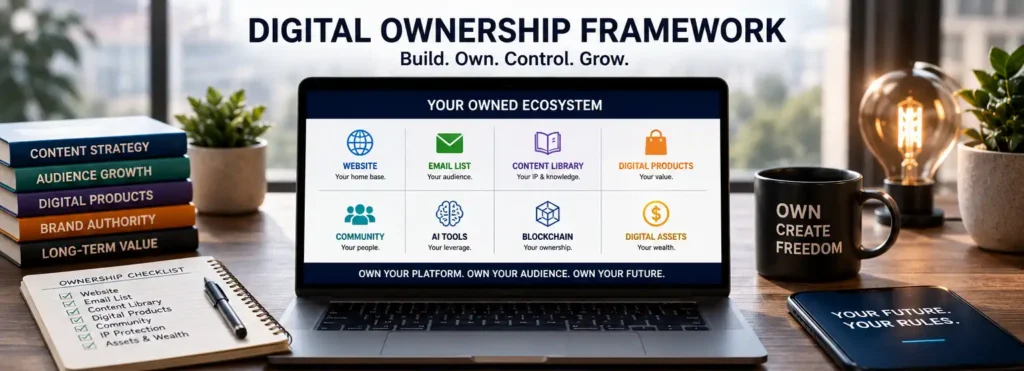
A practical way to think about digital ownership is through five layers:
- Presence: Your website, brand platform, and owned online home.
- Audience: Your email list, community, customers, and direct relationships.
- Content: Your articles, videos, podcasts, frameworks, guides, and media library.
- Products: Your digital products, services, memberships, courses, templates, and offers.
- Assets: Your intellectual property, digital assets, brand equity, blockchain records, and ownership systems.
This framework helps make digital ownership practical. It shows that ownership is not one thing. It is a system of assets that work together.
Final Thought
The AI era will make it easier to create, publish, automate, and scale digital work. But the long-term advantage will not come from creating more random output.
The long-term advantage will come from ownership.
Own your platform. Own your audience relationships. Own your content library. Own your digital products. Own your intellectual property. Own the systems that help turn your ideas into value.
AI changes how value is created. Digital ownership changes how value is controlled.
In the future digital economy, the people and organizations that build owned digital systems will be better positioned to create, protect, and grow long-term value.
Want to follow this conversation? Read more on the Curtis Randall B-Log, or connect through the Contact page.